The agency that runs the Colorado River gave itself an eight-word frame last week and has spent the week since demonstrating it: "swift actions to protect this vital water system." [1] The Bureau of Reclamation's April 17 press release named the numbers. Up to one million acre-feet released from Flaming Gorge Reservoir through April 2027. Annual releases from Lake Powell to Lake Mead cut by 1.48 million acre-feet — from 7.48 to 6.0 MAF — through September 2026. System storage at 36 percent of capacity. April's 24-Month Study projecting Lake Powell could fall below 3,490 feet, the minimum power pool level, by August 2026. [1] The basin-state governors met Secretary Doug Burgum the day of the release; Utah's and five other states' approvals arrived within hours. [2] On Wednesday, the Reclamation calendar had a final decision noted as "coming next week." [1] The river moved from warning to implementation in eight days.
Yesterday this paper described Earth Day as landing inside an active war clock for the first time in fifty-six years, with Reclamation's emergency window carried inside the compound framing. The window has now closed. The seven basin states — Arizona, California, Colorado, Nevada, New Mexico, Utah, and Wyoming — have each registered their positions; the Upper Basin approved the Flaming Gorge moves because the alternative, a Powell elevation below 3,490 feet, would compromise their hydropower rights and, behind those rights, their constitutional leverage at the 2026-expiring operating agreements. The federal government has not yet signed the implementation decision, but the infrastructure of consent is visible for the first time in the crisis.
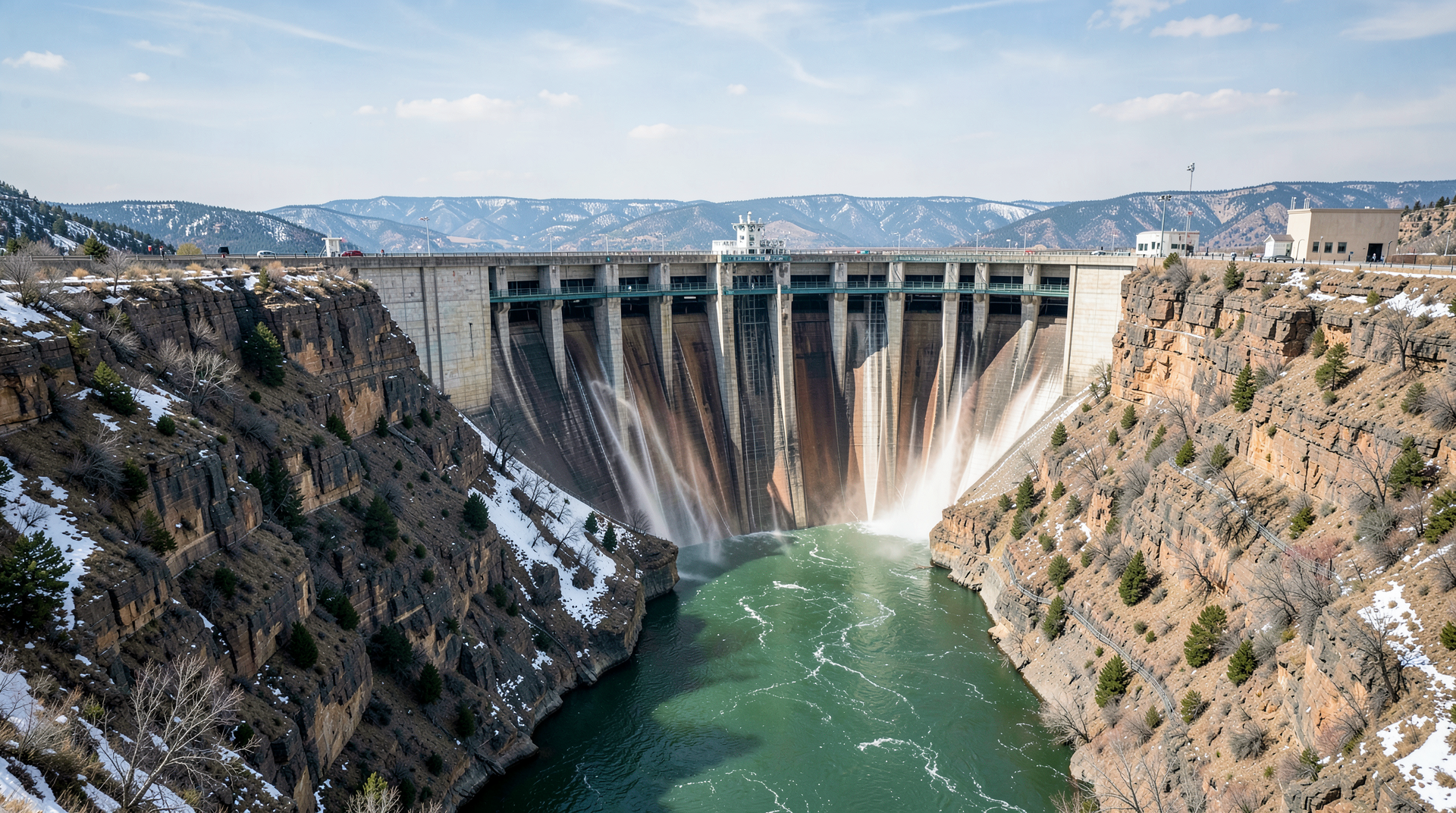
The physical mechanism is straightforward enough to read without hedging. Flaming Gorge, on the Green River in Utah and Wyoming, sits upstream of Powell. Its current storage is roughly 3.1 MAF, about 83% full. [1] Moving up to a million acre-feet south and down into Powell raises Powell's elevation by a projected 54 feet — to at least 3,500 feet by April 2027, above the 3,490-foot minimum power pool threshold at Glen Canyon Dam. [1] The cost, explicit in the Reclamation release, is a drawdown of Flaming Gorge from 83% to approximately 59% of capacity over the year. [1] The secondary cost, also explicit, is an accelerated decline of Lake Mead downstream, with the potential for "up to an additional 40% reduction to Hoover Dam's hydropower generating capacity as early as this fall." [1] The agency is moving water from one threatened reservoir to another threatened reservoir to protect the threshold at which hydropower fails in the upper system, and the trade prices down the lower system's hydropower in the bargain.
This is the part of the story that the drought-triage frame does not carry. Hydropower is not a co-benefit of the Colorado River system; it is the transmission-grid anchor for the interior West. Glen Canyon Dam, Hoover Dam, and the smaller Parker and Davis facilities feed municipal utilities and wholesale markets across six states. If Glen Canyon drops below the minimum power pool, it can still release water through its river outlet works, but the turbines stop. Hoover at reduced capacity means Las Vegas and Phoenix summer peaks need replacement generation, most likely natural gas, at prices that have not been budgeted. The Reclamation release describes these as "operational issues, uncertainty for users, downstream impacts, instability in regional power and water supplies." [1] Read plainly: a regional electricity system under duress coincident with a water system under duress.
Assistant Secretary Andrea Travnicek's framing on April 17 made the instrument explicit. "Given the severity of the risks facing the Colorado River system, it is imperative that we take action quickly to protect a resource that supplies water to 40 million people and supports vital agricultural, hydropower production, tribal, wildlife, and recreational uses across the region." [1] The sentence is not drought language. It is infrastructure-failure triage language — the vocabulary Reclamation uses when it is acting to preserve operational capacity, not to manage a long-term resource. Burgum, in the same release, extended the phrasing: "Interior and Reclamation continue to coordinate with the basin states, tribes, Mexico and basin stakeholders as we make the decisions necessary to operate and protect the system." [1] Operate and protect is the maintenance-engineer vocabulary. A drought statement would say "manage." The switch is small and deliberate.
Two pieces of context the weekly news summary does not include but that change the analysis. The first is the March record heat. Reclamation notes "record-breaking March heat has further intensified drought conditions across the Basin"; the underlying climate data set confirms March 2026 as one of the warmest on record across the upper Colorado basin, accelerating snowpack melt and surface evaporation at reservoirs. [1] The second is the April water-year minimum probable inflow forecast for Powell: 2.78 million acre-feet — 29% of historical average and one of the lowest on record. [1] Those two numbers together produced the emergency condition. The snow that fell during the winter was the lowest in instrumental record; the heat that followed accelerated what did fall into early runoff; the combination left Powell pointed at minimum power pool by August on trajectory projections that accept no favourable assumptions.
The post-2026 governance question is the one X water policy accounts are reading correctly and that the Reclamation release declines to centre. Kyle Roerink of the Great Basin Water Network has described Wednesday's approvals as a pre-position for the post-2026 negotiations, not an isolated drought move. The reasoning: the existing 2007 interim guidelines expire at end of year 2026; the seven basin states have not reached consensus on a replacement framework; the Interior release is explicit that "in the absence of a consensus and following the completion of the NEPA process, the Interior Department will be prepared to determine operations for Post 2026 later this summer to provide certainty and stability for the Colorado River Basin." [1] Translated: if the basin states do not agree by summer, the federal government will impose. The emergency action this week is the federal government establishing, in advance of the imposition, that it can move water between state-claimed reservoirs by administrative action when the system is threatened. That precedent sits on the same shelf as post-2026 governance.
This is the point at which the consequence gap the paper has been pushing clarifies. The MSM framing of the Reclamation action has been "drought emergency," which treats the move as a hydrology update within the existing governance structure. The X water-policy framing has been "federal triage as bargaining leverage," which treats the same action as a shift in the governance structure itself. The actions are the same; the frames diverge on whether Reclamation is operating inside existing agreements or using its emergency authorities to establish terms the new agreements will have to accept. The Salt Lake Tribune's Wednesday report, reflecting state-level reporting, emphasises the approval tempo — "Utah, other states rush to approve plan to send Flaming Gorge water to Lake Powell as crisis loomed." [2] The rush is the signal. Basin-state approvals arrived within hours of Reclamation's release. That is not reconciliation; that is states clearing a precedent they know will be cited against them in post-2026 negotiations if they delay.
The basin's recreation and agricultural users will feel the move in identifiable ways. Flaming Gorge recreation will see boating access reduced earlier than usual, per the Reclamation release. [1] Grand Canyon rafting conditions will be affected by the lower Powell releases. Lake Mead recreation, already compromised, will compress further. Agricultural diversions in the Lower Basin will be managed under the reduced Powell output. Tribal water allocations — the Colorado River compact's weakest set of obligations — have not been publicly renegotiated in this round; the Navajo, Hopi, Ute and other basin tribes have standing rights that Reclamation's release acknowledges in passing. The nineteen tribal nations with Colorado River claims will be watching whether the post-2026 determination gives their claims juridical weight they have not carried in operations for two decades.
The narrow implementation question this week is whether the final Reclamation decision, expected next week, matches the April 17 announcement in substance or modifies the numbers. Environmental groups have signalled concern that the Flaming Gorge draw is larger than the system's recent experience suggests prudent. Upper Basin interests have signalled concern that the precedent of federal reallocation is larger than the number. Lower Basin interests have signalled concern that the Hoover power cut is larger than was publicly costed. The decision will either carry the numbers as announced and stabilise the system for the year, or move the numbers and introduce a second round of basin-state approvals. Either outcome leaves the post-2026 governance question standing.
For readers wondering whether a Colorado River emergency is climate or management or politics, the Reclamation release offers the honest answer: it is all three, operating at once, and the instrument the federal government has reached for this month is the engineering one because the governance one has not produced an agreement. Infrastructure-failure triage is the accurate name for what Reclamation is doing. A drought story does not require a power pool. A management story does not require basin-state approvals arriving inside 48 hours. A climate story does not require hydropower triage. This week required all three. That is how the Colorado River crossed from warning to implementation, with the final decision one week out and the governance it pre-positions still unresolved.
-- DARA OSEI, London