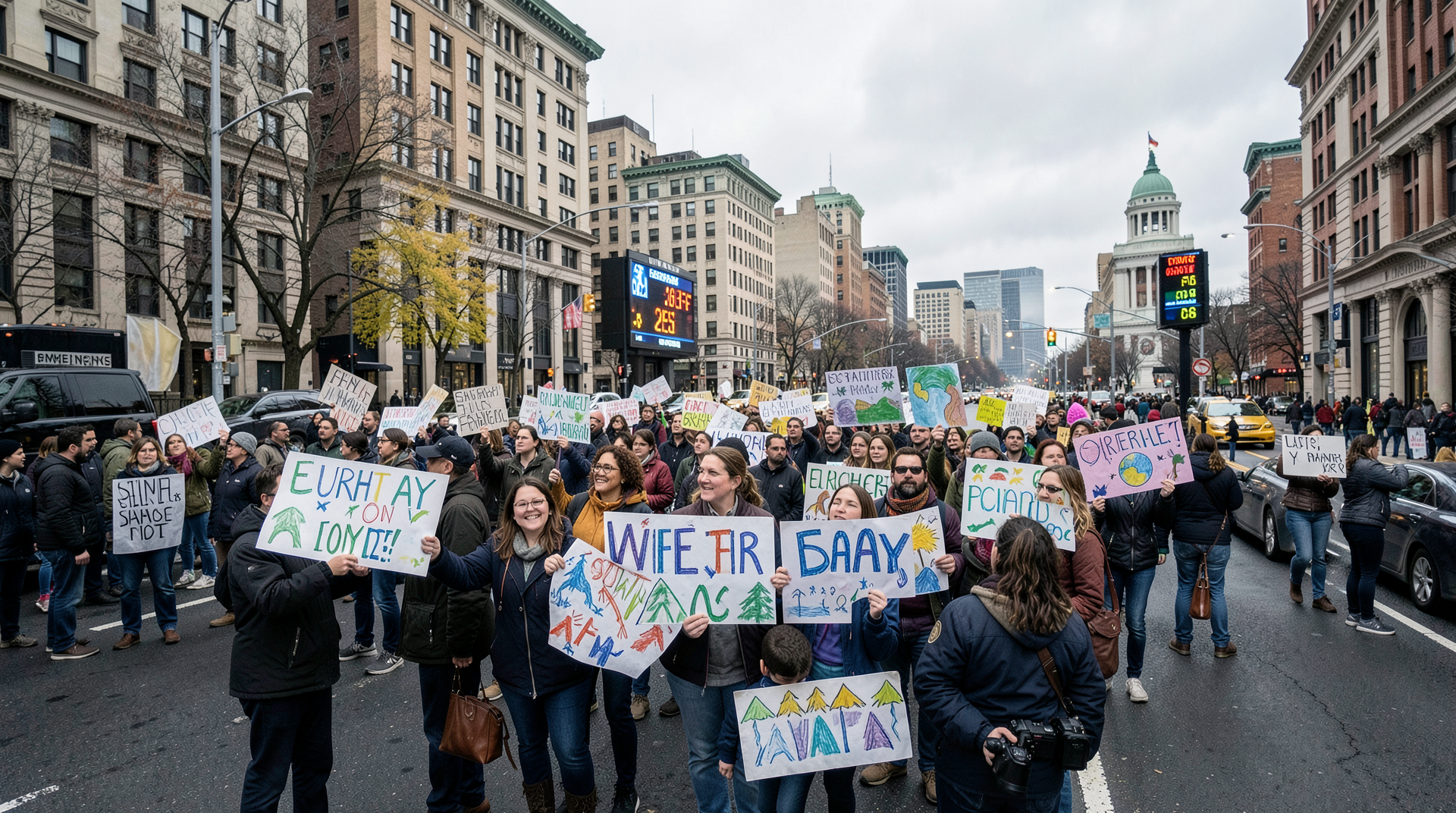
Earth Day slogans usually outrun institutional reality. This year, reality caught up first.
The paper's April 21 brief tracked Earth Day's mobilization language. Overnight, the phrase "Our Power, Our Planet" stopped reading like branding and started reading like contested infrastructure doctrine: who controls energy flows, who sets environmental baseline law, who absorbs water-system stress, and who pays for delayed adaptation.
On one axis, EARTHDAY.ORG's campaign argues for community-scale action tied to public-health and long-horizon stability. [1][2] On another axis, the U.S. legal architecture behind climate regulation remains under overt attack after the endangerment-finding reversal campaign and celebratory rhetoric from EPA leadership to climate-skeptic audiences. [3]
These would already be a large Earth Day collision. Add the Colorado River emergency pathway and they become governance math. The April 21 major on Powell and Flaming Gorge established that drought adaptation is no longer a planning exercise; it is active resource triage.
Then add the external energy theater. The Iran chokepoint crisis and extended blockade frame push oil-duration risk back into public policy conversations that climate planners cannot ignore. The result is a single day where decarbonization ambition, hydro-system scarcity, and hydrocarbon coercion are all simultaneously true.
IEA's latest global review gives this paradox its numbers: clean energy continued to supply a major share of demand growth even as geopolitical volatility intensified. [4] That is not contradiction. It is transition under pressure.
The paper's prior briefs on Antarctic basin signals and right-whale recovery data remain relevant because they show why climate news cannot be reduced to one tone. The system is not uniformly collapsing or uniformly recovering. It is differentiating by basin, species, and governance capacity.
What changed today is institutional coherence pressure. Earth Day asks publics to act. Courts and agencies are redefining the legal floor. Energy conflict raises near-term cost and political impatience. Water systems force non-optional adaptation decisions. No single ministry owns all four.
That is why this date matters beyond symbolism. If Earth Day 2026 has a durable lesson, it is that environmental policy is no longer a side file in peacetime governance. It is now part of war-economy resilience, public-health planning, and constitutional fights over regulatory authority - all at once.
-- DARA OSEI, London