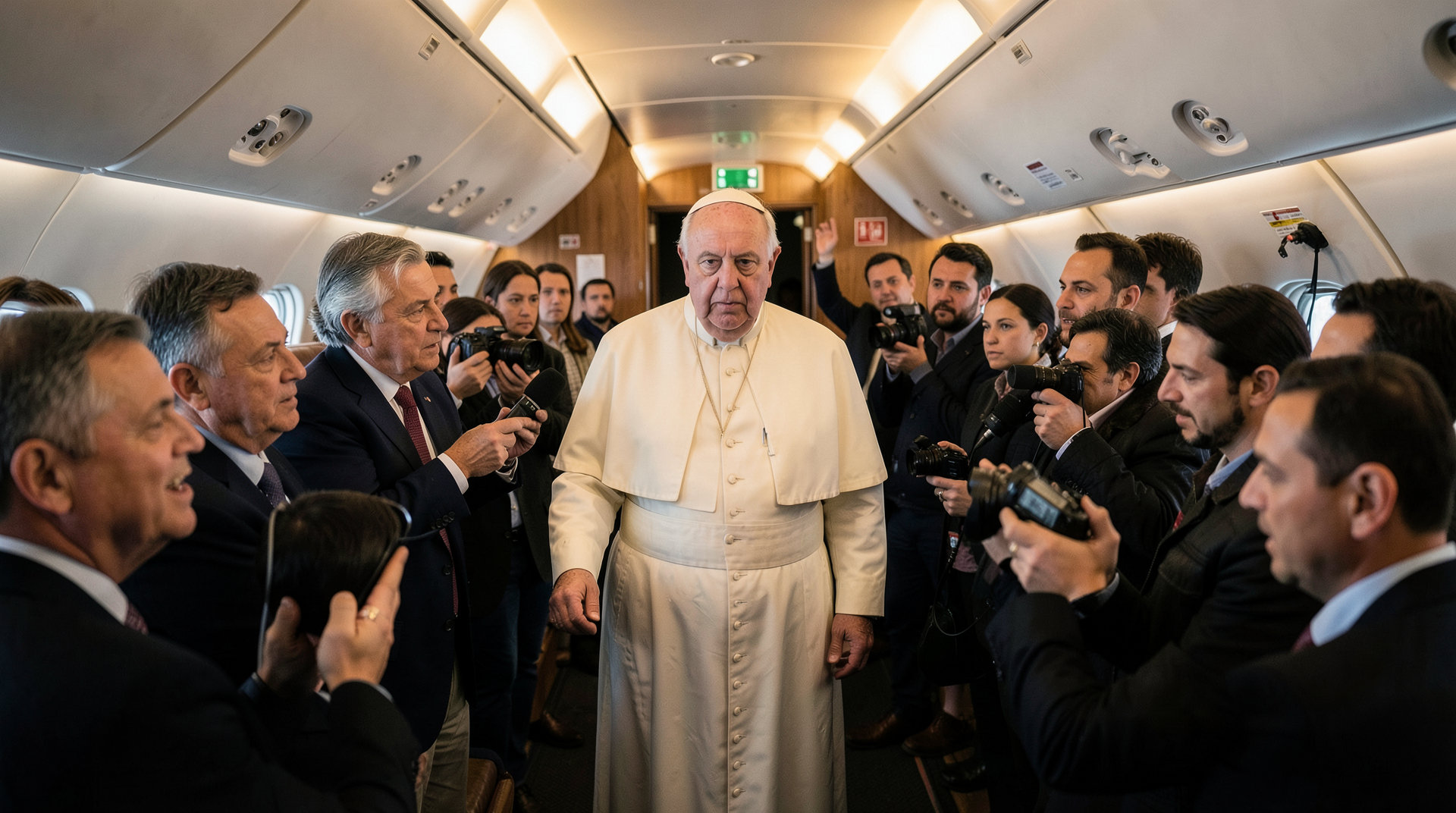
On the Malabo-to-Rome flight, Pope Leo XIV said three things in one sequence that the Vatican usually lets stand apart: he said as pastor he cannot be in favor of war, he condemned unjust taking of life, and he explicitly condemned capital punishment. [1][2] The combination was not rhetorical drift. It was theological placement in public, on the record, in front of the traveling press corps.
Yesterday this paper argued that Leo's Bata prison visit completed a three-act structure across Saurimo, Malabo, and Bata. Friday's in-flight press conference creates a fourth act: auditability. The first three acts were staged in controlled venues. The fourth happened in an unscripted Q&A format where quotation discipline is immediate and globally distributable. [1]
That matters because doctrinal force in modern Catholic politics does not come only from encyclicals. It comes from repeatable public language that bishops, presidents, and prosecutors cannot plausibly reinterpret after the fact. Leo gave that language at approximately 19:50 Rome time, and the record now carries exact text linking Iran's executions to a broader condemnation of unjust state killing. [1][3]
The key quote runs this way: "I condemn all actions that are unjust, I condemn the taking of people's lives, I condemn capital punishment." [1][2] Asked specifically about executions by the Iranian regime, Leo added: "when a regime, when a country, takes decisions which take away the lives of other people unjustly, then obviously that is something that should be condemned." [2][3] In diplomatic terms, he kept his usual grammar. In political terms, he erased the old buffer between "war criticism" and "death-penalty doctrine" in one answer.
A third line from the same briefing does the structural work often missed in the first-day wire copy. Leo said: "As a Church - I repeat - as a pastor, I cannot be in favor of war," and paired that sentence with an appeal to "respect international law." [1] The three clauses - anti-war pastoral, international-law appeal, capital-punishment condemnation - were spoken in one Q&A block. That is why the paper reads the flight presser as a publication event rather than a reiteration. The grammar placed war, unjust state killing, and capital punishment inside a single condemnation field.
There was a second axis in the same briefing, and it was not incidental. Leo said Africa is often seen as a place to extract minerals for the benefit of other countries. [1][3] That sentence repeats the economic-moral frame he deployed on the continent and binds it to the violence frame he deployed in the same Q&A. Extractive order and punitive order are not separate topics in this pontificate's early language; they are branches of one dignity argument.
This is the significance of the four-act reading. Saurimo established internal pastoral legitimacy. Malabo addressed state authority and extraction politics. Bata staged carceral dignity in a notorious prison environment. The flight press conference converted those scenes into doctrine-adjacent propositions that can travel into policy debates in Rome, Washington, and bishops' conferences. [1][4]
USCCB silence now enters Day 9 without reversal or substantive framing response. [5] In ordinary church administration, that could be inertia. In this context, it reads as strategic non-positioning while an American pope defines a line that intersects U.S. federal and state death-penalty policy, immigration detention politics, and wartime rhetoric. Silence is no longer neutral when the underlying text is this explicit.
The first domestic hook is immediate: capital punishment in the United States has long been treated by many Catholic political actors as morally regrettable but politically negotiable. Leo's formulation narrows that negotiating room. He did not introduce new doctrine - Francis had already revised church teaching to reject capital punishment as inadmissible - but he changed the live political temperature by placing the condemnation inside current war coverage and current state violence. [2]
A second domestic hook follows from coalition politics. U.S. Catholic conservatives who supported hardline war or hardline punitive-state messaging can no longer compartmentalize one from the other as easily when the pope has linked them in consecutive clauses. This will not instantly realign voting blocs. It does, however, increase the cost of selective quotation: citing Leo on family ethics while omitting him on capital punishment and unjust state killing now looks less like emphasis and more like omission.
A third hook sits in legal culture. If Leo's language is repeated in upcoming Wednesday audiences or major Vatican texts, abolition advocates in Catholic-majority jurisdictions and defense attorneys in death-penalty cases will cite it as contemporaneous magisterial context, not archival doctrine. The question is not whether papal remarks are binding legal authority. The question is whether they reshape the moral frame in which legal authority is interpreted. They do.
The US context gives the third hook sharper edges. The federal government has resumed executions after a multi-year pause, and several state capital dockets are active. Catholic elected officials and prosecutors who hold execution authority now face a pope who has named their office's core instrument in the same clause as war and unjust state killing. None of that produces an automatic recusal. It does mean that any public defense of capital sentences by a self-identified Catholic official must now address, rather than ignore, the April 23 sequence. That is a measurable change in the rhetorical terrain.
MSM coverage has so far emphasized the U.S.-Iran peace appeal and the broad anti-war line. [2][3] That is true as far as it goes. It under-weights the formal structure of Leo's answer. He did not say "war is bad" in generic humanitarian terms. He named categories, tied them together, and repeated condemnation language with deliberate cadence. The rhetorical style was pastoral; the effect was prosecutorial.
There is a practical media consequence as well. Once the same set of quotes is carried by Vatican channels, AP-distributed copies, and domestic U.S. republications, selective editing becomes harder. [1][2][3] Politicians who want to invoke papal legitimacy now have a narrower excerpt universe. The capital-punishment line is attached to the peace line, and both are attached to the unjust-state-killing line. That bundling effect is exactly why in-flight transcript moments can outperform formal documents in immediate political influence.
There is also a Vatican-institutional reason this matters. In-flight press conferences are volatile but canonical in a practical newsroom sense: they produce quotable, attributable lines that wire services move globally within minutes. Leo used the medium that maximizes immediate transmission and minimizes interpretation lag. For a pontificate still in early definition, that is a governance choice.
In that sense, Friday's flight remarks are less epilogue than publication event. They convert tour symbolism into reusable text for bishops, diplomats, activists, and governments that will all cite different lines for different aims. Leo made that inevitable by speaking in tightly quotable clauses. The political struggle now shifts from what he said to who is willing to repeat all of it.
The divergence with MSM framing sits in exactly this gap. AP and PBS correctly reported the peace appeal and the executions condemnation, but the aggregate effect of their headlines is to treat the flight presser as a single Iran-related beat. [2][3] The paper's read - aligned with how X religious and legal circles circulated the transcript - is that Leo produced a linked condemnation set designed to be re-citable across at least four distinct political conversations: the Hormuz war, the Iranian regime's execution record, U.S. federal and state capital practice, and the extractive politics he named from Malabo. Each of those conversations has its own power center, its own constituency, and its own editorial gatekeeper. A Vatican spokesperson who later tries to narrow the scope will confront a transcript that resists narrowing.
The old reading was that the Africa trip carried moral symbolism and geopolitical sharp edges. The new reading is tighter: Leo has begun to publish the moral constitution of his foreign-policy language, and it now includes capital punishment in the same condemnation set as unjust wartime killing. The Church cannot endorse what it now names in the same breath.
-- ANNA WEBER, Berlin