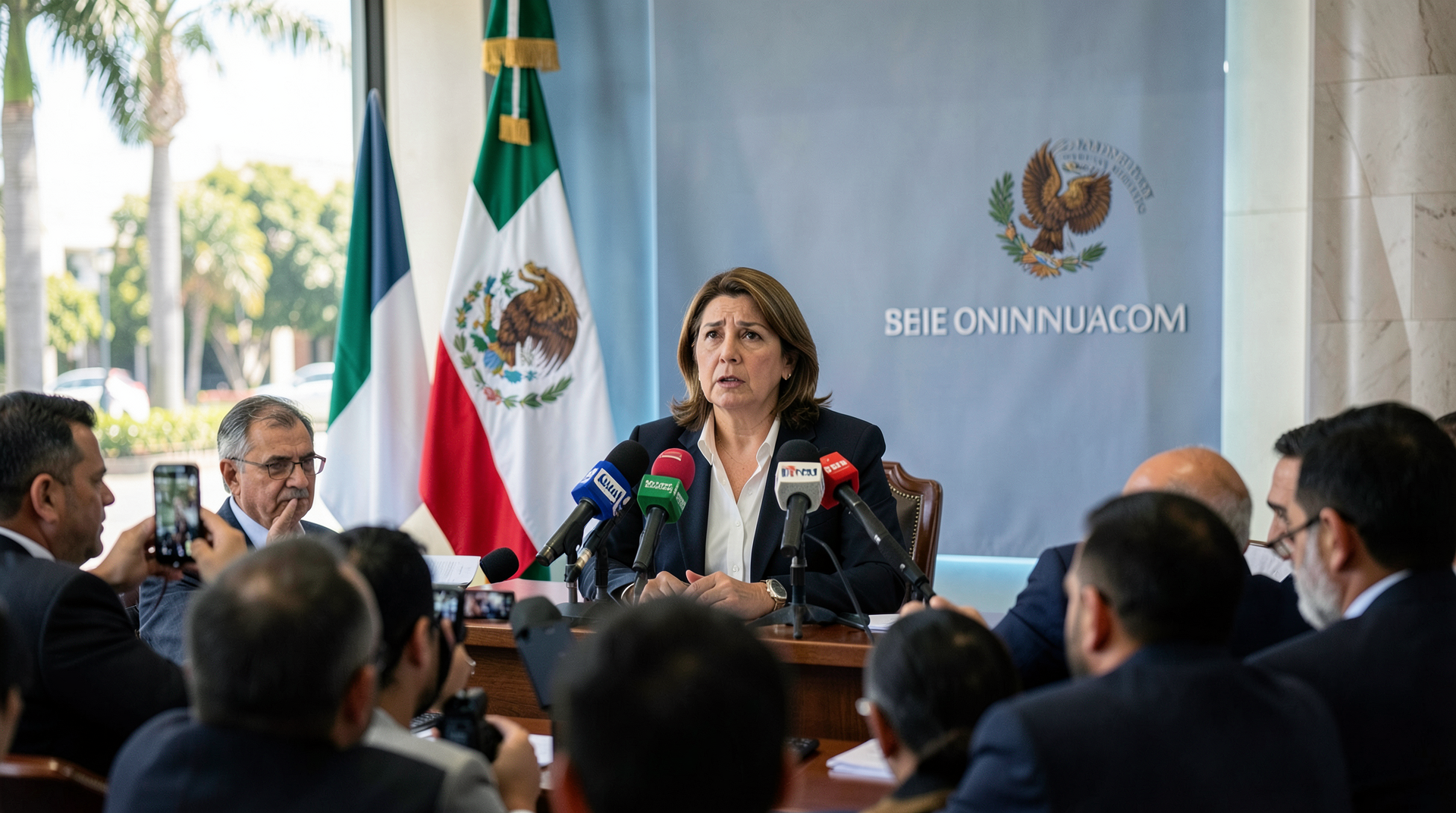
Claudia Sheinbaum's new sentence was not diplomatic language. "This is not a challenge; it is a violation of Mexican law." [1] With that phrase, the Mexican president moved the Chihuahua episode from political grievance into legal characterization, and she did so while fresh reporting indicated the operation may have been the third U.S. covert action on Mexican soil in twelve months. [2][3]
Yesterday the paper described the jump from probe to sovereignty pressure. The day before, it tracked the moment Sheinbaum put "CIA" on record in public language. [4] Friday's change is procedural: a sovereign now names violation, not merely discomfort. That lexical move alters what institutions can do next.
It also reframes continuity with the April 22 naming piece. That article treated the question as attribution and authorization. Friday treats it as repeat incidence plus legal threshold. The LA Times reporting that Chihuahua was the third covert operation in twelve months transforms the event from anomaly into pattern evidence. [2]
Patterns create prosecutorial gravity. One operation can be dismissed as coordination failure. Two create suspicion. Three in one year create potential doctrine: if foreign personnel repeatedly operate through subfederal channels without federal authorization, the constitutional order itself is the injured party. Sheinbaum's language appears designed to establish exactly that legal theory before the Fiscalia General de la Republica issues a preliminary determination.
The institutional escalation was specific, not rhetorical. Sheinbaum named Governor Maru Campos and state prosecutor Cesar Jauregui and demanded they appear before the Senate to explain what collaboration Chihuahua authorized and how. [3][5] That is a subpoena-proximate move in a federal system where governors do not typically testify on security collaboration. El Pais reported that the Torre Centinela intelligence facility in the state had been accessible to U.S. personnel on a "permanent open" basis in the days before the fatal incident. [3] If that reporting holds up under the FGR's review, the state-level collaboration was not a single operation but a standing access architecture - which is exactly the configuration Mexican law assigns to federal authority alone.
The constitutional architecture she is invoking is plain in Mexican law and has been restated repeatedly in her briefings: security relations with foreign states are federal, not state-discretionary. [1][5] That principle is not anti-cooperation by definition. Mexico has long cooperated with U.S. agencies on intelligence, trafficking, and financial tracking. The dispute is over operational presence and command authority inside national territory.
Friday's politics therefore became institutional choreography. Sheinbaum demanded clearer testimony from Chihuahua officials, pressure rose around Governor Maru Campos and state prosecutor Cesar Jauregui, and federal security leadership prepared high-level contacts intended to reassert federal primacy over external security ties. [3][5] The pending Harfuch-Campos meeting is not symbolic. It is a jurisdictional negotiation under public pressure.
MSM framing has split on emphasis. Some outlets still treat the case as a bilateral anti-cartel coordination controversy intensified by a tragic crash. [5] Others now foreground legal breach and federal-state conflict. [1][3] The paper's read is that the second frame has overtaken the first because the presidency has chosen legal vocabulary and because the "third operation" reporting supplies serial context that bilateral rhetoric cannot absorb.
That is where democracy-erosion analysis enters. A republic erodes not only when laws are openly repealed but when enforcement hierarchy blurs in practice. If subnational entities can execute security collaboration with foreign actors outside federal authorization and normalize it until accident exposure, constitutional text remains intact while constitutional command degrades. Sheinbaum appears to be trying to stop that degradation by naming it before adjudication concludes.
Washington will likely continue to describe intelligence cooperation as longstanding and mutually beneficial. That argument is partly true and strategically insufficient. The issue in this episode is not whether cooperation exists; it is whether lawful chain-of-command architecture governs cooperation. If Mexico's federal executive says no and can show repeated operations, the bilateral conversation shifts from partnership language to compliance language.
The first prosecutorial artifact is now "in view," even if not yet filed: a federal preliminary determination could establish whether state-level collaboration crossed statutory lines and whether foreign personnel presence violated the Security Law framework that requires federal control. That finding would not settle every diplomatic claim, but it would concretize the constitutional claim Sheinbaum has now publicly made.
There is also a domestic political calculus. By naming violation in legal terms rather than nationalist abstractions, Sheinbaum appeals to a wider coalition than anti-U.S. sentiment alone: legalists, federalists, and civil-service institutions that prefer process over spectacle. If she can keep the case in that register, she strengthens state capacity while avoiding purely symbolic escalation.
This distinction matters for Mexico's federal future beyond this case file. Federal systems decay when crisis management repeatedly privileges tactical bilateral convenience over constitutional chain-of-command. They recover when executives force agencies back into lawful hierarchy even at diplomatic cost. Friday's language suggests Sheinbaum has chosen the second path. Whether she can sustain it will depend on prosecutorial follow-through and on whether federal institutions are willing to bear short-term security frictions for long-term institutional clarity.
It also creates a test for U.S. counterparts who privately prefer clear legal channels. If Washington wants durable cooperation, it has an interest in helping Mexico restore a visibly federal protocol rather than preserving opaque state-level access points that generate scandal risk. The fastest operational channel is not always the most resilient one.
The risk is reciprocal hardening. U.S. security actors may read this as performative domestic politics and reduce operational transparency further, while Mexican subfederal networks may seek to preserve existing channels out of immediate tactical utility. That would produce more opacity, not less. The only durable exit is a renegotiated cooperation protocol that visibly re-centers federal authorization and records chain-of-command accountability in writing.
The divergence with MSM framing is sharpest here. U.S. wire services and several Mexican outlets have treated the incident through a drug-war sovereignty lens - a familiar template that produces predictable diplomatic choreography and predictable outrage cycles. [5] The paper's read is that the "third operation" datapoint and the Torre Centinela access claim together convert the story into a federalism case file. X conversation in Mexico has made the same turn faster, circulating the "no es un reto, es una violacion" clause as constitutional shorthand rather than as partisan applause line. [1] The gap between those two treatments is not cosmetic; it changes what institutions are being asked to do next.
Until that protocol exists, every new leak or incident will be interpreted through Friday's legal phrase. That is Sheinbaum's strategic bet: by naming "violation" early, she raises the political cost of returning to informal arrangements that bypass federal authority. Whether that bet stabilizes cooperation or hardens conflict will depend on how quickly institutions convert rhetoric into verifiable procedure.
The short-term political reward for both capitals would be outrage management. The long-term institutional reward is rule clarity. Only one of those survives the next incident with legitimacy intact, and only one reduces repeat breach risk over time in practice and law.
Friday's takeaway is therefore sharper than a diplomatic quarrel. Mexico's president has moved the story into a courtroom grammar before a courtroom filing. If the FGR's preliminary read follows the same line, the Chihuahua case will become less a bilateral incident and more a constitutional precedent about who governs force inside the Mexican state.
The democracy-erosion read also applies in reverse. If Sheinbaum sustains the legal frame and the FGR produces formal findings, the case becomes an example of an executive reasserting constitutional hierarchy during external pressure - the opposite of the erosion pattern. Mexican presidents have not always chosen that path when confronted with cooperation-versus-sovereignty trade-offs. Framing the Chihuahua events as a violation of law rather than a diplomatic irritation is the procedural posture most likely to survive the next news cycle with institutional standing intact.
-- LUCIA VEGA, Sao Paulo