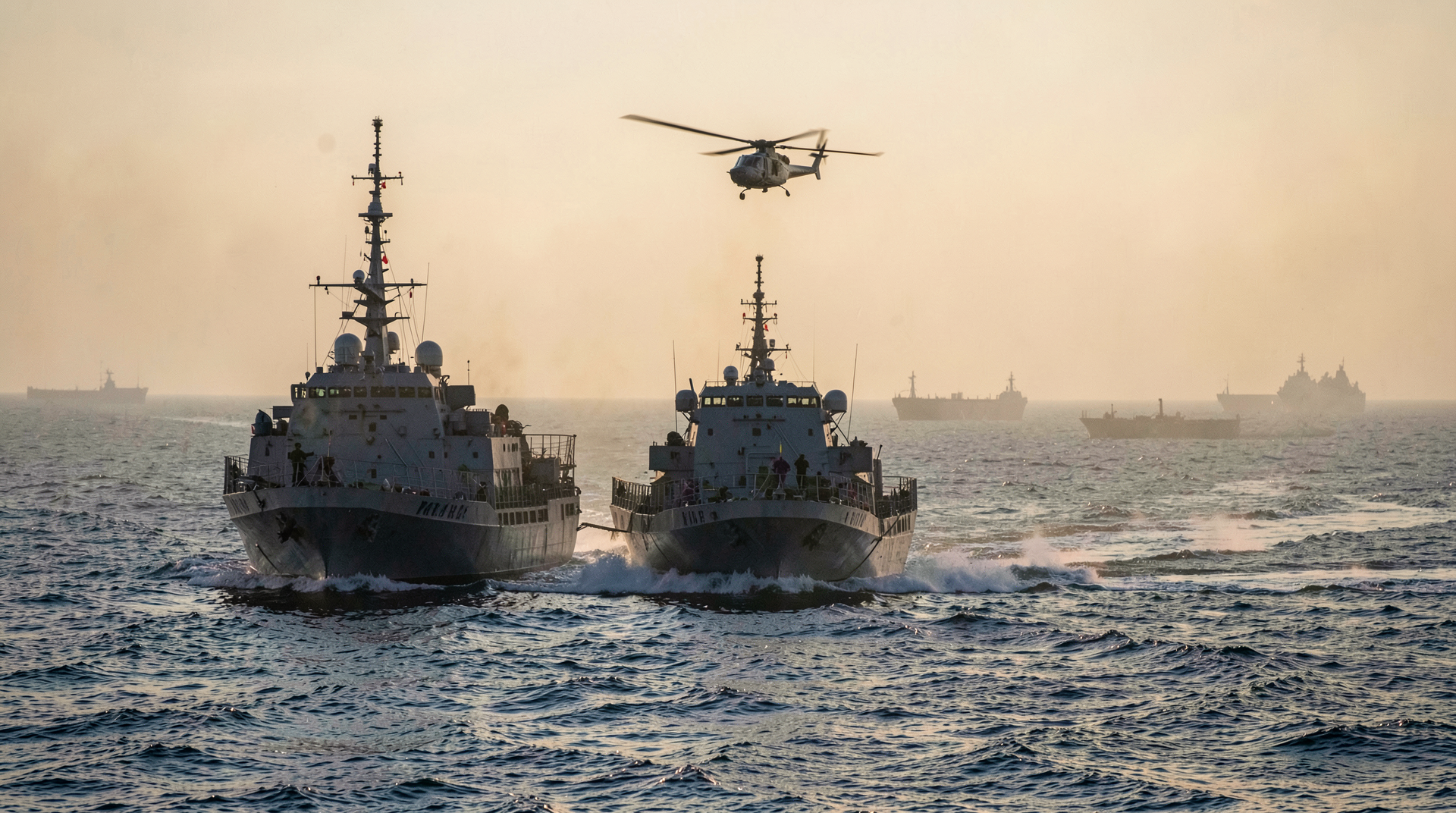
President Donald Trump publicly ordered the U.S. Navy to "shoot and kill" boats laying mines in the Strait of Hormuz, the Pentagon announced a new interdiction of the tanker Majestic in the Indian Ocean, and Iranian forces moved on a third commercial vessel inside roughly 36 hours. [1][2][3] That sequence alone would have defined the day. It did not stand alone.
The paper argued yesterday that Iran had converted the ceasefire clock into a precondition architecture and that Washington had opened Lebanon round two while the kinetic floor remained active. Today's lead advances that frame by one level: the preconditions story is now paired with explicit U.S. lethal-force authorization and reciprocal maritime seizures, not just rhetoric. The architecture moved from coercive ambiguity to declared rules of engagement. [1][3]
At the same time, the allied track at Northwood closed day two with command-and-control, escort, and mine-clearance language that the United States did not write and was not copied on, extending what this paper flagged in yesterday's Northwood account. [4][5] Saudi Arabia remained conspicuously absent from the visible coalition process even as commercial traffic stayed severely constrained. [4][5]
The day therefore broke into three theaters and one connective tissue. Theater one was American authorization: Trump's social post did not simply threaten action; it delegated immediate lethal discretion to Navy crews in an already contested waterway and ordered mine-sweeping at a "tripled-up" pace. [1] Pentagon messaging treated a prolonged closure as "impossible" and unacceptable, but the practical effect of the order was to acknowledge that closure risk had become central enough to justify standing shoot authority. [2]
Theater two was Iranian enforcement and narrative control. Reuters and BBC reporting described Tehran's side of the ledger as seizure, signaling, and blockade-conditional diplomacy. [3][2] The specific vessel sequence matters because it established cadence: after seizures tied to MSC Francesca and Epaminondas in the prior window, the Majestic line now marks a third seizure-chain event in the same strategic period. [2][3] Iran's doctrine is straightforward in public language: while Washington maintains maritime siege architecture, Tehran treats commercial navigation as a coercive arena rather than a neutral channel. [3]
Theater three was legitimacy management inside the Iranian command system. Friday's Mojtaba Khamenei statement invoking unity of voice arrived against persistent reporting that the Supreme Leader had been injured and had reduced public visibility. [6][7] In ordinary weeks, such remarks would be domestic rhetoric. In this week, they functioned as succession-adjacent ratification: the family office signaled continuity while senior state and military organs maintained the precondition line. [6][7] Reporting from Jerusalem by Yosef Stern indicates the significance was not the content alone, but the timing: the statement landed as lethal authorization and seizure escalation converged.
Washington's own command chain also shifted under stress. The abrupt firing of Navy Secretary John Phelan, reported across CNN, AP, Reuters, and BBC-linked coverage, moved from personnel story to war-governance artifact when details of the FY26 dispute surfaced: Phelan argued for a shipbuilding-heavy package, including additional Virginia-class submarine funding and acceleration pressure around surface combatants, while Defense Secretary Pete Hegseth prioritized hypersonics and a Golden Dome down payment. [8][9][10] Sean Parnell announced the departure and offered no replacement timeline beyond acting leadership. [8][9]
The budget fight matters to Hormuz because it is not about one man or one memo. It is a dispute over what kind of war the United States believes it is in. A shipbuilding-forward argument assumes long-duration maritime competition requiring hulls, maintenance, and industrial depth. A hypersonics-and-shield argument assumes political payoff from deterrence theater and strategic messaging. Phelan's removal resolved the bureaucratic argument by removal rather than adjudication, and that procedural fact will outlive this week. [8][10]
The Lebanon track, often described as the "good" diplomatic leg in contrast to frozen Iran talks, did produce a concrete extension. Reporting by Washington Post and CNBC confirms a three-week ceasefire extension announced from the Oval Office while rocket fire was still active during the meeting window. [11][12] The White House can claim process success there, but the contradiction is in plain view: one U.S. theater extends a truce while another receives a kill order, and both are sold as stabilizing policy.
Northwood's closing text sharpened the coalition split that has been forming for days. British and French officials emphasized practical architecture: demining, escorts, and command integration for navigation reopening once political conditions permit. [4][5] That is an allied effort to build a post-blockade operating system. Yet Washington's unilateral blockade logic, and now lethal-force codification, remains the dominant U.S. instrument. The gap is no longer interpretive. It is written in institutions: one coalition planning office, one American trigger authority, one Iranian seizure campaign.
Saudi absence is the silence that keeps compounding. A Gulf reopening design without visible Saudi participation may still produce technical documents, but it struggles to produce regional legitimacy. [5] This is why Friday's facts matter together. A coalition can write escort protocols; it cannot manufacture political ownership where key stakeholders decline to co-sign. The practical result is a narrow operational corridor sustained by force postures rather than by a shared settlement frame.
For markets, the day offered fewer surprises than for constitutional governance. Brent's persistence above recent thresholds, shipping reroutes, and war-risk premia were expected by now. [13] What changed was the state's declared willingness to normalize discretionary maritime lethal force while internal U.S. civilian command showed visible fracture in parallel. [1][8][10] War pricing can absorb bad headlines; legitimacy pricing is slower and often harsher.
For Tehran, the advantage is coherence under pressure. Publicly, officials and affiliated voices continue to tie any diplomatic resumption to blockade relief, while unity language from the Khamenei orbit dampens speculation of elite rupture. [3][6][7] For Washington, the disadvantage is instrument sprawl: siege, extension, lethal authorization, coalition non-participation, and an open Pentagon budget rupture in the same week.
The Friday verdict is not that war widened unexpectedly. It is that governance hardened in mutually incompatible directions. The U.S. converted warning into trigger authority. Iran converted precondition into repeated maritime enforcement. Northwood converted allied intent into technical doctrine outside U.S. command authorship. And the Iranian succession-adjacent voice moved to preempt silence with a unity script while its patriarch remained reportedly impaired. [4][6][7]
What comes next is measurable within days, not months: whether U.S. rules of engagement produce a first publicly acknowledged lethal encounter; whether Iran answers with broader vessel class targeting; whether Northwood communique language translates into deployed mixed escort packages; whether acting Navy leadership locks Hegseth's budget priorities before Congress can impose a different sequencing; and whether Lebanon's three-week extension survives first contact with the same cross-border fire that accompanied its signing. [1][4][8][11]
The paper's position entering Friday was that process was alive while function was frozen. By Friday close, process remained alive, but function had shifted from negotiation to command signaling. The machinery now running this crisis is less diplomatic than institutional: who can order, who can seize, who can write coalition doctrine, and who can speak for absent authority.
There is a longer institutional memory here that readers should keep in view. Every modern Strait crisis eventually produces a map, a legal memo, and a casualty list. The order of appearance varies, but the sequence does not. Friday brought the memo-and-map phase into sharper focus. Washington now has a declared trigger rule. Iran now has a repeated seizure pattern. Northwood now has coalition text under non-U.S. authorship. The next phase in historical sequences is accidental or discretionary contact at sea, followed by retrospective legal justification from all sides. [1][2][3][4]
That is why rules-of-engagement language is not a messaging footnote. ROE wording determines whether a tense approach by a small craft is interpreted as hostile mining behavior, evasive maneuvering, decoy action, or ordinary traffic confusion in compressed lanes. The wider public hears "shoot and kill" as political force. Sailors hear it as split-second legal burden. The gap between those two hearings is where escalation often lives.
The Iranian side has its own version of this burden. Once Tehran publicly frames blockade enforcement as illegitimate coercion and links negotiations to blockade relief, it narrows its own room for tactical de-escalation. A government can privately prefer calm and still feel compelled to produce visible enforcement events to avoid looking strategically coerced. Repetition then becomes policy inertia. That is what the third-ship sequence suggests: not improvisation, but compulsion under declared doctrine. [3][6]
A final Friday contradiction belongs in the record: Washington is simultaneously asking allies to trust U.S. crisis leadership while accepting a coalition process where key texts are written without U.S. seat, and while removing its own Navy civilian at the center of force-structure dispute. [4][8] States can survive one contradiction for a week. They struggle when contradictions are institutionalized across diplomacy, military operations, and procurement governance at once.
Readers should therefore resist false binaries between "war" and "diplomacy" as if they were alternate universes. Friday showed the opposite: diplomacy windows can expand in one corridor while military discretion expands in another, and both can be true under a single administration at the same moment. The policy problem is not contradiction itself; states always carry contradictions. The problem is unmanaged contradiction, where no institution has acknowledged priority order when tradeoffs arrive. Hormuz's next incident will test whether Washington has that priority order or only competing scripts.
Friday did not answer that test. It only set its terms, publicly and irreversibly, for everyone worldwide.
-- SAMUEL CRANE, Washington