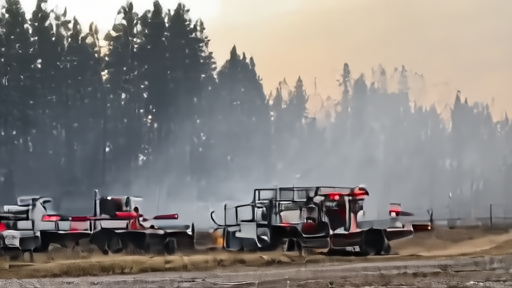
A child's foil party balloon, lifted into a Brantley County power line, produced an arc that landed in dry ground litter and set the largest wildfire in Georgia history. Governor Brian Kemp named the ignition source Friday afternoon at a press conference with Georgia Forestry Commission Director Johnny Sabo. [1] Sabo specified, when pressed, that it was "a kids party balloon that has the aluminum-look to it." The Pineland Road Fire that began earlier in Clinch County, by Kemp's account, was sparked by a fence-welder whose ground spark could not be put out. [2] The paper's Friday major framed the Southeast wildfire complex as a drought-of-record event. Saturday lands the ignition source, the federal command transfer, and the Glynn County evacuation crossing.
The damage figures, by Friday evening's WALB tally, are 122 homes destroyed across the two south-Georgia complexes — eighty-seven in Brantley, thirty-five at Pineland Road. [3] The Brantley fire alone has burned 7,500 acres at fifteen percent containment; the Pineland complex has consumed an additional 31,000 acres in Clinch and Echols. State officials believe the combined fires have destroyed more homes than any other in Georgia history. Two hundred twenty-five firefighters are deployed for structure protection along the Brantley flank; another one hundred fifty active wildfires are burning in Georgia and Florida. The Brantley County Sheriff's Office issued a curfew Friday for the east side of the Satilla River, from Atkinson to Waynesville along Highways 110 and 259. Federal authorities took command of the Brantley response Friday afternoon.
What the ignition fact illuminates is the fuel condition. A foil balloon and a power line have produced sparks for as long as foil balloons have been sold; what is different is the litter on the ground. The drought has been classified by the U.S. Drought Monitor as exceptional across ninety-one Georgia counties — a 25-year record. Pine straw under unmaintained right-of-way, with sub-five-percent live fuel moisture and relative humidity below twenty, is essentially primed kindling. Kemp declared a state of emergency for the ninety-one affected counties Wednesday. The proclamation prohibits price gouging, allows National Guard mobilization, and triggers state emergency-management reimbursements. [2] None of those measures changes the fuel condition. The fuel condition is what made a balloon a structural fire ignition.
The federal command transfer is the operational artifact Day Three has produced. National Interagency Coordination has Type 1 incident management teams now in place at both complexes; FEMA assistance has been requested through the Stafford Act framework. The 911 dispatcher in Brantley County who lost her home to the fire while working her shift — an episode local-news accounts have circulated through the weekend — is one of dozens of households the structure-protection lines could not save. Mylar balloons, by Georgia Forestry Commission staff guidance carried earlier this spring, have been a chronic ignition source under high-fire-danger conditions. Most years, the ignition does not run; this year, three foot-tall flames in dry pine litter found a wind alignment that pushed them into the wildland-urban interface inside the first afternoon.
Day Three of the Southeast complex closes, then, with the ignition fact named, the federal command in place, the evacuation line crossed into Glynn County, and a fuel condition that no operational decision can yet reverse. The drought-of-record framing the Friday major carried — twenty-five-year worst, ninety-one counties under emergency — is the structural backdrop. The party-balloon ignition, in that backdrop, is the Earth Day weekend irony local-weather accounts have already named. The harder fact is what the Saturday tape produces if the wind does not shift: 7,500 burned acres at Brantley, 31,000 burned at Pineland, evacuation lines now thirty miles long, and a fire-weather forecast that Saturday morning's National Weather Service Charleston office has continued to flag through next week. The balloon has been identified. The conditions that turned it into a 7,500-acre fire have not yet been addressed.
-- NORA WHITFIELD, Chicago