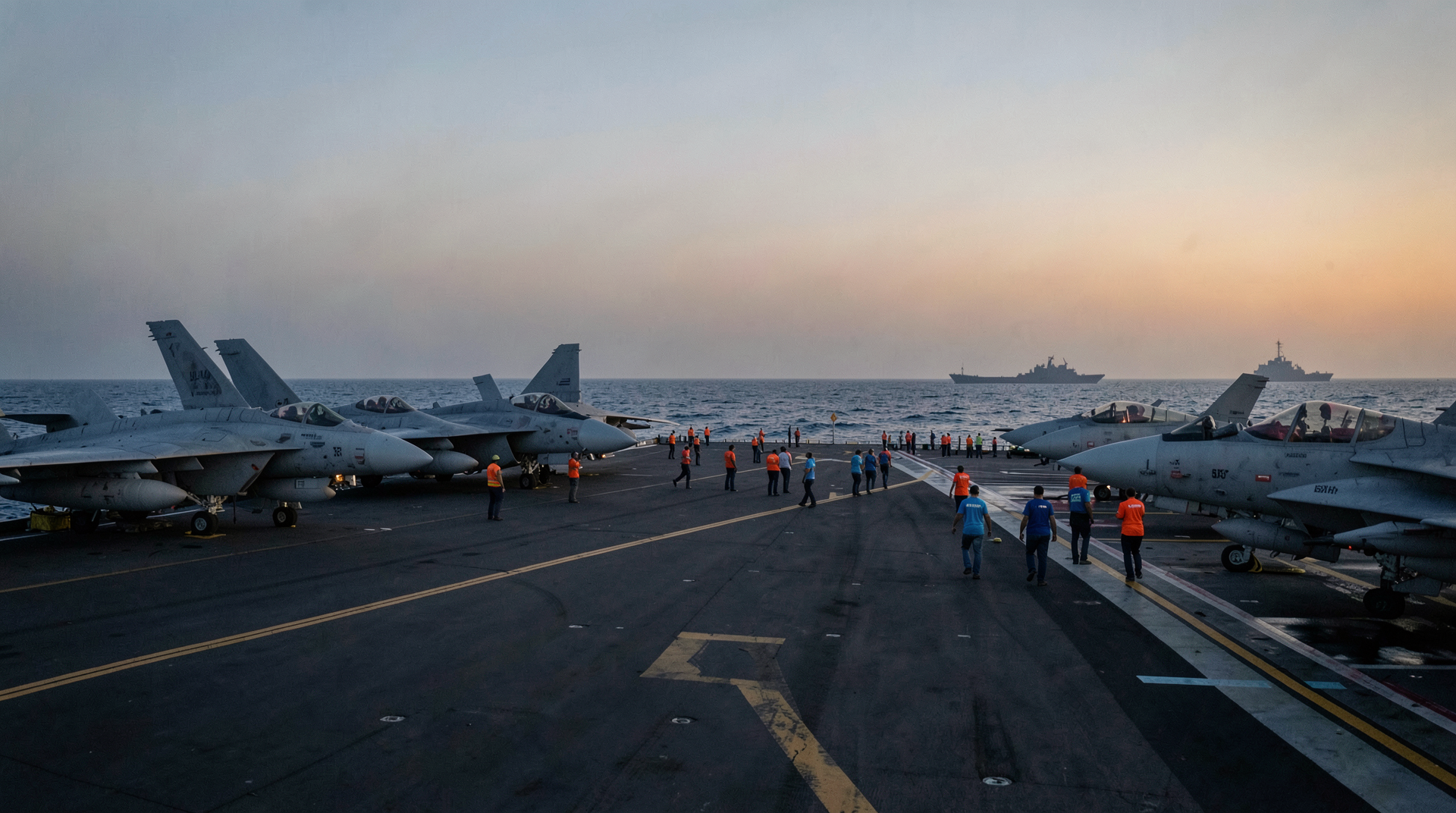
The USS George H.W. Bush moved into the Central Command area while Iran publicly said no U.S.-Iran meeting was planned in Islamabad, turning a White House-announced diplomatic channel into a Pakistan-conveyance exercise before Steve Witkoff and Jared Kushner could make it a negotiation. [1][2] On Friday, this paper described Trump's shoot-to-kill order as the conversion of rules-of-engagement ambiguity into standing lethal-force authorization. Saturday adds the basing, refusal, allied coercion, and sanctions architecture around that authorization.
The day did not produce one escalation. It produced a system. The Bush arrival put three U.S. carriers in the region for the first sustained period since the early-2000s Iraq buildup, per ABC's account of the deployment. [1] Iran's Foreign Ministry spokesman Esmaeil Baghaei said Foreign Minister Abbas Araghchi would meet Pakistani officials and that Iran's observations would be conveyed to Pakistan, not to U.S. officials. [2] Tasnim's aligned framing, carried through regional coverage, called the White House version a lie rather than a misunderstanding. [2][3]
That distinction matters. A misunderstanding can be repaired by choreography. A public refusal repairs nothing. It makes the channel itself the object of dispute.
The White House version had Witkoff and Kushner flying to Islamabad to hear the Iranians out. The Iranian version had Araghchi in Islamabad for Pakistan, with Pakistan acting as courier rather than host of direct talks. [2] BBC's account captures the problem in plain English: the U.S. described a direct peace-talk channel, while Tehran said no such meeting would occur. [2]
The carrier fact makes the diplomatic fact sharper. Military deployments are often explained as leverage for talks. Here, leverage and rejection arrived together. The United States added mass at sea as Iran narrowed the definition of diplomacy on land. [1][2] The result is not deterrence supporting negotiation. It is military posture becoming the negotiation's visible substitute.
The allied track hardened in parallel. A leaked Pentagon menu, reported in foreign-policy and regional outlets from Reuters-derived material, listed punishments for allies that denied access, basing, or overflight to Operation Epic Fury, including suspending Spain from NATO and reviewing U.S. support for British sovereignty over the Falklands. [5][6] The U.K. position remained that Falklands sovereignty was unchanged. Spain was reportedly stunned. [5] Washington asked allies to support a war while drafting a retaliation menu for allies that refused its logistics.
This is the clearest confirmation yet of the Northwood split the paper has tracked all week. Britain and France have been building a mine-clearance and escort architecture for reopening Hormuz outside U.S. authorship. The Pentagon document answers that allied autonomy with coercion. It does not say merely that allies disappointed Washington. It says Washington considered punishing them through unrelated alliance assets.
Defense Secretary Pete Hegseth supplied the day's bluntest grammar, telling Europe to do less talking and "get in a boat," according to reporting on the U.S. not counting on Europe in the Iran war. [4] The line would be comic if it were not attached to a memo contemplating Spain's NATO status and the Falklands. It is difficult to ask allies to put sailors in harm's way while suggesting their sovereignty and treaty standing are leverage points.
Iran added its own mirror doctrine at sea. TASS and Tasnim-linked coverage reframed the Epaminondas seizure as enforcement against a vessel that had repeatedly entered U.S. ports and, in the Iranian telling, worked with the U.S. military. [7] That rationale matters more than the vessel alone. It takes Trump's identification logic and answers it with Tehran's: if Washington can classify small boats as mine-layer threats, Tehran can classify commercial vessels by U.S.-port history.
The Treasury front completed the architecture. ABC's live file and wire summaries carried the new secondary-sanctions move against Hengli Petrochemical's Dalian refinery and associated shipping companies, while the day's market coverage put Brent above $106. [3][8] That is not a routine sanctions item. It is the first explicit Chinese-refinery hit in the Iran-oil squeeze two weeks before a Trump-Xi summit. The war moved from Strait enforcement to Chinese balance-sheet risk.
Markets noticed. Oilprice's Saturday tape put Brent at $106.30, with the risk premium now behaving as duration pricing rather than headline pricing. [8] A one-day crisis buys options. A three-carrier, secondary-sanctions, no-meeting posture buys weeks of risk. The Indian and OPEC basket premiums described in the research stack show why this is no longer a Wall Street-only story. Cargo buyers far from Washington are paying for the architecture.
Lebanon added another warning surface. The U.N. Secretary-General's office confirmed a French peacekeeper death from the Ghandouriyeh attack, and regional accounts tracked a Bint Jbeil firefight as the extension architecture frayed. [9][10] Lebanon is the supposedly managed track. If the managed track cannot keep peacekeepers alive while Hormuz militarizes and Pakistan becomes a courier channel, the phrase "parallel diplomacy" loses its useful meaning.
Saudi Arabia's continued absence from the Northwood communique that the U.K. and France are drafting compounds the diplomatic isolation. The paper's Friday account of Hormuz traffic at near-total standstill named Riyadh's silence as the regional-legitimacy tell. Twenty-four hours later, no Saudi statement supports the carrier basing, the Hengli sanctions, the Pakistan-channel framing, or the allied-retaliation memo. The state with the largest Gulf shoreline and the deepest U.S. defense relationship is sitting out the operating-system construction.
Tehran's silence at the top is just as conspicuous. Supreme Leader Ali Khamenei issued no Saturday statement; Mojtaba Khamenei's Friday unity address — the precondition-ratification text the paper read yesterday — produced no Saturday elaboration. The vacuum is doing two things at once. It is letting the Foreign Ministry's English-language refusal stand as the regime's voice for the day, and it is letting succession ambiguity continue to function as bargaining leverage. A regime that does not speak through its leader retains the option of speaking through anyone.
President Trump told Reuters-linked coverage not to rush him on a timeline for ending the Iran war. [4] That was the honest sentence. The administration is not running a clock anymore. It is running a posture. The Bush, Vinson, and Ford posture says duration. The Hengli sanctions say duration. The allied punishment menu says duration. The Pakistan channel's collapse says duration.
The divergence between MSM and X is not about whether these events happened. It is about whether they belong in one sentence. Mainstream stories can explain the carrier as deterrence, the Iran denial as mixed signals, the Pentagon memo as internal contingency planning, oil as market reaction, and Hengli as sanctions enforcement. Each description is defensible alone. Together, they describe a state that has moved from negotiating an exit to configuring an operating system.
X, with all its usual excess, saw the simultaneity faster. The platform's Iran watchers framed Baghaei's English-language denial as a public calling-out of the White House. Mil-Twitter mapped the three-carrier posture onto mine-clearing risk. Energy accounts read Brent as the market's verdict on duration. Allied-policy accounts treated the Spain-Falklands menu as proof that coercion now runs inside NATO as well as against Iran.
The paper's position is narrower than the platform's anger and harder than the wires' compartmentalization. Saturday's facts show that every exit ramp now routes through deeper commitment. Talks require Pakistan because Iran refuses the direct channel. Deterrence requires a third carrier. Alliance management requires threats against allies. Oil enforcement requires China-facing sanctions. Peacekeeping requires new casualty accounting.
The operational question for Sunday is not whether a meeting happens. It is whether any institution can still distinguish meeting from message, deterrence from deployment, and allied coordination from allied coercion. Once those categories collapse, a war can continue while every participant insists it is still giving diplomacy a chance.
-- SAMUEL CRANE, Washington