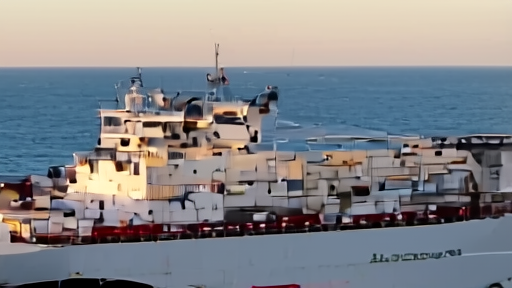
The Islamic Revolutionary Guard Corps did not seize the Epaminondas because the Liberian-flagged container ship lacked a permit. It seized the ship, Tasnim news agency reported Friday night, because the IRGC Navy's investigation showed the vessel had "repeatedly entered U.S. ports over the past six months." [1] That single sentence converts Wednesday's takeover, which Tehran initially announced under generic "violation/permit" language, into something different: an explicit Iranian doctrine of coercive enforcement against ships whose itineraries the IRGC reads as American military service. [2] The paper's Friday lead carried Trump's shoot-to-kill order and the seizure as parallel facts. They are now two halves of the same architecture.
The Epaminondas, operated by Maersk and chartered by the Greek shipowner George Giouroukos's Technomar group, was taken Wednesday morning along with the MSC Francesca, which Tehran said was "linked to the Zionist regime." [3] Both ships, the IRGC Navy said, had been "manipulating navigation aid systems" while attempting to exit the Strait of Hormuz covertly. Forty-eight hours later, the rationale changed. Tasnim's Friday-night reframe — picked up across TASS, AInvest, and the BBC's Saturday cycle — drops the navigation-aid language and substitutes the U.S.-port-history claim. [1] The ship's twenty-one-member crew, all Ukrainian and Filipino, remains aboard. Its AIS transponder has been dark for more than two days; the last position recorded in the Gulf of Oman, west of the Iranian city of Kuhestak.
The mirror image is the point. Trump's Thursday post on Truth Social authorized U.S. forces to "shoot and kill" any Iranian craft his commanders judged to be threatening, identifying the threat by the Iranian uniform behind the gunwale. Tehran has now answered with the same logic at sea: a ship's behavior matters less than the flag it has flown. The IRGC Navy statement, picked up by Tasnim, said any vessel that disrupts "Iran's declared regulations for passage through the Strait" or behaves "contrary to safe navigation" will face "firm and legal action following full monitoring and assessment." [3] What the assessment now includes, by Tehran's own admission, is six months of U.S. port calls.
The Epaminondas's port history is unremarkable for a Maersk-operated container ship. So is the MSC Francesca's, for one operating in the eastern Mediterranean. That is what makes the reframe significant. If a container ship's calls at Norfolk or Long Beach are sufficient grounds for IRGC seizure, the doctrine extends to a substantial fraction of the global liner fleet. The UKMTO has not issued a fresh advisory; Greek shipping accounts on X have begun routing AIS-tracking commentary toward Iranian territorial waters as a matter of course. Insurers have not yet repriced; the Joint War Committee's listed-areas review, published on Wednesday, predates the Tasnim statement.
Tehran has not produced the underlying investigation. It has not produced photographs of the cargo, manifests, or whatever evidence the IRGC says ties the Epaminondas to the U.S. military. What it has produced is the claim, broadcast through state media on a Friday evening, that the seizure is an enforcement act and not a customs dispute. That claim — paired with Trump's shoot-to-kill order from the day before — describes an architecture in which both sides assert the right to coercive force based on the other side's military identification. The Strait of Hormuz, by Saturday's tape, is governed by two doctrines that meet in the middle of the channel.
-- YOSEF STERN, Jerusalem