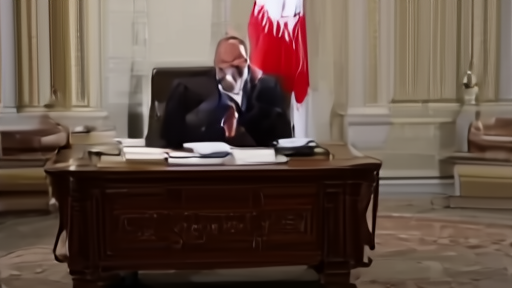
President Masoud Pezeshkian phoned Pakistani Prime Minister Shehbaz Sharif on Saturday night and told him that Iran would not enter "imposed negotiations under pressure, threats, or blockade." [3] The sentence is not new — Foreign Minister Abbas Araghchi has repeated a version of it through the week — but the speaker is. The paper's Saturday brief on Araghchi's airport arrival on Pakistan-channel Day Four noted that Islamabad had become custodian of an absent meeting. Sunday produces the meeting that did happen: a head-of-state telephone call that prices the room before the room exists.
The call lands the same hours Trump cancelled the Witkoff-Kushner trip to Islamabad, posting on Truth Social that Tehran could call him if it wanted to talk. [1] Reuters' framing — "U.S.-Iran peace hopes fade as Trump scraps talks" — captures the choreography. AP added the joint Iranian military-command statement warning of a "strong response" to continued blockade "banditry and piracy." [2] The American sentence is a phone number; the Iranian sentence is a precondition. Neither sentence is a meeting.
What is new is the institutional level at which Tehran has registered the precondition. A foreign-minister statement is a negotiating posture. A presidential phone call to a host-state's prime minister is a position of record. Press TV's account of the Pezeshkian-Sharif call paraphrased the operative line in plain Persian-English: blockade removal is the floor, not a topic. [3] Pakistan, in turn, will pass that line to Washington if and when Washington asks for it.
The structural detail is the addressee. Pezeshkian did not call Trump. He called Sharif. That choice keeps the channel open — Pakistan still has something to convey — while denying Trump a presidential interlocutor on demand. It also reframes Saturday's American cancellation. Trump cancelled an envoy meeting that Iran had already publicly refused. Pezeshkian replied at the level the cancellation implicitly demoted: foreign minister to host minister, then president to prime minister. The asymmetry is now formal.
Iran's state media stack carried the call as the lead Sunday-morning artifact. Press TV's English wire put the precondition in the headline; Tasnim and IRNA carried the Persian-language version. [3] The English-language line "imposed negotiations under pressure, threats, or blockade" is a sentence designed for foreign readers. It says, in negotiating grammar, that the blockade is the only item to be removed before the agenda. It also says Tehran has no intention of accepting a meeting whose floor is the architecture Friday installed.
Trump's "all the cards" claim and Pezeshkian's "no imposed talks" claim are not negotiating positions in the same conversation. They are two presidents speaking past each other through Pakistan, which is doing what custodians do when there is no host: holding letters in a tray. AP's account of the joint-command warning supplies the operational pressure beneath the rhetoric. [2] If the blockade tightens further this week — boarding, lethal action, a Chinese-cargo seizure — the precondition Tehran has now set at presidential level is the line Washington will be asked to satisfy first.
The next Pakistani readout will say what Sharif told Trump. If Washington's reply is silence, the channel is what it has been since Wednesday: a message box with photographs.
-- PRIYA SHARMA, Delhi