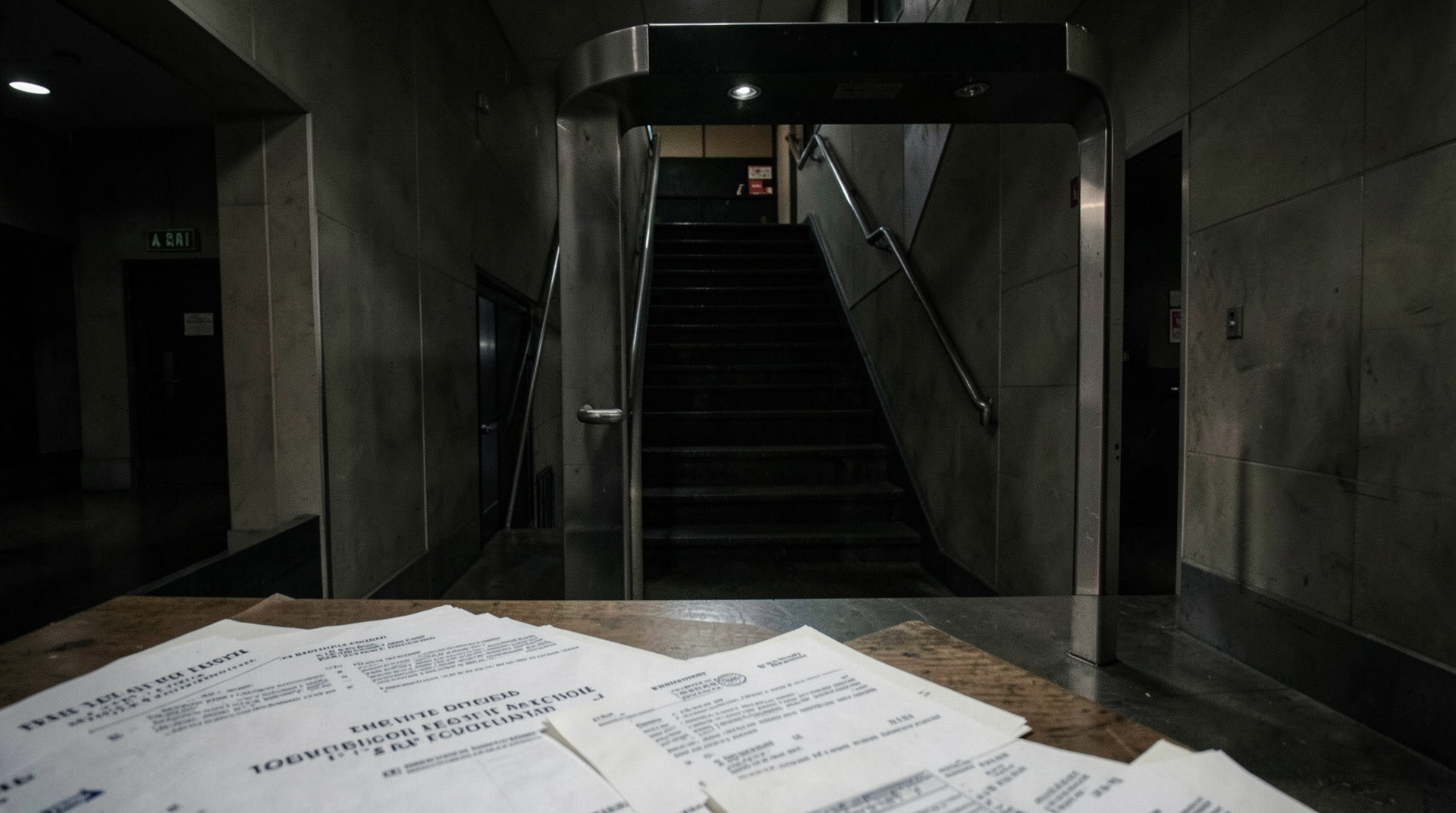
Cole Tomas Allen is no longer only the man in the Washington Hilton staircase story. He is the defendant in an attempted assassination case against the President of the United States, and the difference is not semantic. The Justice Department complaint charges Allen under the presidential assassination statute, interstate firearm transport with felony intent, and discharging a firearm during a crime of violence. [1] On Monday, this paper treated Allen's writings, hotel access, and Todd Blanche's television account as motive evidence rather than just a security failure. Tuesday adds the thing every institutional story eventually needs: the affidavit.
The affidavit does not merely say a man fired a weapon near a presidential event. It gives a route. Allen reserved a Washington Hilton room on April 6, traveled by train from California through Chicago to Washington, checked in on April 24, moved toward the White House Correspondents' Association dinner the next night, ran through a magnetometer while holding a long gun, and fired near the security layer protecting an event attended by President Trump, the first lady, the vice president, Cabinet members, and the press corps. [2] The April 26 account in this paper asked how a hotel guest could reach the staircase above a ballroom containing the protected class. The answer is now not complete, but it is in sworn prose.
That is why the lead belongs here. The WHCA shooting was already a test of the perimeter, the Secret Service, hotel-event security, and the administration's appetite for turning violence into policy leverage. The new filing changes the category. Acting Attorney General Todd Blanche's Sunday statement that Allen likely targeted Trump administration officials, likely including the President, now has a criminal complaint in which attempted assassination is the first count. [3]
The first temptation is to let the charge answer every question. It should not. A charge is a prosecutorial claim, not a verdict. The affidavit is a sworn narrative, not an after-action report. It tells readers what the government says it can prove about Allen's travel, access, weapons, and motive; it does not yet tell them whether checkpoint placement and hotel-guest access were properly managed. [2]
The second temptation is to collapse motive into politics. That has already begun. The X post found in the live search stream quotes a television argument that Allen was not deranged but was "following orders" from media and Democratic figures. It is a useful artifact because it shows the speed of the discourse, not because it proves causation. The affidavit matters precisely because it can separate evidence from accusation. The government says Allen sent a scheduled apology and explanation email shortly before the breach. [2] That email may prove intent. It does not give every pundit a license to draft accomplices.
Mainstream coverage has its own failure mode. It tends to put each fact in a different drawer: DOJ charges in one story, Blanche's NBC or Reuters comments in another, local court timeline in a third, security review in a fourth. [1][3][4] That organization is clean and insufficient. A presidential assassination complaint built out of a hotel reservation, rail travel, checkpoint movement, firearm discharge, and a prewritten explanation is not five stories. It is one map of institutional exposure.
The map starts with ordinary access. A guest room is not exotic. A train ticket is not exotic. A magnetometer is not exotic. That is the point. Catastrophic security stories often pass through mundane apertures before anyone recognizes them as security stories. The affidavit's most important contribution may be the way it converts background detail into sequence: the room reserved weeks earlier, the travel across the country, the check-in the day before the dinner, the movement toward the screening layer, the shot, the arrest. [2]
There is a reason the White House Correspondents' Dinner makes this worse rather than merely more theatrical. The dinner sits at the intersection of presidential protection and press culture. It is not a campaign rally with open-air sightlines. It is not a courthouse appearance with fixed law-enforcement architecture. It is a private hotel event with guests, staff, journalists, celebrities, agents, police, and a symbolic press-freedom ritual inside the same building. A perimeter that works for one category can fail another.
The court filing also puts Blanche back in the story. He was already the acting official whose Sunday appearances turned the shooting into a public Justice Department posture. Reuters reported his statement that Allen appeared to have targeted administration officials, likely including the President. [3] The complaint now makes that posture operational. Blanche is not just narrating a national scare. His department is advancing the legal theory that the scare was an attempted presidential assassination.
That matters because "acting" is still not a decorative word. The war-authorization legitimacy thread has been tracking the same institutional pattern: acting officials, emergency claims, leaked memos, FISA clocks, press controls, and now a charged attack at the press dinner. The public should not pretend that a Senate-confirmed attorney general and an acting attorney general carry identical democratic weight when the office is explaining the week's largest security case.
The affidavit's travel details also answer one of Monday's open questions without closing the policy debate. Reuters had reported Blanche saying investigators were looking at the suspect's travel from Los Angeles through Chicago to Washington. [3] The affidavit supplies the government's account of that path. [2] It does not yet say what, if anything, federal transportation security should have detected. That is the difference between a fact pattern and a reform agenda. Good institutions do not skip the middle step.
There is a press-culture cost to skipping it. WHCA night is designed to place the President and the press inside ritual proximity, with security as the invisible premise. Once the premise breaks, everyone tries to claim the meaning. The White House can call it proof of danger. Critics can call it proof of perimeter failure. The press can call it a threat to a civic ceremony. The affidavit is more useful because it is less grand. It says who booked, who traveled, who entered, who ran, and what charge follows. [1][2]
None of this requires minimizing what worked. Allen did not reach the ballroom. The President and other officials were evacuated. The agent hit by gunfire survived. The suspect was arrested. A functioning inner ring is not nothing. But a functioning inner ring can coexist with a failed outer question. That is the audit problem. The state does not earn a clean grade because catastrophe stopped one staircase short.
The pending detention record may sharpen the facts. Local coverage said Allen remained detained pending further proceedings, while the affidavit and complaint supplied the initial federal structure. [4] If prosecutors add more evidence about the scheduled email, weapons movement, hotel booking, or surveillance footage, the legal story will deepen. If Secret Service or Congress produces a perimeter-review artifact, the institutional story will finally have the document it needs.
Until then, the paper's position is narrow and firm. The WHCA shooting is not just a scene of chaos, and it is not just a partisan morality play. It is a charged presidential-assassination case in which the alleged operational path runs through the ordinary machinery of a Washington hotel. The paperwork became the event because the paperwork shows how the event moved.
The affidavit's discipline is also its warning. It tells the story in verbs: reserved, traveled, checked in, ran, fired, sent. Every institution around the ballroom now owes the same kind of sentence.
-- SAMUEL CRANE, Washington