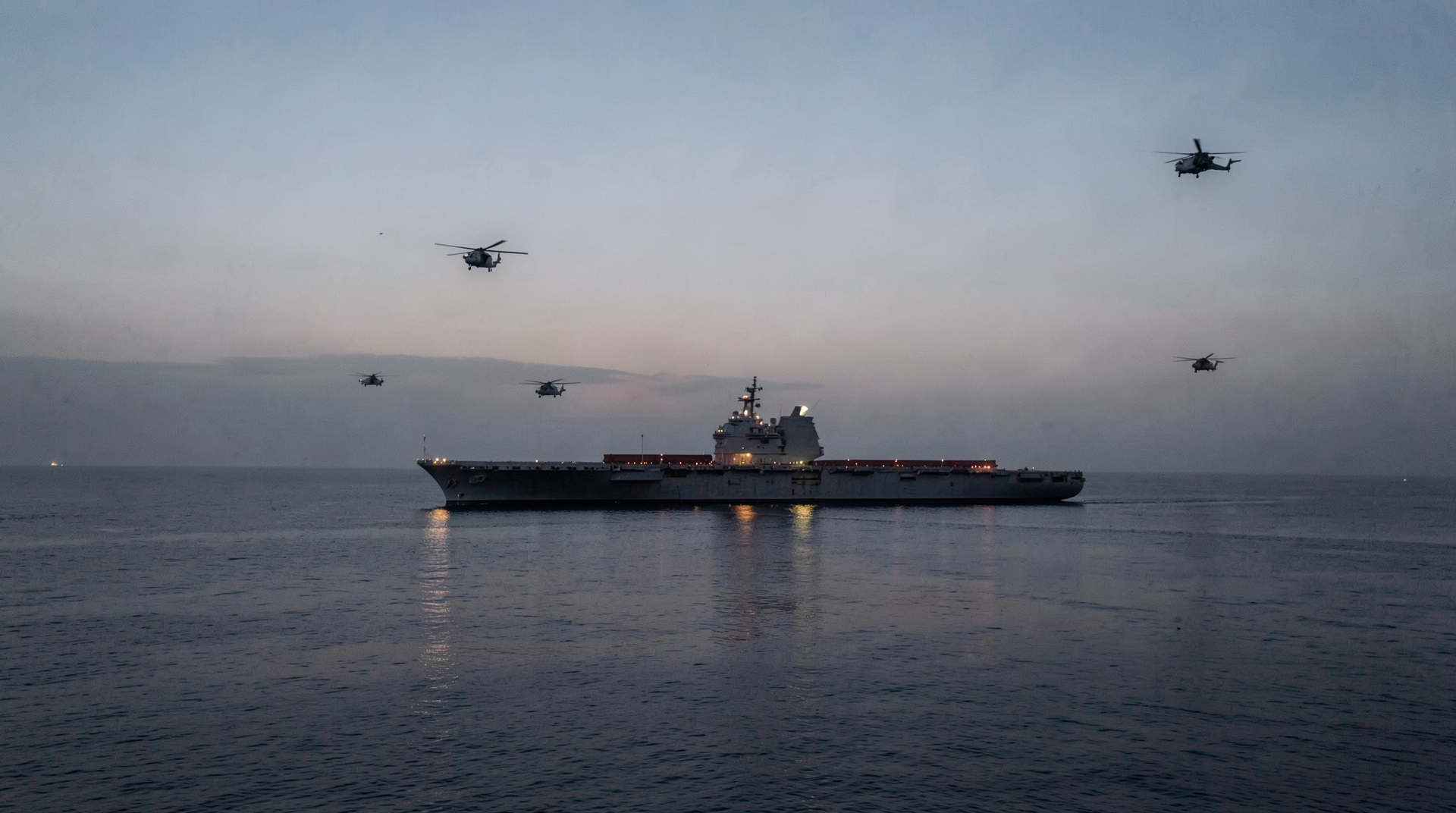
President Donald Trump has told his senior aides he is no longer interested in the Iranian proposal that Pakistan carried to Washington over the weekend, and has directed them to plan for an extended U.S. naval blockade of the Strait of Hormuz instead, the Wall Street Journal reported Tuesday night, citing U.S. officials briefed on the meeting. Reuters confirmed the WSJ account in early Wednesday Asia trading and Bloomberg said the President had concluded that continuing to throttle Iranian oil exports was "less risky" than either resuming the U.S.–Israeli bombing campaign or extracting the United States from the war entirely. [1] [2] [3]
The decision, conveyed privately rather than announced, is the hinge on which this paper's two prior editions turn. The April 28 lead reported that the Pakistan relay had carried an offer to Washington but had no claimed American owner — a channel in transit, not a negotiation. Wednesday's news is that the channel existed, the offer was received, and the offer has been refused. The April 27 framing — that Secretary of State Marco Rubio had drawn a nuclear line that narrowed any acceptable deal to a single clause — has been confirmed by the rejection itself. The Iranian proposal, relayed through Foreign Minister Abbas Araghchi to Pakistani mediators in Islamabad over the weekend, sequenced a Hormuz reopening and a blockade lift before any nuclear discussion. [4] That sequence is what Trump has refused.
Rejection is the policy now. Not a vote, not a tweet — a tasking.
The operational picture is already in the tape. Brent crude rose for an eighth straight session on the WSJ report, settling above $111 a barrel in early Wednesday trading; gasoline futures touched a 3.75-year high. [5] The U.S. Treasury issued an advisory to American banks Tuesday warning of sanctions exposure for handling Chinese teapot refineries' Iranian-linked business, the kind of move sanctions experts read as the financial-system extension of a blockade rather than a parallel track. [6] CENTCOM, which began the maritime blockade on April 13, said as of April 25 it had turned back 37 vessels; on Tuesday it disclosed its first publicly announced search-and-release boarding of a non-Iranian-bound cargo ship in the Gulf of Oman, the artifact of a blockade acquiring procedural texture. [7] The pattern is one decision and several agencies executing it.
The phrase "extended blockade" is the new fact. The Wall Street Journal's account, which Bloomberg and Reuters relied on for their Wednesday morning copy, said Trump had decided in meetings with top aides "to continue putting pressure on Iran's ability to export oil by stopping any vessel heading to or from the Islamic Republic's ports," and had concluded that this was a less risky course than resuming bombing or walking away. [3] Reuters reported on Wednesday that crude markets read the WSJ account as the spine of an eighth-day rally that has now priced in a Hormuz closure stretching into summer. [1] [5] The World Bank on Tuesday said global energy prices will rise 24 percent in 2026, the sharpest such move since the 2022 Ukraine invasion, while warning that its baseline assumes Hormuz "gradually recovers" by May; the upside risks now overwhelm that baseline. [5]
Iran's offer, as described to the Associated Press by two regional officials briefed on the closed-door talks, contained three phases. Phase one would extend the current ceasefire toward a permanent end of the war. Phase two would reopen the Strait of Hormuz and lift the U.S. naval blockade in parallel. Phase three would address Iran's nuclear program in subsequent talks. [4] Rubio, in a Fox News interview Monday, said Tehran was offering to reopen the strait only on terms that left the strait under Iranian control, and characterized the proposal as a stall. [8] Trump told reporters Saturday, after canceling the planned Witkoff-Kushner trip to Islamabad, that Iran had sent a "much better" proposal, but added the phrase that hardened into Wednesday's policy: "It's very simple: They cannot have a nuclear weapon; otherwise, there's no reason to meet." [4]
Pakistan, having delivered the offer the United States has now refused, is the unsentimental loser of the day. Prime Minister Shehbaz Sharif had invested considerable political capital in hosting the second round of talks; the hotel that was staged for the delegation in Islamabad has sat empty for nearly a week. [9] Qatar publicly endorsed Pakistan's mediator role on Tuesday and called the use of Hormuz as a "pressure card" unacceptable in a Foreign Ministry statement, which extends the chorus from a Saudi-and-Bahrain UN convening earlier in the week. [10] Pakistani Field Marshal Asim Munir, who had told Trump in an April phone call that the blockade was "a hurdle" in talks — a recommendation Trump publicly denied receiving — is now the named author of advice the White House has formally rejected. [11]
What "long" means inside the planning is the question the WSJ account does not yet answer. The bracket the market has begun to price is shaped by physical constraints rather than policy ones. Treasury Secretary Scott Bessent posted on X last week that Iran's onshore storage at Kharg Island would be "full" within "a matter of days," after which "the fragile Iranian oil wells will be shut in." [12] An Eurasia Group/Vortexa analysis cited by Axios this week put Iran's combined floating-storage and onshore-buffer capacity at roughly two and a half months — twenty Very Large Crude Carriers repurposed as mobile tanks plus three weeks of dry-land cushion. [13] Foundation for Defense of Democracies analyst Saeed Maleki told Axios this was "delay tactics measured in days, not weeks." The Iran International dollar tape carried the parallel signal: the rial cleared 1.8 million per dollar Wednesday, an open-market level that the Tasnim and Raja News exchange has been struggling to explain in increasingly factional terms. [14]
The "long" planning, in other words, is not open-ended. It is calibrated to the moment Iran's storage saturates and production has to cut, which the administration's own Treasury secretary and several private fleet-trackers expect inside ninety days. Whether the planning is for the political consequences of that moment or for the next moment is what the WSJ account leaves unsaid. The President's own telegram on his approval ratings — that "the price of oil and gasoline may remain high through November's midterm elections," delivered to reporters on the morning the blockade began two weeks ago — suggests an administration that has begun to absorb the domestic cost as part of the price of the choice rather than a reason to make a different one. [15]
Allied politics traveled in the opposite direction. King Charles III, in a rare joint-session address to Congress on Tuesday — the second by a British monarch in U.S. history — used the speech to call NATO and aid to Ukraine indispensable, with the floor giving its loudest standing ovation on the Ukraine line. [16] German Chancellor Friedrich Merz, in a Sunday interview, said Iran's leadership was "humiliating" the United States by sending envoys to Islamabad without result and asked publicly what Washington's exit strategy was; he also offered minesweepers for Hormuz. [17] These are not statements that ride alongside the Wednesday tasking; they ride against it. The paper's "every exit ramp leads to deeper commitment" frame from late March now has, on the same broadcast week, a refusal of the relayed off-ramp and an allied chorus questioning whether the ramp closing is a victory or a trap.
The Fed Chair will speak from inside that box at 2:30 p.m. Eastern Wednesday. Powell's last FOMC press conference, which is expected to confirm a hold at 3.50–3.75 percent, will be the first time U.S. monetary policy publicly attributes its inertia to the Hormuz blockade rather than to domestic data. [18] Federal Reserve Governor Christopher Waller said April 17 his entire path for rates depends on whether the strait reopens. [19] If it does not, "I'll have to balance the risks to the two sides of the Fed's dual mandate," Waller said — central-banker code for staying on hold and considering hikes. The administration that has chosen the blockade has chosen the rate path that comes with it. The Senate Banking Committee is expected to vote Kevin Warsh out of committee on a 13-11 line at 10 a.m. Wednesday, on the strength of Senator Thom Tillis dropping his hold after the DOJ probe of Powell collapsed last Friday. [20] On the same morning the WSJ tasking lands, the post-Powell Fed acquires its name and a Senate path. The post-Powell economy acquires its premise: a war premium that does not abate.
The OPEC verdict arrived a day early. The United Arab Emirates announced Tuesday it would leave OPEC and OPEC+ on May 1 after six decades of membership, citing the war's "disruptive impact" as the moment to chart its own production path. [21] [22] Brent did not move on the announcement. Bloomberg's Javier Blas, in a column the same afternoon, called it "the biggest existential crisis OPEC has faced" — a phrase the cartel's competitors and creditors will mark. [23] But the market's lack of reaction is the more disciplined verdict. With Hormuz closed, the UAE cannot ship its barrels regardless of quota. [22] The exit is a post-war fact pretending to be a same-day fact. The same-day fact is the blockade.
The paper's question — what does "long" mean in operational terms — has a partial answer in CENTCOM's vessel count. As of April 27, six tankers laden with Iranian oil had been forced back to Iranian ports by the blockade since April 13, according to Kpler ship-tracking data and SynMax satellite analysis. [24] Where 125 to 140 vessels crossed in or out of the strait daily before February 28, only seven did in the most recent twenty-four-hour cycle, and none carried oil for the global market. [24] The blockade is succeeding on its own terms. It is also imposing the cost on the country that elected the president who chose it: gasoline at four-year highs, an FOMC frozen by oil, and an ally chorus from Berlin to London publicly asking what the strategy is.
There is one frame the paper has carried since March 21 that today's news vindicates and complicates at once: every exit ramp leads to deeper commitment. The Pakistan offer was an exit ramp. It has been refused, by tasking. The next ramp is the one Treasury Secretary Bessent has already named — the moment Kharg Island fills and Iran shuts in production — and that ramp is not under American control. It is geological. It is, on Vortexa's reading, sixty to ninety days out. The post-Powell Fed will inherit it. The midterm electorate will price it. The allied chorus will keep asking the question Merz asked Sunday.
Wednesday is the day rejection became the policy. The instruction set is the news. What it leaves on the desk for next week is whether the planning anticipates the storage moment or simply waits for it. The WSJ account does not say. Neither did the President. The blockade does what it does until something stops it, and on the present record nothing is scheduled to.
The closest thing to a stop on the calendar is the FOMC press conference. Powell, in his last act as chair, will say the Fed is on hold because external energy conditions are uncertain — the central-bank phrase for "the war." Then Warsh will be voted out of committee. Then Brent will close where it closes. Then the President's aides will keep planning, in the room they were in Tuesday night, for the long version of an act they began two weeks ago and have now decided to extend.
Tehran's Foreign Ministry spokesman Esmaeil Baqaei called the U.S. blockade "unlawful and criminal" in an X post Sunday — language that is now, as a matter of Tuesday's tasking, the term of art for the American policy. [25] The paper's reader does not have to choose Tehran's adjectives to register the operational fact: a blockade that began as an instrument of pressure has become, by Wednesday, the instrument itself. The Pakistan channel did not fail. It worked exactly. Washington heard the offer, weighed it against bombing and against a deal, and chose neither. It chose to keep doing what it is doing, longer.
That is the policy. The headline number is sixty days. The headline word is "extended." The headline question, in plain English: how long can a blockade last before it stops being a tactic and starts being a war?
-- SAMUEL CRANE, Washington