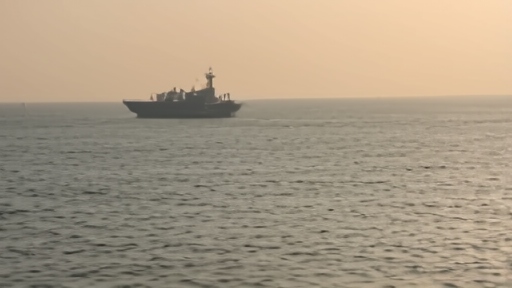
Al Jazeera's Digital Investigative Unit on Thursday published the most detailed public account of what the Hormuz blockade has actually allowed through. The investigation tracks 202 voyages by 185 distinct vessels across the Strait of Hormuz between March 1 and April 15. Seventy-seven of them — 38.5% — were directly or indirectly Iran-linked. Sixty-one of those vessels appear on US, EU, UK or UN sanctions lists. Sixteen carry false flags from landlocked countries: Botswana, San Marino, Madagascar, Guinea, Haiti, Comoros. [1] Even after US enforcement of the blockade took effect on April 13, twenty-five ships crossed the strait in the next forty-eight hours.
The Apr 29 brief on CENTCOM's first search-and-release of a boarded cargo ship named the new mechanism but had no scale; today's investigation supplies the scale and the failure mode. The Apr 29 brief on storage and the tanker fleet as the real blockade clock framed Iran's operational counter-strategy; today the operational counter-strategy is documented at vessel level.
The numbers refute the dominant frame on either side. They refute the administration's "tightening" framing — twenty-five ships in forty-eight hours after enforcement is not tightening. They also refute the Iranian-resistance framing — sixty-one vessels on sanctions lists and sixteen with false flags is not a sustainable shadow fleet, it is a sustained sanctions violation that names operating firms in five jurisdictions. Operating firms by share of voyages: Iran 15.7%, China 13%, Greece 11%, United Arab Emirates 9.7%. The Greek and UAE figures are the surprise. The China figure is not.
One vessel in the Al Jazeera dataset deserves separate attention. The investigation identifies a tanker named "13448" — a numeric designation rather than a name — that carries no IMO number, the standard maritime identifier issued by the International Maritime Organization to commercial vessels above 100 gross tons. [2] An IMO number would normally be the minimum requirement for Suez Canal transit, P&I insurance, or commercial port calls anywhere in the EU. This vessel does not have one. It is too small to require it under the formal rules but, the Al Jazeera investigators document, it has been carrying Iranian-origin crude port-to-port between Iranian ports and unflagged transshipment points in the Gulf since March 14. Its operator filed sanctions-list paperwork in Hong Kong on March 22.
The 13448 is the test case. CENTCOM has the authority under the Apr 13 enforcement order to board and search any vessel transiting Hormuz with credible suspicion of Iranian-origin cargo. The Al Jazeera report puts the 13448's voyages in writing; the question is whether CENTCOM, having boarded and released a cargo ship on Apr 27 (the search-and-release artifact carried by the paper Apr 29), uses the published evidence as a basis for action or treats publication as a separate matter from operational intelligence. The administration has, in past sanctions cycles, made clear that public OSINT is an evidentiary supplement and not a trigger.
The 16-fake-flag list is the part of the report that breaks new policy ground. Botswana — landlocked since independence in 1966 — does not maintain a maritime registry. Neither does San Marino. The use of these flags is not a creative legal strategy; it is straightforward fraud. The Lloyd's List Intelligence database has, for years, tracked false-flag cases; what changes today is that the false flags are now public, named, and tied to specific vessels. Brian O'Toole at the Atlantic Council, asked by reporters about the Iran-linked share, called the published list "the first time the blockade-evasion architecture has been mapped to specific vessels with named operating firms in writing." [3] He did not say what the next step ought to be.
Brent crude opened in London at $124.30 a barrel and printed $126.10 by midday. The eight-day rally extended to nine days. The BBC paired the AJ investigation with the Brent print and made the structural argument: if the blockade is porous-by-design, $126 prices duration risk, not throughput risk. [4] That distinction matters. Throughput risk is a barrel-count problem with a barrel-count solution; duration risk is a months-long problem the global tanker fleet, the IMF program calendar in Pakistan and the four-year-high US gasoline price all sit inside.
Greece's standing in the Operating Firm column is the European political consequence. Greek shipowners — long the world's largest tanker fleet — appear in 11% of the voyages Al Jazeera tracked. The European Commission has, since 2024, treated Greek-flagged vessels carrying Russian oil as an evolving sanctions-implementation problem. The Iran extension of that pattern is now in writing. Whether Athens responds to the published evidence with its own enforcement action — or waits for Brussels to compel one — is the European cliff this report opens. The Greek Ministry of Maritime Affairs did not respond to Al Jazeera's request for comment by deadline.
UAE-operated firms at 9.7% are a separate problem. The Apr 29 paper carried the UAE OPEC exit's silence as the cartel-discipline story; today's data point — that UAE companies operate 9.7% of the documented Hormuz voyages — sits beside that exit. The first asks what UAE producer policy looks like outside OPEC. The second asks what UAE-flagged commercial behavior in Hormuz looks like under the blockade. They are different desks; the answer to one tells the other something.
The blockade has now received its first public vessel-level audit. The audit shows it is not a blockade in the technical sense — a closure of the strait — but an enforcement regime with a 38.5% Iran-linked share continuing to transit. The Apr 30 oil price prices that fact. The CENTCOM mechanism has not yet boarded the vessel that exposed it. Whether the next maritime artifact on this thread is a CENTCOM board, a Greek prosecution, a UAE statement, or a fourth fake-flag designation is the operational question this investigation forces.
-- YOSEF STERN, Jerusalem