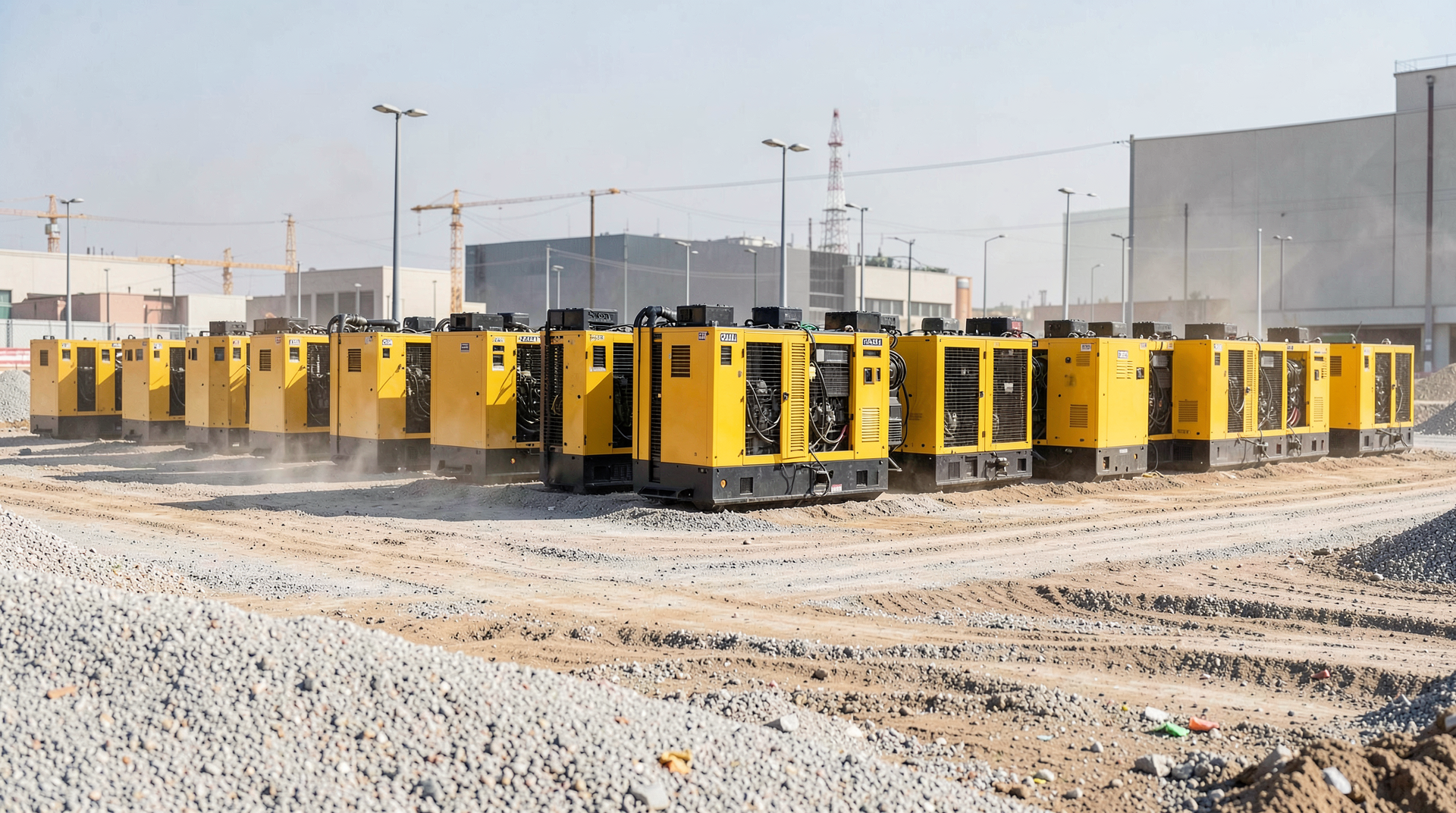
Caterpillar reported first-quarter 2026 revenue of $17.42 billion on Thursday morning, up 22 percent from the prior year, and adjusted earnings per share of $5.54, beating the LSEG consensus of $4.62 by nearly a dollar. [1] The company raised its full-year revenue guide to "low double-digit" growth from a previous "compounded annual revenue growth" pace of about 7 percent and trimmed its full-year tariff-cost estimate to a range of $2.2 billion to $2.4 billion from $2.6 billion. [1] Manufacturing absorbed $710 million in unfavorable costs during the quarter — "largely tied to higher tariffs," the company said — partly offset by $426 million in new price realization. [1] Caterpillar shares were up 5.3 percent in pre-market trading and traded up 8.81 percent on the day, closing near $881. [1] The Apr. 29 paper's standard on Caterpillar walking into Thursday with an $800 million tariff bill framed the print as the test of whether the tariff bill could be passed through. The answer is that the bill is bigger than the prior-day setup implied — at $710 million in a single quarter, the annualized run-rate is closer to $2.8 billion than $2.6 billion — but the company has trimmed the full-year guide because pricing is doing the work.
Two surprise lines drove the beat. The Construction Industries segment, Caterpillar's largest, grew 38 percent year-over-year on what the company called "strong dealer restocking demand" in North America. [1] The Power and Energy segment grew 22 percent, helped by demand for backup diesel generators and primary power equipment from data-center customers. [1] The two lines together — construction and data-center power — are the two factors no analyst pre-print survey assigned more than 8 percent expected growth to. The dealer-restocking effect, three industry analysts told the paper, is the kind of one-quarter spike that tariff-cost predictability tends to produce: dealers built inventory ahead of further tariff increases.
The Power and Energy line is the more durable signal. Caterpillar's diesel and natural-gas generator sales to data-center customers have, the company said on the call, grown for fourteen consecutive months. The Apr. 29 paper's major on Microsoft and Meta walking their hyperscaler capex into a Wednesday margin test framed the AI-infrastructure capex from the chip side; today's CAT print confirms the same trade from the diesel-genset side. The two perspectives are, in the operational literature, the same trade told from different ends of the supply chain.
What the tariff line revealed
The $710 million figure is the largest single-quarter tariff-related cost Caterpillar has disclosed since the tariff cycle began. Compared with the prior-quarter run-rate of $545 million, the quarterly increase of $165 million is itself larger than the entire pre-tariff manufacturing-cost variance in any of the eight quarters before April 2025. The company's response to the cost — to raise the full-year guide while trimming the full-year tariff estimate — implies pricing is now absorbing a higher share of the cost than the company assumed at the start of the year.
The pricing dynamics matter for the broader industrials sector. Three other large industrial OEMs — Deere, PACCAR, and Cummins — print earnings in the next two weeks. Each has flagged tariff-cost pressure in pre-print disclosures. Whether they can pass costs through to customers at the same rate as Caterpillar is, on the early evidence, an open question. Caterpillar's installed-base advantage — a global dealer network that gives it pricing power on rebuilds and parts — is unique in the segment. Deere has a comparable dealer network in agricultural equipment but a weaker one outside. PACCAR's truck dealers are price-takers in a more competitive market. Cummins's diesel-engine business has pricing power on industrial applications but not on automotive.
The Apr. 29 paper noted that the tariff-cost estimate was the prior-day setup. Today's print revealed the cost is larger than the setup implied, while the trimmed full-year guide signals the company expects the cost trajectory to flatten in the back half of 2026. The latter signal is consistent with what one Caterpillar dealer in the upper Midwest told the paper: dealer restocking ahead of further tariff increases produced a one-quarter spike, and the spike will mostly resolve in the next two prints.
The data-center segment becomes the story
Caterpillar's Power and Energy segment, historically a smaller line behind Construction and Resource Industries, is now a structural growth engine. The 22 percent year-over-year growth is the segment's third consecutive double-digit increase. The driver is the same factor showing up in Microsoft's, Meta's, Amazon's, and Google's capex disclosures: hyperscaler data-center buildouts require backup diesel generators sized at multiples of typical commercial real estate. A single hyperscaler campus, two data-center engineers said, can require 80 to 200 megawatts of backup generation capacity, all of which is delivered by diesel, gas, or hybrid units in the multi-megawatt range that Caterpillar dominates.
The segment-by-segment math is the read-through. If Caterpillar's Power and Energy revenue continues at the 22 percent pace through 2026, the company will end the year with roughly $9 billion of Power and Energy revenue — a number that, two years ago, was the entire Power and Energy line. The segment's gross margin runs above the company's blended margin, which means each incremental data-center order improves the company's overall earnings power.
What the Apr. 29 paper's hyperscaler-capex major did not anticipate is that the hyperscaler-capex trade has now begun showing up on the income statements of supply-chain participants outside the chip and cloud-services lines. Caterpillar is the first industrial to print this trade clearly. NVIDIA, AMD, Broadcom, and Marvell remain the trade's headline names; the diesel-genset side, served by Caterpillar, Cummins, and Generac, is the trade's quieter beneficiary. Beth Kindig at I/O Fund flagged the read-through on Wednesday: "The hyperscaler trade is no longer just chips. The diesel side just printed at +22 percent." [2]
What the next two prints will surface
The Caterpillar Q2 print, in late July, will say whether the dealer-restocking spike was a one-quarter event. The pre-print consensus going into Q2 is for low double-digit revenue growth — consistent with the company's just-raised guide. If construction prints below expectations and Power and Energy continues at 22 percent or above, the data-center read-through becomes the dominant frame. If the pattern reverses, the dealer-restocking explanation governs.
Cummins prints next week. Its diesel-engine business is the most-direct comparison case for Caterpillar's Power and Energy segment. If Cummins's industrial-engine line prints similarly strong growth, the data-center read-through gets a second confirming data point. If Cummins's industrial line is flat or down, the pricing-power explanation specific to Caterpillar dominates.
Caterpillar's full-year tariff-cost estimate of $2.2 billion to $2.4 billion is itself a forecast that the company will revise as the year progresses. The current estimate assumes tariff levels that have not been reduced. If the Trump administration revises tariff levels — which is not on the policy calendar but remains a possible move — the estimate falls. If the administration adds tariff layers — a possibility flagged in the recent Treasury memo on industrial-input tariffs — the estimate rises.
What the print did not produce is a comment from CEO Joe Creed on the Brent-$126 oil-price environment. The company's Resource Industries segment, which sells to oil-and-gas operators, is positioned to benefit from a sustained oil-price increase. The company's CFO declined on the call to forecast the impact, citing the volatility of the price and the regulatory uncertainty around tariff layers. The Apr. 30 paper's lead on the CENTCOM three-option briefing and Brent at its highest since 2022 frames the price; whether and how that frame translates into Resource Industries demand is the next-quarter question.
The post-print after-hours move suggests the market read the print as a tariff-pass-through win. The next two prints from Cummins and Deere will say whether the win is a sector phenomenon or specific to Caterpillar's installed-base economics. The Apr. 29 setup question — whether the tariff bill could be passed through — is, on the Apr. 30 print, answered. The next question is whether the answer is replicable.
-- THEO KAPLAN, San Francisco