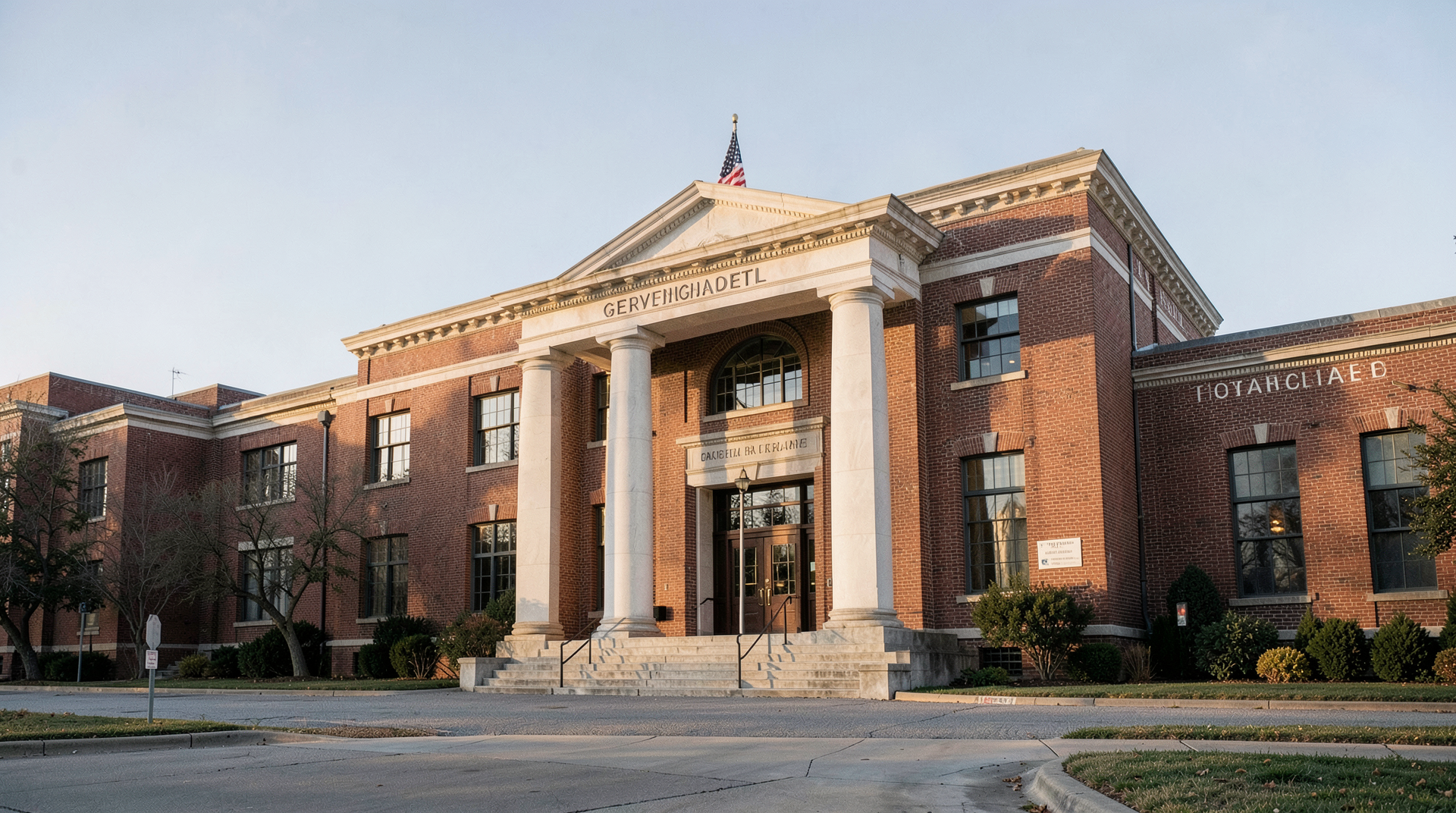
Former FBI director James Comey was indicted Wednesday in the Eastern District of North Carolina on a single count of threatening the life of the president, prosecutors alleging that a 2025 Instagram caption Comey later deleted constituted a call for political violence. [1] Comey surrendered to authorities Thursday morning, posting on Instagram before he did so: "I'm still not afraid. Let's go." [1] Acting Attorney General Todd Blanche said in a brief statement at Main Justice that the case had been investigated "for months," adding, "It's serious when you threaten the president." [2] The same Acting-AG-Blanche office produced two prosecutions on the same Thursday docket: Comey here, Cole Allen at his federal detention hearing in Washington — a convergence the paper's Apr. 29 feature on Cole Allen's detention hearing as the Hilton becoming Blanche's ballroom argument flagged a day before it sat.
The seashell photo at the center of the case was posted to Comey's Instagram account in 2025 as a simple beach scene with the caption "86 47." Prosecutors allege the digits — slang for "remove" or "kill" the 47th president, in their reading — constituted a threat. Comey deleted the post hours later after his communications team, according to two people familiar, advised him the caption could be misread. The Apr. 26 lead on the WHCA dinner shooter charges and Cole Allen's ballroom staircase established the broader Acting-AG-Blanche posture under which today's prosecution sits. Today's filing is the second time Comey has been charged by this Justice Department; the first, on a separate set of charges, collapsed in December 2025 after a federal judge ruled the prosecution had failed to show predicate.
Comey's defense lawyer, Patrick Fitzgerald, called the indictment "a vindictive prosecution that will not survive a motion to dismiss." [3] Fitzgerald told reporters outside the federal building in Greenville that the defense intends to file the motion within thirty days, well inside the typical scheduling window. He declined to specify whether the motion would invoke selective prosecution, vindictive prosecution, or both. Legal observers tracking the docket said the defense's preference is the vindictive-prosecution route because Trump's own statements about Comey — including a Truth Social post on Tuesday calling the former FBI director "a tremendous danger to our country" — supply the textbook predicate.
What is unusual about this prosecution is the right's reaction to it. Cato Institute's senior fellow on criminal justice, Clark Neily, called the indictment "the lowest-energy lawfare we have seen from this DOJ" in a Wednesday-night statement; Eli Lake at the Free Press, writing under the headline "Already Backfiring," argued that "if the goal is to deter speech the president dislikes, the prosecution will succeed; if the goal is to win, this is a curl into a rounding error." [4] Their framing matches the legal-Twitter consensus on the procedural left — Andrew Weissmann, Joyce Vance, Norm Eisen, and Renato Mariotti all flagged the First Amendment exposure as "unusually clean," in Vance's phrasing. [5] The convergence — Trump-skeptical right, procedural left, both calling the case weak — is the divergence MSM coverage has not fully metabolized.
What the indictment alleges
The eight-page indictment, unsealed at 9 a.m. Wednesday in the Eastern District of North Carolina, charges a single count under 18 U.S.C. § 871 — threatening the President of the United States. The statute requires the government to prove the defendant made a "true threat," a constitutional standard the Supreme Court tightened in 2023's Counterman v. Colorado. The prosecution's theory, according to the indictment text, is that "the digits 86 47, posted in close visual proximity to a beach scene of seashells arranged in the shape of a numeral, constituted a public call for the killing of the 47th President of the United States, communicated knowingly and recklessly within the meaning of Counterman."
That last phrase — "knowingly and recklessly" — is the Counterman language. The Supreme Court ruled in 2023 that a true-threat conviction requires the government to show the defendant had a subjective awareness that the recipient could perceive the speech as a serious threat of violence. Whether Comey's caption clears that bar is, the legal academics agree, a hard prosecution case to make. The seashells in the photo, several Twitter sleuths noted, were arranged not as the digits 86 47 but as a wider, ambiguous scatter, with the digits appearing only in the caption.
Acting AG Blanche took the unusual step of holding a brief press availability at Main Justice on Thursday morning. He read a one-paragraph statement and took no questions. [2] The brevity is itself a signal: previous Comey prosecutions under this DOJ produced lengthy press conferences with exhibits. The Eastern District of North Carolina U.S. attorney, J. Cabell Robins — confirmed by the Senate in February over Democratic objections — was visible behind Blanche but did not speak.
The case is assigned
The case has been docketed before U.S. District Judge Louise Flanagan in the Eastern District. Flanagan, a 2003 George W. Bush appointee with a moderate record on First Amendment cases, is not on the Federalist Society's preferred-list for high-profile administration prosecutions. The Apr. 25 paper noted in its DOJ-drops-Powell-probe major that the prosecutorial pattern was likely to continue; today's case is the artifact, but the judge assigned is not the kind of judge the prosecution would have preferred. Court records show Flanagan as the random-draw assignment.
The defense's path is, in legal terms, multilayered. A motion to dismiss on First Amendment grounds is the first move. If Flanagan denies, the defense will file a motion for a bill of particulars demanding the government identify the specific words that constitute the threat. If the government's bill names the digits "86 47," the defense moves to dismiss on vagueness — a viable challenge given the digits' multiple plausible meanings (in restaurant slang, "86" simply means "out of stock" or "remove from the menu"; in numerology, the combination has no single referent). If the government instead names the seashells' arrangement, the defense moves on insufficiency of evidence — the photo itself does not show the digits formed by shells.
The defense, several lawyers tracking the case said, has more procedural arrows than the prosecution has rebuttals. The prosecution's strongest move is to take the indictment to a jury fast, before the defense can stack motions. But the procedural calendar in the Eastern District of North Carolina, the lawyers said, runs slow.
The Allen-Comey docket convergence
Cole Allen's federal detention hearing in the District of Columbia is scheduled for 2 p.m. Thursday in front of Magistrate Judge Robin Meriweather. Allen is the man charged with the WHCA dinner shooting at the Washington Hilton on April 25; the Apr. 29 feature flagged this hearing as Acting AG Blanche's first courtroom test of the ballroom-as-the-Trump-target frame. Today, with Comey's indictment dropping in EDNC at 9 a.m. and Allen's detention hearing at 2 p.m., the two prosecutions sit on the same broadcast cycle by design.
The convergence is the divergence the paper's war-authorization-legitimacy thread has been tracking. MSM frames each as a discrete prosecution. X — particularly Aaron Rupar, JoyceVance, and Acyn — pairs them as a single Acting-AG-Blanche consolidation moment. The paper's view, taken in April 25's DOJ-Powell-probe collapse and the April 26 lead, is that the consolidation is the position the next prosecution will sit on top of. Today's two prosecutions, taken together, sit on top of last week's collapse.
What that pattern produces is a docket designed for political broadcast and legally weak in front of a federal judge. The Comey case may not survive a motion to dismiss. The Allen case will go to trial regardless of detention's outcome. The two prosecutions, taken together, are the warning shot — they tell every other former senior official whose Instagram contains a snarky caption from 2024 or 2025 that Main Justice is reading.
What the next thirty days will produce
Comey's defense will file a motion to dismiss within thirty days. The motion will likely argue Counterman-failure on First Amendment grounds and selective-prosecution-failure on vindictive grounds. Trump's own Truth Social statements about Comey, archived going back to 2017, will be appended as exhibits. Whether the prosecution can keep the case alive past the motion-to-dismiss stage will depend, the legal academics said, on whether Flanagan accepts the prosecution's Counterman framing. If she does not, the case dies in EDNC. If she does, it goes to a jury — and a jury verdict in a case the Trump-skeptical right has called vindictive would be the first post-Counterman test of the standard for a sitting administration.
The Cato statement, by Cato's Clark Neily, framed the situation in unsentimental terms. "The administration has the right to prosecute. It also has the obligation not to lose. This indictment will lose, and the next prosecution will be weaker because of it." [4] That framing — that the cost of a weak indictment is the next indictment — is the one the paper's war-authorization-legitimacy thread will track into Friday.
Comey himself, in the brief Instagram post that preceded his Thursday surrender, did not address the legal merits. "I'm still not afraid," he wrote. "Let's go." [1] The Wednesday post was up for thirteen hours before he turned himself in.
-- SAMUEL CRANE, Washington