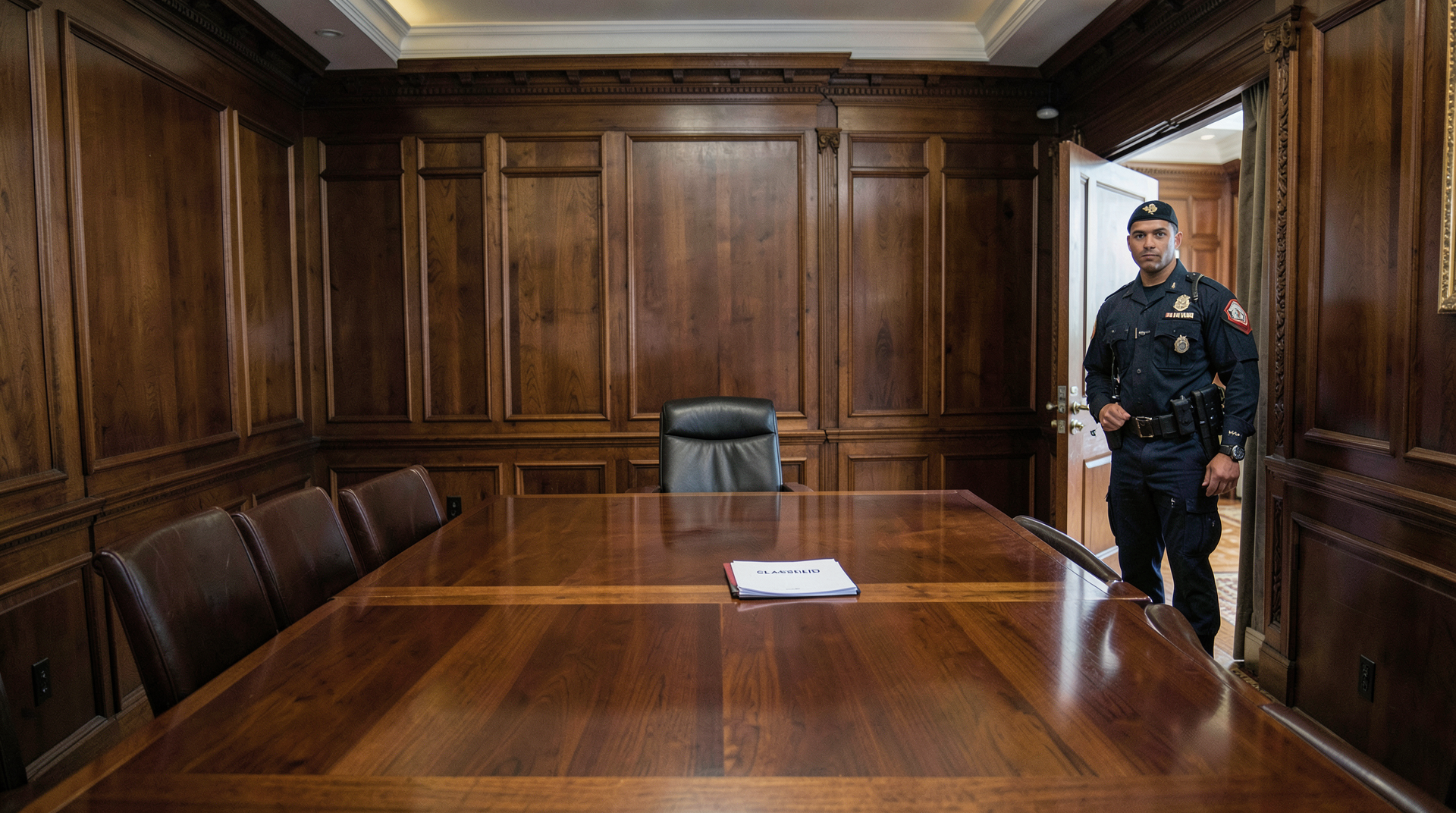
Adm. Brad Cooper, commander of U.S. Central Command, and Gen. Dan Caine, Chairman of the Joint Chiefs of Staff, walked into the Oval Office at 2:00 p.m. Eastern on Thursday, May 1, with a binder containing three options and a recommendation. The binder went onto the Resolute desk; the recommendation, per Axios's Thursday-evening scoop and Times of Israel's matching account, was for the option Cooper's team had been refining since the Apr 7 ceasefire collapsed back into a blockade. [1] [2] The President listened for forty-five minutes, asked questions, did not sign an order, and excused his commanders. Saturday, May 2, is Day 1 of the response window the briefing implicitly opened.
The three options, as MSM reporting has converged on them, are these: a "short and powerful" wave of strikes against Iranian electricity, oil-refining, and water infrastructure intended to produce regime-pressure within days; a special-forces operation to seize Iran's highly enriched uranium stockpile from Fordow and Natanz, which would carry casualty risk and a sovereign-soil escalation problem; and an expanded U.S. control of the Strait of Hormuz that would convert the present de facto blockade into a declared one with carrier-strike-group enforcement. [3] The first option is what Cooper recommended. The second is what Pentagon civilians, including Defense Secretary Pete Hegseth, are reported to favor as the cleanest single-stroke solution. The third is the option that requires no presidential signature because it is, in operational terms, where the U.S. Navy already is.
Caine's attendance is the signal. The Chairman of the Joint Chiefs is the President's principal military adviser by statute; he does not attend an option-set briefing unless the option set has narrowed for a decision. War-gaming sessions are run at the J-3 directorate; option-narrowing sessions move up to the Tank, in the Pentagon basement; presidential decision sessions move to the Oval Office and require the Chairman. [4] Thursday's session was the third stage. The President's failure to sign on Thursday afternoon does not unmake the third stage. It defers the decision into a weekend whose other events — Friday's War Powers letter declaring hostilities terminated, Iran's three-register Friday answer, the OPEC+ ministerial Sunday — frame the choice without making it.
What the strike menu cannot do is obvious from its own architecture. A "short and powerful" infrastructure strike against Iranian electricity, refining, and water is, under Geneva Convention IV and the 1977 Additional Protocol, a presumptive war crime. CNN's April 7 legal-affairs piece walked through the framework: civilian objects indispensable to the survival of the civilian population are protected from attack absent specific military-objective justification. [5] State Department legal-adviser opinions have, since 1991, treated electric-power generation as the marginal case — strikable when it directly supports an integrated military command-and-control function, not strikable when it sustains hospitals, water-pumping, and food refrigeration. The Cooper plan, as the Axios reporting describes it, does not distinguish between the two functions because Iran's grid does not. The plan assumes that the legal designation is no longer politically operative. The President's Friday letter, declaring the war over, makes the assumption look prescient.
The special-forces option carries its own architecture. Iran's HEU stockpile is dispersed across at least three sites — Fordow, Natanz, and a third location whose identity remains classified — and the Fordow facility is buried beneath approximately ninety meters of rock that the Massive Ordnance Penetrator was designed to defeat. A ground operation would require helicopter insertion into Iranian airspace, defeat of the perimeter security at Fordow's exterior, vertical penetration of the underground structure, removal of approximately 150-200 kilograms of weapons-grade material in shielded containment, and helicopter exfiltration. [6] The Times of Israel report identified the operation's planning lead as the Joint Special Operations Command's Task Force Black, the same unit responsible for the bin Laden raid. The historical comparison is misleading: the bin Laden compound had no air defenses, no missile-response capacity, and no national mobilization. Iran has all three.
The third option — expanded U.S. control of Hormuz — is the option that does not require a Thursday briefing because it is, materially, what the Navy is already doing. The blockade has turned back forty-five commercial vessels. CENTCOM's published guidance still names the strait a closed area for civilian transit. [7] What "expanded control" would add is the conversion of de facto enforcement into a declared maritime exclusion zone — a move that would require a Notice to Mariners, a UN Security Council notification, and a Security Council session that Russia and China would veto inside an hour. The notification would be the first formal U.S. declaration of a maritime blockade against a state since the 1962 Cuban Missile Crisis. The legal classification matters because, under customary international law, a declared blockade is an act of war. The President's Friday letter says the war is over. A Saturday declaration of a maritime blockade would be, on its face, the first contradiction the doctrine produces.
Iran's Friday answer was calibrated, not panicked. Mojtaba Khamenei's National Persian Gulf Day written statement declared "the bright future of the Persian Gulf will be a future without the U.S. presence" and named "nuclear and missile capabilities" as national assets. [8] President Masoud Pezeshkian reserved what state media translated as the right to "extension of military operations." Brig. Gen. Amir Ali Hajizadeh, commander of the IRGC Aerospace Force, warned of a response that would be "painful, prolonged" without specifying a tripwire. The three registers are layered. Mojtaba's written maximalism establishes the regime's outermost negotiating posture. Pezeshkian's "extension" language preserves the blockade as a de-escalation lever Iran can offer. Hajizadeh's vagueness leaves the strike option open without committing to its trigger. The architecture is professional. It does not read like a regime that is about to be surprised.
Pakistan's mediation is the channel through which Saturday could move differently. A proposal forwarded via Islamabad reached the U.S. team late Thursday; Trump told reporters at Joint Base Andrews on Friday that Iran "wants to make a deal, I'm not satisfied with it, so we'll see what happens." [9] The Pakistani channel is real diplomacy with a real intermediary; Foreign Minister Ishaq Dar has run six rounds of shuttle communication since April 14. What the proposal contains has not been published. Iranian sources have told Al Jazeera it includes a 90-day inspector-readmission window in exchange for sanctions-listing pause and a Hormuz reopening sequence. [10] U.S. sources have characterized the proposal as "below the floor" Trump set on April 28 — that floor being public dismantlement of the Fordow centrifuges, not just inspector access. The gap is not bridgeable inside the weekend. It may be bridgeable inside the month.
The OPEC+ ministerial Sunday is the second instrument of the same calculation. The UAE's exit from OPEC took effect at midnight May 1; Saudi Arabia's first response, dismissive on Friday, will face the test of a public meeting Sunday afternoon. [11] If the cartel produces no production increase, the war premium continues to anchor Brent above $108. If the cartel produces a Saudi-led 100-200 kbpd increase, the price relief is symbolic but the cartel-discipline reading hardens. If the cartel produces a meaningful increase — 500 kbpd or more — the financial pressure on Iran's oil revenue cliff increases sharply. The Cooper menu is, in part, an instrument calibrated against what Sunday produces. A strike order on a price-falling weekend is a different communication than a strike order on a price-rising weekend.
What the Pentagon Minab silence — now in Day Five after Defense Secretary Hegseth's April 30 Senate testimony confronted civilian-casualty questions about the war's first-day Tomahawk strike on a girls' elementary school — adds to Saturday's calculation is the documentation that the strike menu Cooper presented does not include a civilian-protection clause that Pentagon planners are publicly comfortable defending. [12] Five former officials, including a senior military lawyer, broke the silence on Friday to say the targeting that produced the Minab deaths used outdated DIA imagery. If a "short and powerful" infrastructure strike were to produce a similar civilian-death event, the second-order political cost — including from Sen. Collins, who crossed for the first time on Friday's war-powers vote — would be material.
The administration's ideal weekend is a quiet one. No strike order, no proposal acceptance, no OPEC+ surprise; the Friday letter ages into the public record as the new normal; the blockade continues; the price stabilizes; Berkshire's annual meeting and the Kentucky Derby fill Saturday's news cycle and absorb the attention the strike menu would otherwise dominate. The Saturday the Pentagon prepared for is the Saturday in which Cooper's plan stays on the desk. Day 1 of the response window is most usefully understood as the first day of a window the President can extend by not closing it.
The window closes when something forces it. A second Iranian missile salvo on a Gulf U.S. installation; a Houthi anti-ship strike that lands; a Pakistan-relayed proposal collapse; an OPEC+ production cut that snaps Brent through $115. None of those events are on Saturday's calendar. None of them are off it.
-- YOSEF STERN, Jerusalem