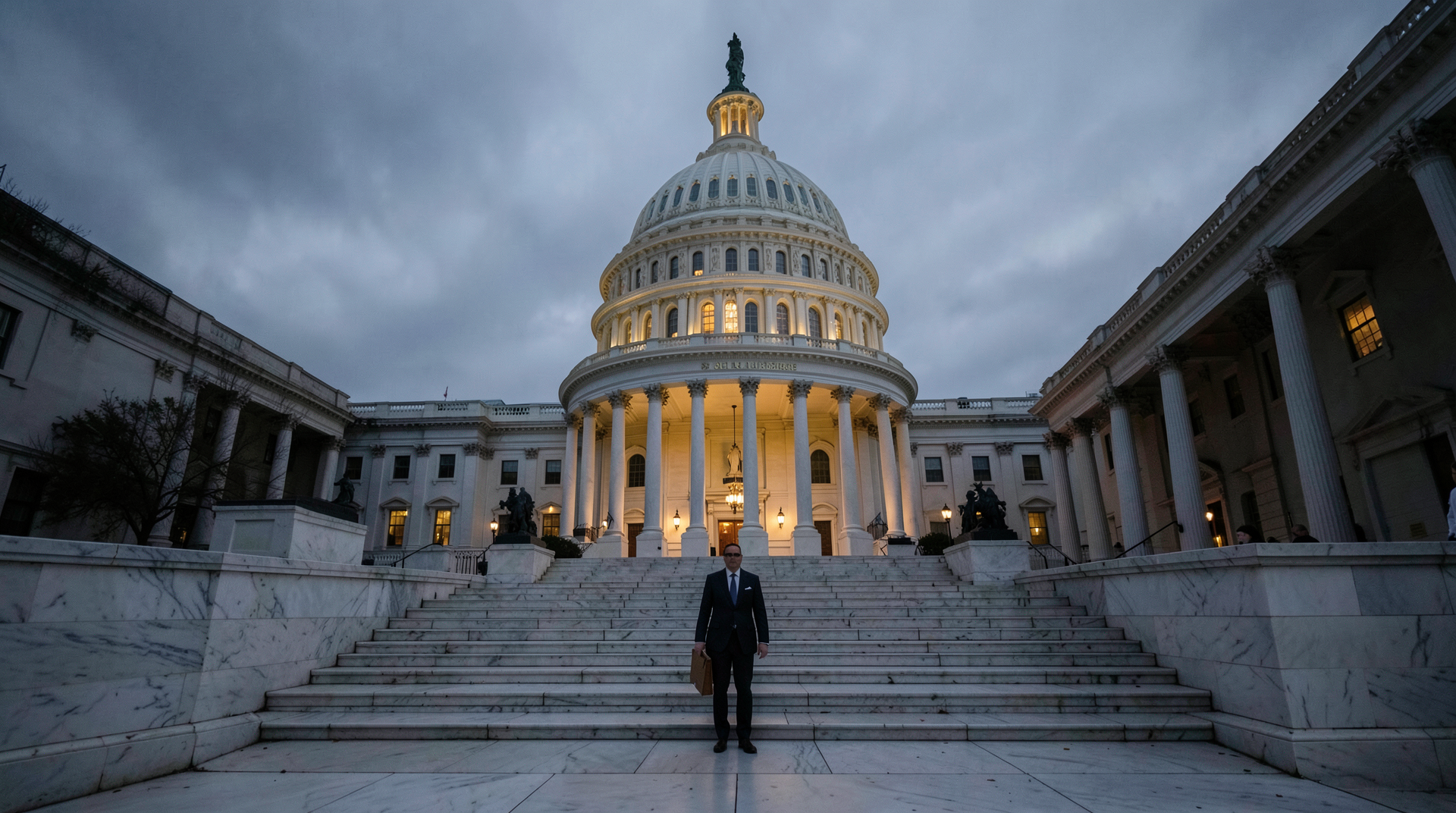
The letter went up to the Hill on Friday afternoon, May 1, while a Navy destroyer was turning back its forty-fifth commercial vessel at the Strait of Hormuz and a CENTCOM strike menu sat on the Resolute desk. Addressed to Speaker Mike Johnson and President Pro Tempore Charles Grassley, four pages, signed by the President, it informed Congress that "the hostilities that began on February 28, 2026 have terminated." [1] The April 7 ceasefire, the letter argued, paused the sixty-day clock written into Section 1544(b) of the 1973 War Powers Resolution rather than allowing it to run out. The clock, on the administration's reading, had simply gone away.
The Senate had answered three hours earlier. A sixth war-powers resolution requiring withdrawal failed 47-50, with Sen. Susan Collins (R-Maine) crossing for the first time in the war and Sen. Rand Paul (R-Ky.) holding his prior position. [2] No floor schedule was posted for a seventh attempt. The Capitol emptied for the weekend; the President signed the letter; Brent crude, which had touched $114.66 a barrel on April 30, settled at $108.10 on the day's tape. [3] The Pentagon announced separately that 5,000 troops would leave Germany over the next year — the second statutory floor the same administration walked through on the same Friday. [4] The paper's account of Day 60 on Friday morning called the deadline "a void, not a contested precedent." Friday afternoon turned the void into a doctrine.
The doctrine, examined alongside four other moves the same regime made in seven days, has a shape. The War Powers Resolution is a binding statute. So is Section 1233 of the National Defense Authorization Act, which prohibits a permanent reduction of U.S. forces in Europe below a 75,000-troop floor without a Pentagon impact report. So is Section 2 of the Voting Rights Act, which the Justice Department is now positioning to read in Louisiana v. Callais as requiring proof of discriminatory intent rather than effect. So is the Federal Vacancies Reform Act, under which Acting Attorney General Todd Blanche has now run the Department of Justice for thirty days with no permanent nominee on the calendar. So is the appointments-clause architecture the White House cited under Arthrex when it terminated all twenty-two members of the National Science Board on April 24. [5] Five binding statutes, recharacterized within one week as administrative inconveniences. Friday's letter is the keystone.
John Bellinger III, who served as legal adviser at the State Department under George W. Bush, told Al Jazeera on Friday that the administration's reading of the ceasefire as a clock-pause "stretches the statute past the point where the words still hold." [1] A naval blockade, he said, is on its plain reading a continuing hostile act under both U.S. and customary international law; it is not a state of peace inside which a sixty-day clock can be paused. The administration's letter does not engage that point. It cites the April 7 ceasefire as evidence that hostilities ended, then describes — in the classified attachment that accompanied the letter — what Roll Call's reporting characterized as ongoing force-posture adjustments. [2] The unclassified document told Congress the war was over. The classified document told Congress the war's logistics tail was being reshuffled. The contradiction lives inside the same envelope.
What the letter accomplishes politically is more legible than what it accomplishes legally. Gas at the pump averaged $4.39 a gallon across the country on May 1, per the daily blockade ticker Fox News has been running on its energy desk. [6] Republican governors heading into a cycle that includes nine 2026 gubernatorial contests have asked the White House for "something we can quote." The letter is something they can quote. It says the war is over, on White House letterhead, addressed to the Speaker. It tells voters in Florida and Georgia and Pennsylvania that the price at the pump is a residual market pricing-in, not a continuing operation. The blockade itself is unchanged. CENTCOM's published guidance still names Hormuz as a closed area for commercial transit. Adm. Brad Cooper, the CENTCOM commander, briefed Trump on Thursday in the Oval Office on what Axios first reported as a "short and powerful" wave of strikes against Iranian electricity, refining, and water infrastructure, plus a special-forces option to seize Iran's highly enriched uranium stockpile and a third option to expand U.S. control of the strait. [7] Gen. Dan Caine, the Joint Chiefs Chairman, attended. Caine does not attend an option-set briefing unless the option set has narrowed for a decision.
Iran answered Friday in three registers, none of them de-escalatory. Mojtaba Khamenei, who succeeded his father as Supreme Leader on March 12, issued a written statement on the regime's National Persian Gulf Day calendar declaring "the bright future of the Persian Gulf will be a future without the U.S. presence" and naming "nuclear and missile capabilities" as national assets. [8] President Masoud Pezeshkian, in a parallel statement, reserved what state media translated as the right to "extension of military operations." A proposal forwarded by Pakistan reached the U.S. team late Thursday; Trump told reporters at Joint Base Andrews on Friday that Iran "wants to make a deal, I'm not satisfied with it, so we'll see what happens." [9] The Pakistani relay is real diplomacy with a real channel. The blockade is real coercion with real ships. The CENTCOM menu is real planning with real targets. The "termination" letter is a piece of paper.
Sen. Collins's vote to defeat the war-powers resolution is the most legible single piece of new information in the day's tape. She had voted for every prior version, including the April 17 attempt that lost 48-49. Her statement Friday named the ceasefire as the change of fact: a vote to compel withdrawal from a war the President's letter said was over would, she argued, "second-guess a peace I cannot in good conscience disturb." It is a defensible reading of the statute on its face. It is also a reading available only because the President's letter exists. The letter created the political room into which Collins could move. The Senate's rejection, in turn, supplied the institutional cover the letter needed: a body that could have reasserted the clock declined to. The two acts produced each other.
Rep. Thomas Massie (R-Ky.), whose constitutional-skeptic posture has been the right's clearest internal critique of the war, posted on X within forty minutes of the letter's release: "You cannot terminate hostilities by letter while you are running a blockade and reading a strike menu." [10] Rep. Pramila Jayapal (D-Wash.) called the letter "the legal architecture of indefinite war" on the House floor before adjournment. Sen. Tim Kaine (D-Va.), who has authored every Iran war-powers resolution since February, told reporters his seventh attempt would land Tuesday. The Senate calendar does not currently accommodate a Tuesday floor vote; the seventh resolution will, on present scheduling, sit in committee.
The four other statutory moves are the context. The Pentagon's 5,000-troop withdrawal from Germany, announced by spokesperson Sean Parnell on Friday "in recognition of theater requirements," takes the U.S. presence below the 75,000 floor written into NDAA Section 1233 unless the impact report Congress required has been quietly filed and not released. [4] The House Armed Services Committee minority, led by Rep. Adam Smith (D-Wash.), said in a statement Friday afternoon that no impact report had been transmitted and that the announced reduction "appears on its face to violate the statute." The Justice Department's "we are ON IT" tweet on May 1, which followed the Supreme Court's April 29 decision in Louisiana v. Callais requiring intent-based showings under VRA Section 2, signaled a nationwide redistricting push to be completed before the June filing deadlines for the November midterms. [11] Acting AG Blanche, whom Trump replaced Bondi with on April 2, has now publicly stated he is open to permanent service while the 210-day Vacancies Reform Act clock continues to run. [12] And the National Science Board firings, which the White House grounded in the Arthrex doctrine, draw what Duke Law's Jeff Powell described in Nature on May 1 as "an incoherent rationale": Arthrex's remedy is to make principal officers removable by the President, but NSB members were already removable, and the firings did not address the appointments problem the citation invoked. [13]
The five moves share a method. None of them violates the statute openly. Each of them reinterprets the statute in a way that, if accepted, drains the statute of force without producing a citable rule of repeal. The first-term posture confronted statutes head-on; courts pushed back; defeats accumulated as defeats. The second-term posture treats statutes as malleable text whose effective meaning is settled by the executive branch's reading until a court — or a Congress — produces a contrary reading with teeth. Friday's letter is the cleanest single example. It does not declare the War Powers Resolution unconstitutional. It does not refuse to send the report. It sends the report and tells Congress, in the report's first paragraph, that the report is moot because the war is over. The Senate's 47-50 vote three hours earlier was the predicate; the letter was the closure.
The financial system priced the move, partially. Brent gave back two percent on Friday after the proposal-via-Pakistan headline crossed; the curve remains in deep backwardation, prompt month above $112 and December below $94, which is the shape of a market pricing a discrete-time end to a war it does not believe is over. [14] The S&P 500 closed at a record 7,230.12. Apple led the index higher on a $100 billion buyback authorization that abandoned its long-standing net-cash-neutral target. The market's position is that the letter means something. The Pentagon's position, as expressed by the Caine attendance Thursday and the unmoved CENTCOM blockade orders Friday, is that the letter means nothing. Both positions cannot be right past the weekend.
Saturday is Day 1 of the response window the Cooper-Caine briefing implicitly opened. The President's options sit on the desk: an infrastructure strike against Iranian electricity, refining, and water targets that Geneva Convention IV and the 1977 Additional Protocol would, on the State Department's own legal-adviser opinions, characterize as prima facie war crimes; a special-forces operation against the Fordow and Natanz uranium stockpiles that would carry casualty risk inside an Iranian sovereign-soil context; or an expansion of U.S. control over Hormuz that would convert the present de facto blockade into a declared one. The letter announcing the war's termination does not foreclose any of those options. It simply removes the legal frame within which they would have to be authorized. The administration's position is that the frame, after Friday, is no longer required.
The structural test of the doctrine arrives in two pieces. The first is what the Pentagon does with the option set this weekend. If a strike order moves, the "termination" letter becomes a document Congress will be asked to read against an action it explicitly disclaims. If no strike order moves, the letter becomes the operational reality: a blockade run from Bahrain by ships acting under standing rules of engagement that Congress, having declined to vote, has implicitly funded. The second piece is what the Senate does with Sen. Kaine's seventh resolution. A 47-50 vote with Collins's defection is one rejection; a 46-51 vote next week with another Republican crossing — Murkowski has been the watch — would harden the rejection-as-policy reading. A 48-49 vote with no further crossings would suggest the letter changed nothing.
What the letter has already changed is the public record. As of 4:17 p.m. Eastern on May 1, the United States is — by the President's own filing — not at war with Iran. The Navy destroyers in the Gulf of Oman, the F-35s on Bahrain ramps, the carrier strike group repositioning south of Diego Garcia, and the CENTCOM operations cell that Cooper and Caine briefed Thursday are all, by the same filing, performing a peacetime posture. The blockade is, by the same filing, not a hostile act. The strike menu is, by the same filing, contingency planning of a kind every administration prepares.
This is the doctrine the paper has been describing across editions in five different contexts. On Friday it acquired its keystone instance. The deadlines are optional now because the statutes that wrote them have been read, by the executive branch, as not binding the executive branch. The reading has not been tested by a court. It has not been rejected by a Congress. Until one of those things happens, the reading is the law.
Sunday brings the OPEC+ ministerial that will publicly answer the UAE's midnight exit from the cartel; Tuesday brings Comey's first motion to dismiss; May 11 brings Cole Allen's preliminary hearing and a possible superseding indictment naming the President as the attempted victim; May 14 brings Trump and Xi in Stockholm. None of those events alter the document Trump signed Friday. The document declared a war over. The war is the test of whether declarations of that kind, in this regime, suffice.
-- SAMUEL CRANE, Washington