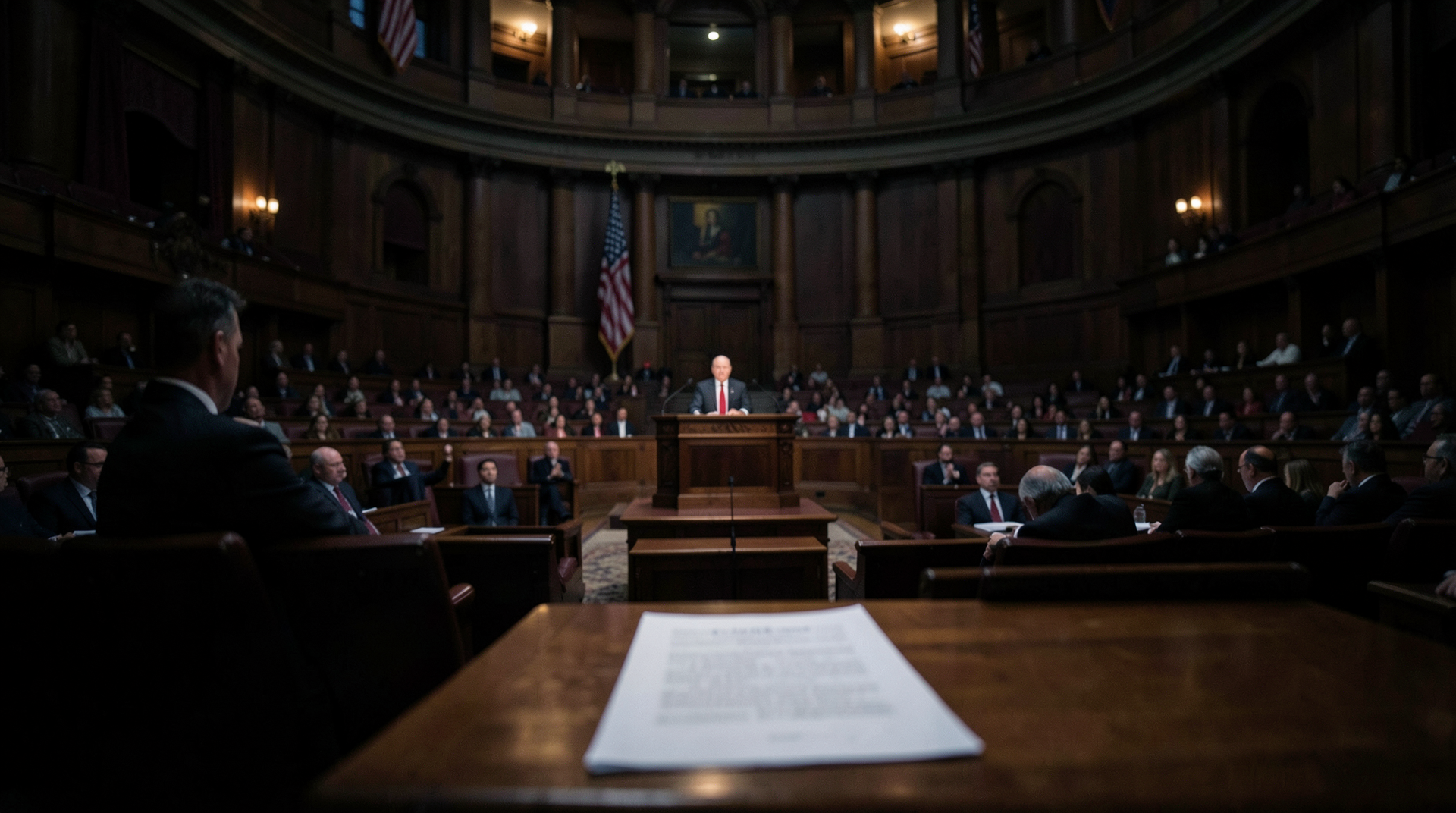
The 1973 War Powers Resolution gives a president sixty days to obtain congressional authorization for an armed conflict he has begun without one. Today is day sixty of the U.S. war on Iran. The Senate adjourned Thursday without taking up authorization, after rejecting the sixth war-powers resolution of the war on a 51-47 tally with only Susan Collins and Rand Paul defecting from the Republican caucus. [1] The administration has argued for the past forty-eight hours that the ceasefire announced in late February — and broken at least twice since — has paused the statutory clock. Defense Secretary Pete Hegseth advanced that theory under oath at the Senate Armed Services Committee on Thursday. [2] Senator Tim Kaine, who has authored five of the six failed resolutions, told reporters Hegseth's argument was "a very novel argument that I've never heard before" and "certainly has no legal support." [3]
Day sixty falls and Washington has decided the deadline does not exist.
The paper's Apr. 29 account of the sixth war-powers vote read the 51-47 roll call as the first formal congressional war-powers vote of the war recorded as a rejection. The reading from a day later was that rejection-as-policy was producing dockets, indictments, and a CENTCOM option set on a single broadcast. The reading from today is more concrete and more diminished. The statute has reached its first hard numerical deadline since the war began. The deadline is being treated as void by the executive, dismissed as inoperative by the Republican Senate majority, and read by even sympathetic conservative lawyers as already lost. The category move that matters is not constitutional — the courts will not get there in any timeframe that matters — but documentary. From this morning forward, the 1973 statute is no longer a contested precedent. It is a dead letter in the eyes of the only branch with the votes to enforce it.
The administration's procedural posture has been consistent. The White House notified Congress of the original strikes within the 48-hour window the statute requires. It has not asked for an authorization for the use of military force. It has not produced a withdrawal certification under Section 5(b). It did not contest the Senate's resolution Thursday on the merits — Majority Leader John Thune simply allowed the vote to come up and let it die on a partisan tally with two GOP defections. Hegseth's testimony added a new layer: the ceasefire announced February 26 by President Trump and broken on at least two documented occasions has, in the Pentagon's reading, suspended the 60-day clock until hostilities formally resume. [4] The Federalist Society's own published commentary called the theory "creative" and "without statutory anchor." Kaine, on the floor Thursday afternoon, called the resolution a "paper tiger" and said the executive branch had decided it could "decide on its own when wars begin and end." [3]
CENTCOM Commander Adm. Brad Cooper and Joint Chiefs Chair Gen. Dan Caine returned to the Oval Office Friday with a refined infrastructure-strike plan, narrowed from the three options the paper described yesterday. Two officials briefed on the Friday return said Trump asked Cooper Wednesday to thin the menu down to its smallest "short-and-powerful" variant. [7] The military and the legal arguments are now synchronized — the same week the Pentagon says the 60-day clock has stopped, the Pentagon also delivers the operational expression of an unbounded mandate. Brent crude opened the day at $124, a hair below Wednesday's four-year high.
Iran answered in three registers overnight. Tehran's air defenses activated against small reconnaissance drones around 3:40 a.m. local time, per Tasnim and Fars; impact was reported in Pasdaran district, casualties unclear. Mojtaba Khamenei, who succeeded his father as supreme leader after the February 28 strike on the elder Khamenei, issued his second written statement since taking office, with the line "no place for them except at the bottom of its waters" referring to U.S. naval presence in the Gulf. [5] The statement defended Iran's nuclear capabilities and rejected reparations talks. President Masoud Pezeshkian, who has occupied the more conciliatory register in the Iranian leadership the past month, abandoned it on Thursday, calling the Hormuz blockade "an extension of military operations" and adding that "the Islamic Republic does not negotiate under bombs." IRGC Aerospace Commander Hossein Salami, in a televised remark Thursday evening, warned of "a painful, prolonged response."
There is no precedent for what a paused 60-day clock looks like. The Vietnam-era authors of the resolution wrote it precisely to prevent the executive from arguing that any operational pause restarts the calendar. Senator Jacob Javits, in the 1973 floor debate, said the clock was meant to be "self-executing on its own dates, not on the executive's." Congressional Research Service analyses produced through every reauthorization cycle since have read the statute to mean that ceasefire pauses do not toll the clock unless certified to Congress under Section 5(b). [6] The Pentagon has not produced such a certification. Senator Roger Wicker, the Armed Services chair, declined to ask Hegseth for one Thursday. Asked by Senator Jack Reed whether the administration had any document beyond Hegseth's verbal claim that the clock was paused, the witness paused, then said: "We are operating under the President's authority as Commander-in-Chief and the 2001 AUMF where applicable."
The 2001 AUMF — the Authorization for Use of Military Force passed three days after the September 11 attacks against "those nations, organizations, or persons" responsible — has been stretched fifteen times across four administrations to cover operations its drafters did not anticipate. Iran is not named in it. Iran is not, on any plausible reading, an "associated force" of al-Qaeda. Senator Reed, a 2001 vote in favor, told reporters Thursday: "I voted for that authorization. I know what it covers. It does not cover this." Senator Wicker did not pursue the question.
The roll call Thursday is the structural data point. Collins and Paul have now broken with their party on every war-powers vote since the war began. Senator Lisa Murkowski, who voted yes on the second resolution in March, has voted no on the four since. Senator Mitch McConnell, who in April said publicly that "the constitutional question on this war is unsettled," voted no Thursday without speaking on the floor. The Republican caucus discipline has tightened, not loosened, as the deadline has approached. The Democratic caucus held its 47, including Jon Tester and John Fetterman, both of whom had voted no on prior resolutions; Fetterman's office declined to explain the reversal. Senate Foreign Relations Chair James Risch, who briefly entertained a bipartisan AUMF draft in April, told the Free Press Thursday evening: "There is no appetite. None. Not on either side. The question is moot."
A statute being moot when its first hard deadline arrives is not the same as a statute being unconstitutional. The courts have, since the 1973 passage, declined to adjudicate war-powers disputes between the political branches under the political-question doctrine. The D.C. Circuit's 1990 ruling in Dellums v. Bush, the most-cited case, said congressional plaintiffs lacked standing absent a formal congressional vote authorizing or condemning the action. The Senate's six rejections do not, the friendly-right Cato brief argues, qualify as that vote — they are votes against authorization, not votes for it. The vehicle Kaine has not yet introduced — a resolution stating that the war is unauthorized and the President must withdraw forces under Section 5(b) — would be the closest the Senate has come to producing a justiciable record. He told reporters Thursday he is drafting it. He did not say when he would file it.
Acting Attorney General Todd Blanche signed two prosecutions on the same Thursday docket the Senate killed the resolution on. The paper's Apr. 30 account of the second Comey indictment read the EDNC seashell-photo indictment as the second prosecution Blanche signed inside one news cycle. The Friday filing the lead carries through is more pedestrian and more revealing: the Department of Justice declined Thursday to take a position on whether the War Powers Resolution constrains the President. The Office of Legal Counsel memo Hegseth cited at the Senate hearing — the legal foundation for the ceasefire-pauses-the-clock argument — has not been published. Senator Sheldon Whitehouse asked for it Thursday and Hegseth did not commit. Without the OLC memo on the public record, the legal theory is a verbal claim by a Cabinet officer, repeated by his department, without documentary support.
A statute the executive ignores, the legislature lets die on a partisan tally, and the judiciary declines to adjudicate is a statute that has changed status. The 1973 Resolution remains on the books. Its enforcement mechanism — congressional disapproval, executive withdrawal — has now failed at the deadline of its highest-stakes test since Vietnam. Whether that failure is precedential, or merely Trumpian, is the open question of the next administration. For now, on day sixty, the answer is operational: there is no day sixty-one of the resolution because there was never a day sixty.
The CENTCOM Cooper-Caine plan goes to the Oval Office at 2 p.m. Eastern. The Senate is not in session. The OLC memo is not public. Brent is at $124. Mojtaba Khamenei's "bottom of its waters" line is in print on the front page of every Iranian state outlet this morning. Pezeshkian's "extension of military operations" framing has begun to circulate in Tehran's diplomatic rolodex. The day's calendar continues, as if the statute had never bound it.
-- SAMUEL CRANE, Washington