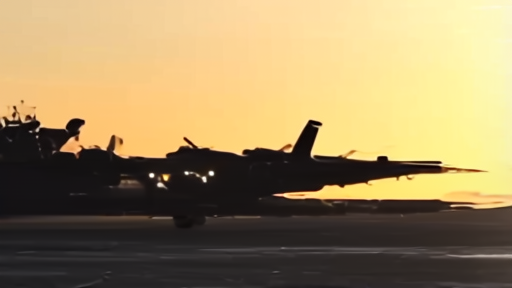
Adm. Brad Cooper, the four-star commander of US Central Command, spent Saturday afternoon on the flight deck of USS Tripoli in the Arabian Sea. CENTCOM published the photographs Sunday: Cooper in coveralls, marines around him, F-35Bs in the background, the wake visible off the stern. [1] On Thursday, Cooper had been in the Oval Office with Gen. Dan Caine, presenting what officials described as a "short and powerful" strike menu against Iranian targets. [2] In thirty-six hours, the country's senior Middle East commander moved from a brief in Washington to a deck in the Gulf of Oman.
The paper covered the Thursday meeting in CENTCOM's Cooper and Caine deliver a short and powerful strike menu and Saturday is Day One. The Saturday deck visit is what comes next in the sequence. Commanders do not travel to forward platforms during the deliberation phase. They travel during the decision phase.
The blockade ledger continued to climb across the same window. Tribune India, citing CENTCOM's running tally, put the number of vessels turned back at 48 over twenty days, up from 45 on May 1. [3] Al Jazeera's tracker on the shadow fleet that has been moving Iranian crude through transponder spoofing reported the same direction of movement: more interdictions, fewer cargoes reaching the Gulf of Oman. [4] CBS, citing Pentagon sources, said the operational tempo has increased since the Wednesday Oval session. [5]
The argument that this is routine command travel does not survive the calendar. CENTCOM commanders do visit forward-deployed forces. They do not normally do it the same Saturday they appear on the President's "not paid a big enough price" line, while the Iranian fourteen-point counter is on the table, while a Saudi-led OPEC+ meeting is adding 188 thousand barrels per day into the war premium, and while the Strait remains under blockade for the twentieth day. The deck photo did all of those things in one image.
President Pezeshkian, in remarks on Iranian state television Saturday, framed the US naval positioning as "an extension of military operations" rather than a deterrent posture. [6] Iranian officials did not separate the Cooper visit from the strike-menu briefing. They put the two events into a single sequence. The Iranian framing matches the operational-phase reading on X — that the Tripoli visit is decision support, not morale support. State media in Tehran ran the photographs alongside the fourteen-point counter as if they were a single news event.
What MSM has emphasized: the Saturday photograph as command imagery. The Tribune India dispatch, the Al Jazeera tracker, and the CBS Pentagon write-through all treat the deck visit as expected. None of them follow the chain — Wednesday Oval, Thursday brief, Saturday deck. [3][4][5] What X has emphasized: the chain. CENTCOM's official account posted the photographs at 9:14 a.m. Eastern; defense Twitter had stitched the sequence together by mid-morning. The sequence — strike menu Thursday, Trump rejection of Iranian terms Saturday morning, Cooper on deck Saturday afternoon — is the story X tells. It is the story the Pentagon's communications strategy invites by publishing the photograph at all.
USS Tripoli is an America-class amphibious assault ship. It carries F-35B Lightning II aircraft and a Marine expeditionary unit. The B-variant Lightning operates from the deck, vertical-takeoff capable, with a strike radius that puts Iranian coastal infrastructure in range without tanker support. The Tripoli has been on station in the Arabian Sea since the third week of April, alongside elements of Carrier Strike Group 11. [7] The Saturday photograph shows the F-35Bs on deck and the catapult-less ski-jump architecture the platform uses for its STOVL operations. That detail is what defense accounts on X seized: the strike menu Cooper handed to the President on Thursday was the menu the Tripoli could deliver.
Trump, asked Sunday on the South Lawn whether strikes could resume, said: "of course they can. They can resume tomorrow." [8] He paired the line with a reference to "the price they have not yet paid." It was the same vocabulary as Saturday. What changed in the interval was the deck photograph. The President's line, repeated, against a moving image of the platform that would deliver a strike, is not a verbal posture. It is a target-grid demonstration.
Whether the strike resumes is not the only question. The other is whether the Cooper visit was a cue to Tehran or a cue to Riyadh. Saudi Arabia spent Sunday running an OPEC+ meeting that added 188 thousand barrels per day, a production increase against a war premium. That is not a hedge against escalation. That is a bet on imminent de-escalation. The Saudis would not be adding barrels into a market they thought was about to absorb a strike. The deck photograph and the OPEC+ communiqué point in opposite directions. One of the two reads is wrong.
What is not wrong: the operational tempo. Twenty days of blockade. Forty-eight vessels turned. A four-star on a deck Saturday. A fourteen-point counter Iran sent through Pakistan. A President saying the price is not high enough. The geometry is converging. Whether it converges on a strike, a strike threat, or a strike-and-deal, the ground under the convergence is the deck of the Tripoli.
CENTCOM's caption on the Saturday photograph was three sentences. None of them mentioned Iran. None of them mentioned the strike menu. They mentioned Cooper, the sailors, the marines, the operations. The reader is invited to draw the rest. The reader has been doing so since Sunday morning.
-- YOSEF STERN, Jerusalem