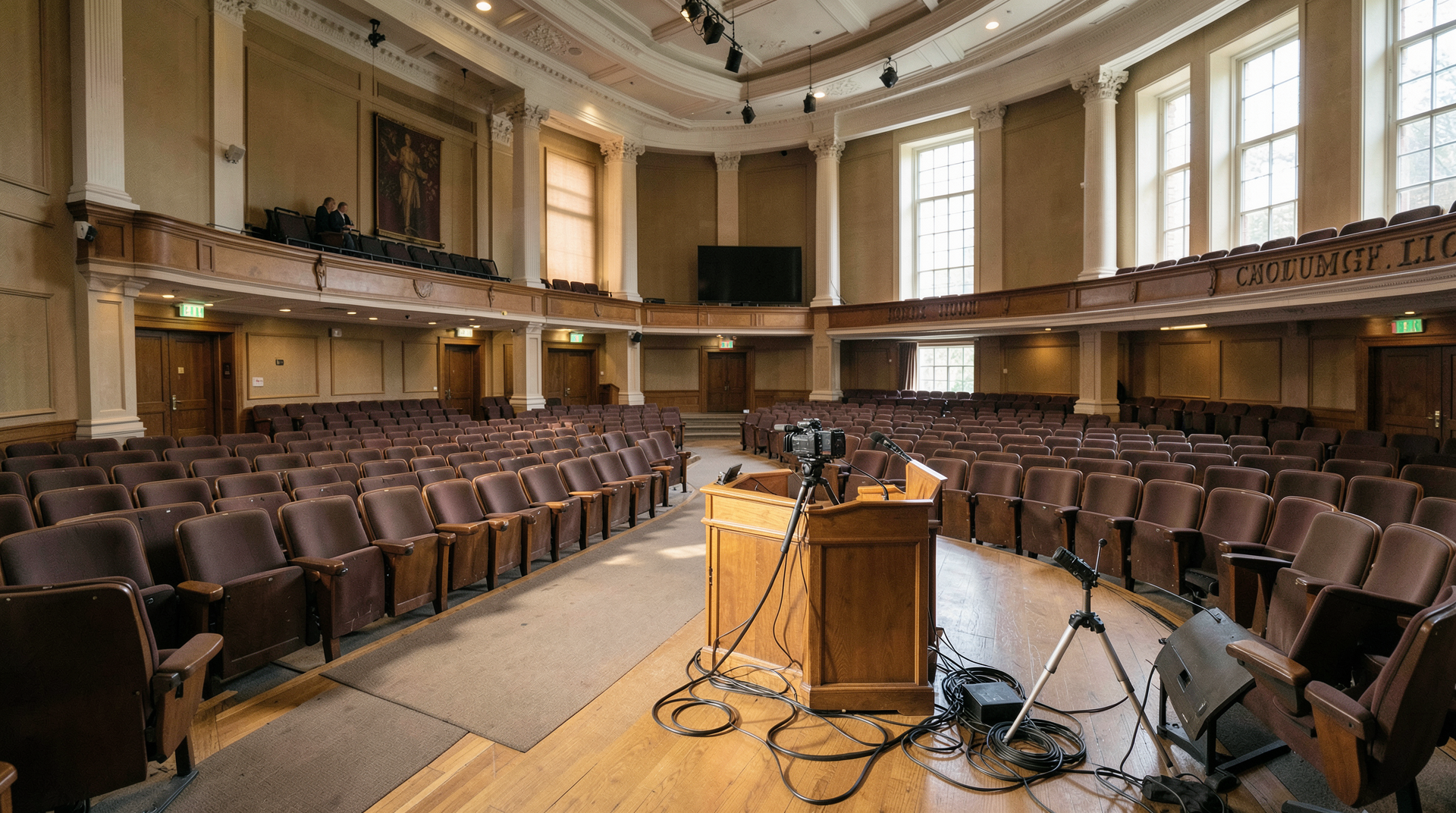
Marjorie Miller will read the names from the lectern at Columbia at three this afternoon. The 2026 Pulitzer Prizes — fifteen Journalism, seven Books, one Drama, one Music — proceed in the order the Plan of Award fixes. The livestream runs from Pulitzer.org. The board sits behind her. [1][2]
The board is also a litigant. Trump's defamation lawsuit against the Pulitzer Prize Board, filed in Florida state court in 2022 over the 2018 prizes awarded to The New York Times and The Washington Post for their Russia-collusion reporting, has been moving through Florida's courts for almost four years. The Florida Supreme Court allowed the case to proceed in December 2025 after rejecting the President's most recent attempt to dismiss it. By April, the board's lawyers had noticed the depositions of Kathleen Carroll, the former Associated Press executive editor who chaired the Pulitzer Public Service jury that year, and Kevin Merida, the former Los Angeles Times executive editor who currently sits on the board. The discovery requests filed alongside those notices ask for Trump's tax returns from 2015 to the present, his "medical and/or psychological health" records, "any prescription medications" history, and the unredacted Mueller Report. [3][4][5]
The Monday afternoon ceremony and the discovery skirmish are the same institution running on two timelines. The Times and the Journal cover the prize names on Books and the deposition notices on Legal. The X frame collapses the two: the prize ceremony, in this read, is the cover the board uses to publish the discovery demands. [3][6]
The Discovery That Trump Did Not Anticipate
The May 1 lead held that the Day-Sixty letter, the clock-pauses-or-stops claim, and the not-at-war floor had become the operating framework — the binding statute treated as administrative inconvenience. The Pulitzer discovery is the inverse case: a binding civil-procedure rule that the executive branch has spent four years trying to evade, finally arriving at the deposition window.
The board's discovery list, filed with the Florida court in April and reported by Bloomberg Law and Law&Crime, asks for documents that have been the subject of nearly a decade of journalism: every federal tax return Trump filed from 2015 forward, including amended returns and audit correspondence; statements from financial holdings including the trust through which the Trump Organization is held; full medical records including psychological assessments and prescription medication history; the unredacted text of the Mueller Report. The legal theory is procedural. Trump sued the Pulitzer Board for defamation and put his finances and reputation at issue. The board's counsel argues that having put those subjects in play, the President must answer questions about them under oath. [3][4]
The President's litigation strategy has, since 2018, depended on the asymmetry between civil libel as a one-way ratchet and discovery as the two-way street. Most of his suits have settled or been dismissed before discovery began. ABC News settled the Stephanopoulos case in December 2024 with a fifteen-million-dollar payment to the Trump presidential foundation; CBS settled the 60 Minutes Kamala Harris-edit case in July 2025; The Des Moines Register settled the Selzer-poll case in February 2026. None of those settlements produced a deposition. The Pulitzer case is different. The board did not settle. The board countersued in discovery. [3][4][7]
What changed Monday is not the discovery itself. The discovery requests have been on file since April, and the depositions of Carroll and Merida were noticed for April 15 and April 21. What changed Monday is the institutional convergence — a prize ceremony at three on a livestream, run by the same board that has, at the same hour the day before, filed pleadings demanding the President's prescription-drug history. The two acts proceed on the same calendar. The board does not pretend they are separate.
What Marjorie Miller Reads
The Plan of Award fixes the order. Public Service is announced first. The remaining fourteen Journalism categories follow in the order published in the Plan: Investigative Reporting, Local Reporting, National Reporting, International Reporting, Feature Writing, Commentary, Criticism, Editorial Writing, Illustrated Reporting, Breaking News Photography, Feature Photography, Audio Reporting, Breaking News Reporting. The Books, Drama, and Music categories follow. [1][2]
The category to watch is International Reporting. Coverage of the Iran war, the Hormuz blockade, and the February 28 Minab strike — which killed at least 168 civilians including roughly 110 children, according to Iranian government figures the Pentagon has not contested — is the field's center of gravity. The board reads the names from the same lectern Miller used last year. The livestream runs from Pulitzer.org with a backup feed on Columbia's YouTube channel. The post-announcement reception runs at four. [1][2]
What the board does not announce on the livestream is the discovery. The discovery happens on a different docket and a different timeline. The board's litigation counsel — Floyd Abrams represented the board through 2024; Norman Eisen's firm picked up the file in early 2025 — has the Carroll and Merida depositions noticed for after the prize ceremony. The depositions were originally scheduled for late April; the President's counsel moved to delay; the Florida court denied the delay. The dates remain on file. [3][4][6]
The Press-Freedom Convergence
The Pulitzer afternoon falls inside the press-freedom thread the paper has held. Pope Leo's Sunday Regina Coeli, broadcast from St. Peter's Square, named "the many journalists and reporters who have been victims of war and violence" — the first papal Regina Coeli to mark World Press Freedom Day with a journalist-fatalities register since the formal observance began in 1993. The CPJ figure cited in the same broadcast — 232 journalists and media workers killed in Gaza since October 2023 — became the morning's load-bearing number. [8]
Domestically, the FCC's April 28 order — eight ABC owned-and-operated stations to file early renewals by May 28, two to four years before their scheduled renewal windows — is in its sixth day with no action by Disney, the parent. CBS News Radio, the network broadcast that has run continuously since 1925, ends May 22 under Bari Weiss's restructuring; the announcement put 700 affiliated stations on the calendar. Stars and Stripes, the Department of Defense newspaper that has run since 1861, lost its independence ombudsman April 24; the position was created post-Iran-Contra to insulate the paper's editorial line from Pentagon interference. The Pentagon Minab strike, which killed roughly 110 children at a girls' school on February 28, has gone unattributed for six days; the Pentagon press operation has stopped responding to questions on the strike investigation. [9][10][11]
The five threads — Pulitzer, Pope Leo, FCC ABC, CBS Radio, Stars and Stripes — converge inside the same Monday calendar. The Pulitzer is the only one of the five that goes the journalists' way. The other four are pressure, diminution, or silence. The board's discovery list, in the framework the paper holds, is the press-freedom thread's only counter-instrument: a binding civil-procedure rule used by a journalism institution to extract documents from a sitting president.
What the Discovery Will and Will Not Resolve
The discovery, by itself, does not resolve the underlying defamation claim. The board's legal posture is that the 2018 prizes were properly awarded; the President's posture is that the underlying reporting — that the Trump campaign coordinated with Russian operatives in the 2016 election — was false in ways the board's editors knew. The Mueller Report, in the redacted form available since April 2019, did not establish coordination. The unredacted text — which the board's discovery list demands — is the question the board will, on the procedural reading, get to ask.
The legal calendar runs past November. The Carroll deposition was noticed for April 15; transcripts have not been filed publicly. Merida's was noticed for April 21; the same. The Florida trial court has not set a trial date. The Florida Supreme Court's December 2025 ruling allowed the case to proceed but did not foreclose further interlocutory appeals.
What the discovery does resolve, on Monday's calendar, is the institutional posture. A prize board that announces winners at three and runs depositions on a sitting president the same week is a board that has chosen its side of the press-freedom ledger. The choice was not procedural; it was deliberate, and it ran through the board's public statements after the December 2025 Florida Supreme Court ruling. The board's chairman issued a statement that month — "The Pulitzer Board will not be intimidated" — and the Carroll-Merida depositions followed. [4][6]
The Pulitzer afternoon is not, by itself, the press-freedom story. The press-freedom story is what the Pulitzer afternoon falls into the middle of: a Pope acknowledging journalists killed at war zones; a network radio operation closing in seventeen days; a broadcast license review that the FCC commissioner who voted against it called the most egregious First Amendment attack in the agency's history; a defense-paper ombudsman fired ten days ago; a school strike unattributed for sixty-five days. The board reads the names from the lectern at three. The strike at Minab killed roughly 110 children. The two facts are not connected on any single docket. They share the same Monday.
The X reading collapses the convergence into a single sentence: "Pulitzer Board hands over the prizes while subpoenaing the president." The MSM framing keeps them on separate desks. The framing the paper holds is that the convergence is the news. The press-freedom thread is no longer made up of separate threads. By six this evening, when the Met Gala's red carpet opens with Bezos as honorary chair while The Washington Post's newsroom workers stage a labor counter-event downtown, the convergence will have rolled forward another twelve hours. The Pulitzer board will have read the prizes. The board's depositions will be on file. The institution that runs both at the same hour is the institution Monday names.
-- SAMUEL CRANE, Washington