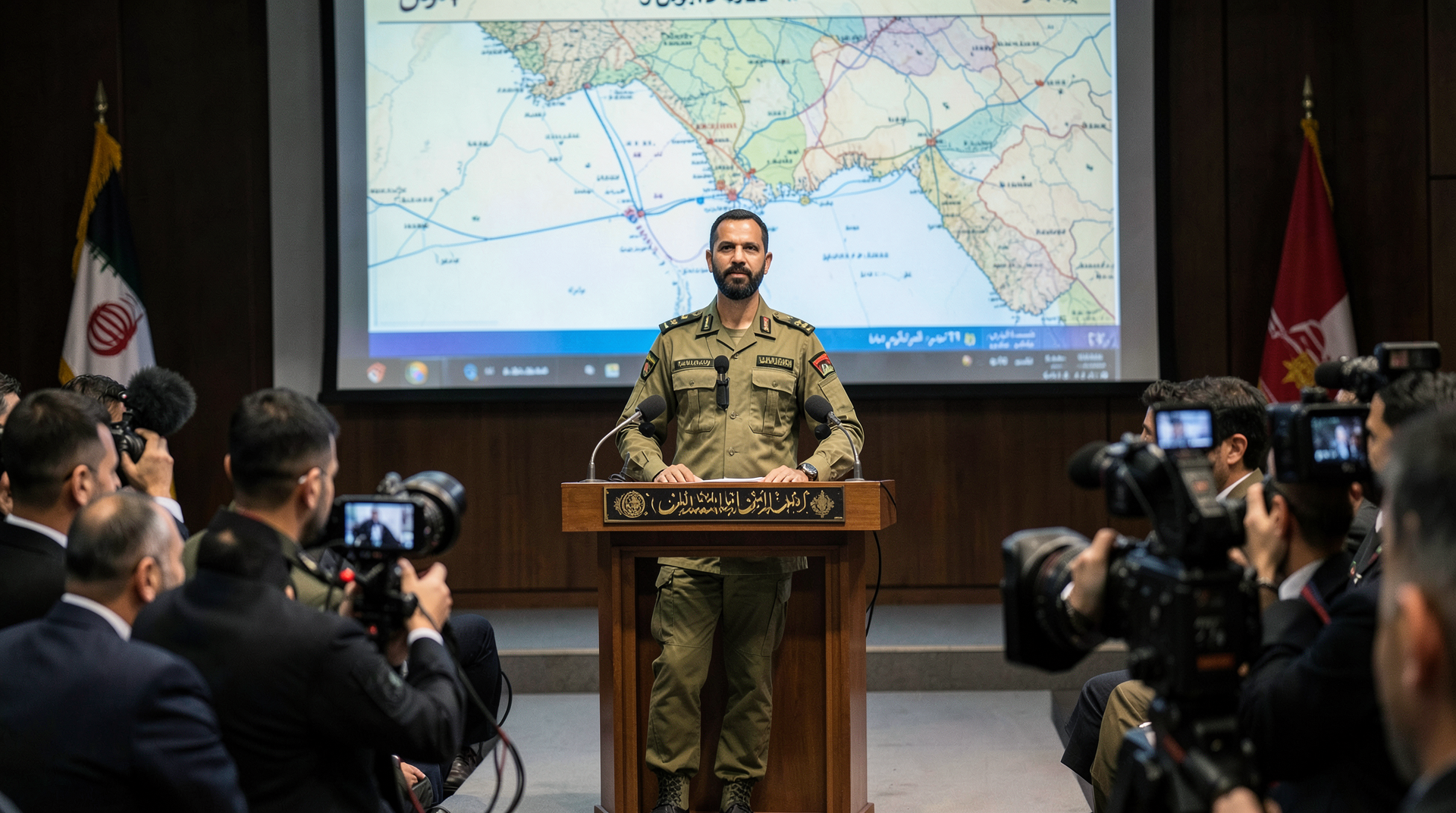
The Islamic Revolutionary Guard Corps issued its statement Sunday from Tehran. The U.S. military has thirty days to lift its naval blockade of Iranian ports. After that, the IRGC said in a release distributed by Press TV and the Middle East Monitor, the United States will face a choice between an "impossible military operation" or a "bad deal." Ebrahim Azizi, the chairman of the parliament's national security commission, added that any U.S. interference with the Hormuz maritime regime "will be considered a violation of the ceasefire." Trump's Sunday-afternoon response, on the press lawn, narrowed the rejection of Iran's fourteen-point counter-proposal: "There's a possibility we go and start strikes again if they misbehave." [1][2][3]
The May 3 lead held that Iran's fourteen-point counter, OPEC-plus's eighty-eight-kilobarrel June add, and Admiral Cooper's USS Tripoli boarding arrived the same Saturday and Trump rejected all three by Sunday lunch. The Monday extension is that the rejection now has a clock attached. Two clocks, in fact: Iran's thirty-day deadline running through early June, and Trump's "misbehave" trigger running on no calendar at all. Each is calibrated to the other's blink.
The Reserved Trigger
Trump's Saturday Truth Social post — that Iran has "not yet paid a big enough price for what they have done to Humanity, and the World, over the last 47 years" — is now the operating posture. The phrase "47 years" indexes the rejection not against February 28, when the U.S.-Israel air war began, but against 1979, the founding of the Islamic Republic. The frame is regime-change posture, not war-termination posture. The fourteen points cannot answer that frame. The fourteen points were not designed to. [4][5]
The Sunday extension narrowed the language. "Strikes can resume" and "if they misbehave" are reserved triggers, not deadlines. The reservation is the architecture. A trigger without a date allows the President to choose his moment. A deadline forces the choice. Iran's thirty-day clock is the deadline; Trump's reservation is the option held against it. The asymmetry is the architecture. [3][6]
What changed Sunday is operational, not rhetorical. The Pentagon announced, Sunday afternoon, that U.S. Navy assets would begin escorting commercial shipping out of the Strait of Hormuz under a mission framed as humanitarian. The Stars and Stripes account Sunday named the directive as having come from the President to CENTCOM commander Admiral Brad Cooper. The Iranian read of the same announcement is what Azizi articulated: any U.S. ship or aircraft entering the Hormuz maritime regime under that mission is a ceasefire violation. The two readings sit on the same map. [7][8]
The IRGC's Calendar
The IRGC clock began running Sunday May 3. It expires June 2. The deadline was issued in writing — the Press TV release ran in Persian and English — and was repeated by Azizi on state radio Sunday evening. The deadline mirror's Iran's thirty-day end-of-hostilities clause from the fourteen-point counter-proposal Pakistan relayed to Washington Friday. Tehran's diplomatic calendar and Tehran's military calendar now run on the same thirty days. [1][2][9]
What Azizi added to the IRGC release was the legal instrument. The fourteen-point counter-proposal was a diplomatic instrument; the IRGC's deadline is a deterrence instrument; Azizi's "violation of the ceasefire" framing is the bridge between the two. If the U.S. ship-escort mission proceeds, Iran's procedural position is that the ceasefire ends. The ceasefire that ends, in this read, is the April 7 ceasefire — the same ceasefire Trump's May 2 letter to Speaker Johnson cited in declaring hostilities terminated for War Powers Resolution purposes. The U.S. position that the war is over and the Iranian position that the war could re-start have, in the Hormuz architecture, the same load-bearing date. [2][9][10]
The IRGC's structural detail is the Khatam ol Anbia Central Headquarters, which announced April 28 that Iranian forces had reinstated "strict management and control" over the Strait. Khatam ol Anbia is the IRGC's engineering and logistics arm and, functionally, the operational command for the Strait closure since Tangsiri's death in late February. The April 28 statement was, in retrospect, the procedural foundation under the May 3 thirty-day deadline. The IRGC was not announcing a new posture Sunday; it was attaching a calendar to a posture that was already in place. [11][12]
The CENTCOM Architecture
CENTCOM's force posture in the region runs against a different calendar than the IRGC's deadline. The USS Tripoli, the amphibious assault ship Admiral Cooper boarded Saturday in the Arabian Sea, sits with the wider Hormuz force structure: the carrier strike group rotated through Diego Garcia in early April, the destroyer escorts, the air wing operating from Al Udeid. The forty-eight commercial vessels CENTCOM has redirected since the blockade began on April 13 are the operational measure. The IRGC's thirty-day deadline is the political instrument layered on top of that operational measure. [13][7]
Cooper's deck visit Saturday was, on the Pentagon's framing, routine. The May 3 lead held it was not. A commander who has briefed a three-option strike menu in the Oval Thursday and then visits the platform from which one of those options would launch is locating optionality, not preserving it. The Sunday ship-escort directive — Trump's "Project Freedom," in the Pentagon's internal framing — runs the same logic on a different surface. Escorting commercial vessels out of the Strait is the humanitarian frame. The military frame is that any IRGC vessel that approaches the escort under Iran's "violation of the ceasefire" framing converts the humanitarian mission into a casus belli the President can hold reserved. [7][13][14]
What the architecture does not include, on the public record, is a withdrawal mechanism. The Senate's sixth War Powers Resolution failed 47-50 on April 30, with Senator Susan Collins crossing for the first time. The Day-Sixty letter has been on file since May 2. The Comey vindictive-prosecution motion is on the docket. The Cole Allen preliminary hearing falls May 11. None of those domestic instruments produces a binding constraint on the Hormuz architecture. The constraint is the IRGC's thirty-day deadline, and the deadline does not belong to Washington. [15]
The Iran Read That Trump Cannot Buy
What Tehran is not saying out loud, but what its public posture clarifies, is that the fourteen-point counter-proposal was the off-ramp. The IRGC's thirty-day deadline is what runs after the off-ramp closes. The fourteen points asked for: a thirty-day end of hostilities, lifting of the blockade, release of frozen assets, payment of reparations, end to Lebanon hostilities, a new Hormuz mechanism. Trump's "47 years" rejection took the frame off the table. What replaces the frame is the deadline. [16][17]
Mojtaba Khamenei's April 30 Persian Gulf Day statement, which the May 3 paper carried, framed the regional architecture: "future without U.S. presence." Pezeshkian's May 2 remarks framed the Iranian state's response window as "extension of military operations." The IRGC's May 3 statement is the operational architecture under those rhetorical positions. The three together are not separate communications. They are the same communication delivered through three channels: the political successor, the elected executive, and the military arm. [18][19]
The Iran-aligned read on X Sunday night was triumphant. "Complete control of Hormuz returns" and "the strait is now under the strict management and control of the armed forces" — phrases that ran across Iranian state media and the IRGC's public-affairs accounts. The U.S. read on the same channels was that the threat is empty. The IRGC has reduced its publicly visible deterrent capacity since Tangsiri's death; the small-boat fleet has been degraded; the air-defense network has taken sustained losses since February 28. The empty-threat read, on the operational level, is plausible. The deadline-as-instrument read, on the political level, is independent of the operational level. The deadline does not have to be enforceable to operate. It only has to be on the calendar. [11][20]
What June 2 Resolves
The IRGC's thirty-day clock falls June 2. The OPEC-plus ministerial falls June 7. The Cerebras IPO prices mid-May. The Trump-Xi summit runs May 14 and 15. The Treasury General License 134B Russia-oil expiry is May 16. None of those dates was originally indexed against the IRGC clock. All of them now sit inside the thirty-day window.
What June 2 does not resolve is the regime-change frame. The "47 years" rejection on Saturday was not a counter-proposal; it was a statement of position about the underlying state structure. A deadline that asks the U.S. to lift the blockade by June 2 cannot answer a frame that asks the Islamic Republic to stop existing. The IRGC's thirty-day clock is calibrated to a war-termination posture. The U.S. President's "47 years" frame is calibrated to a regime-change posture. The two postures cannot meet inside thirty days. They cannot meet inside thirty months.
What June 2 does resolve is the procedural question. If the deadline expires without the blockade lifting, Iran's stated next step — "an impossible military operation" or "a bad deal" — runs on the Hormuz infrastructure already in place. The escalation surface is the Strait. The escalation instrument is the Hormuz Letter the IRGC has been signaling since April. The thirty days are the window inside which Iran communicates that the bargaining position no longer survives the rejection.
The X reading, inside the channels that follow the Hormuz file, was that the two clocks running concurrently is the news. The MSM framing kept them on separate desks — diplomatic stall on State, escalation watch on Pentagon, energy-price watch on Markets. The framing the paper holds is that the convergence is the regime. By June 2, one of the two clocks will have produced an answer. The answer will not be a ceasefire; the ceasefire on file is what one side is operating under and the other says is already void. The answer will be the next instrument.
The blockade ran. The fourteen points landed. The IRGC named the deadline. Trump reserved the trigger. Azizi made the violation explicit. The Saudi-Russian eighty-eight thousand barrels added into June. None of those instruments resolves the underlying contradiction. The paper's frame from May 3 holds: the contradiction has not resolved. It has moved. The Monday extension is that the contradiction is now indexed against a thirty-day calendar that ends June 2 — a date that, on Sunday morning, was nothing, and that, by Monday afternoon, is the date the war's next instrument arrives on.
-- YOSEF STERN, Jerusalem