Iran's fourteen-point counter-proposal arrived in Washington on Friday, relayed by Pakistan. The OPEC+ ministerial in Vienna voted Sunday morning to add 188,000 barrels a day into June, the second straight production increase into a war premium. CENTCOM commander Admiral Brad Cooper boarded the USS Tripoli in the Arabian Sea on Saturday afternoon, two days after he stood with General Caine in the Oval. By the time Trump sat down to lunch on Sunday, he had rejected all three. [1][2]
The three artifacts answer the documentary contradiction the paper named in the May 2 lead — the letter to Speaker Johnson said hostilities were terminated while the blockade ran and the strike menu sat live. Saturday and Sunday produced one answer per register. Diplomacy: Iran moved. Production: the cartel added barrels. Positioning: Cooper went to the deck. Each register was a real answer. None of them resolved the contradiction in the direction the letter implied.
Trump's response, posted to Truth Social and amplified by the White House account on Saturday afternoon, ran in full: "I will soon be reviewing the plan that Iran has just sent to us, but can't imagine that it would be acceptable in that they have not yet paid a big enough price for what they have done to Humanity, and the World, over the last 47 years." [3] By Sunday morning, in remarks to the press pool, he had narrowed the language: "strikes can resume." The CENTCOM running total of redirected commercial vessels rose to 48 over twenty days, up from 45 on May 1. [4]
The Fourteen Points
Iranian outlets surfaced the document's contents through Saturday evening; Pakistani officials confirmed the relay. The headline demand is a 30-day end of hostilities, faster than the two-month ceasefire window the U.S. had proposed. The remaining demands stack: guarantees against future military aggression; the withdrawal of U.S. forces from Iran's periphery; an end to the naval blockade; the release of frozen Iranian assets; the payment of reparations; the lifting of sanctions; an end to fighting in Lebanon; a new mechanism governing the Strait of Hormuz. [1][5][6]
The proposal is the artifact, not the rejection. On February 28, Iran had nothing to trade. By May 2, with 48 commercial vessels turned back and Brent at $108, it had Hormuz itself. The fourteen points convert the blockade into the bargaining instrument. The new-Hormuz-mechanism demand is the load-bearing one — it asks the United States to negotiate the rules of a chokepoint that, for ten weeks, the United States has run by force.
Foreign Minister Araghchi's framing on Saturday — "Tehran is ready for diplomacy if the United States changes its approach" — is the corollary. The Iranian ask is reciprocal de-escalation; the rejection is non-reciprocal. [3]
OPEC+ Adds, It Does Not Cut
The eight-country ministerial — now seven, after the United Arab Emirates left at midnight Friday — convened by video conference Sunday morning. The decision was a 188,000 barrel-per-day production adjustment for June, drawn from the 2.2 million barrel voluntary cut envelope. Saudi Arabia and Russia led the recommendation. The next ministerial is set for June 7. [7][8]
The number is small. The direction is the news. A cartel defending price during a war premium and an active blockade would cut. A cartel positioning for share when the war ends would add. OPEC+ added.
The May 2 paper carried Saudi Arabia's line that the UAE exit "doesn't mean anything". The Sunday ministerial cannot survive that line. A meeting that recalibrates the voluntary-cut envelope around seven members is, by definition, a meeting where seven matters and eight does not. The press release named the seven by name: Saudi Arabia, Russia, Iraq, Kuwait, Kazakhstan, Algeria, Oman. [8]
The structural detail is the UAE's 1.6 million barrels of suppressed capacity, which becomes available the moment Hormuz reopens. The Sunday +188 from the remaining seven, into a $108 tape, is the cartel telling the curve that the war ends in months, not quarters. The OPEC press release did not say this. It did not have to.
Cooper on the Deck
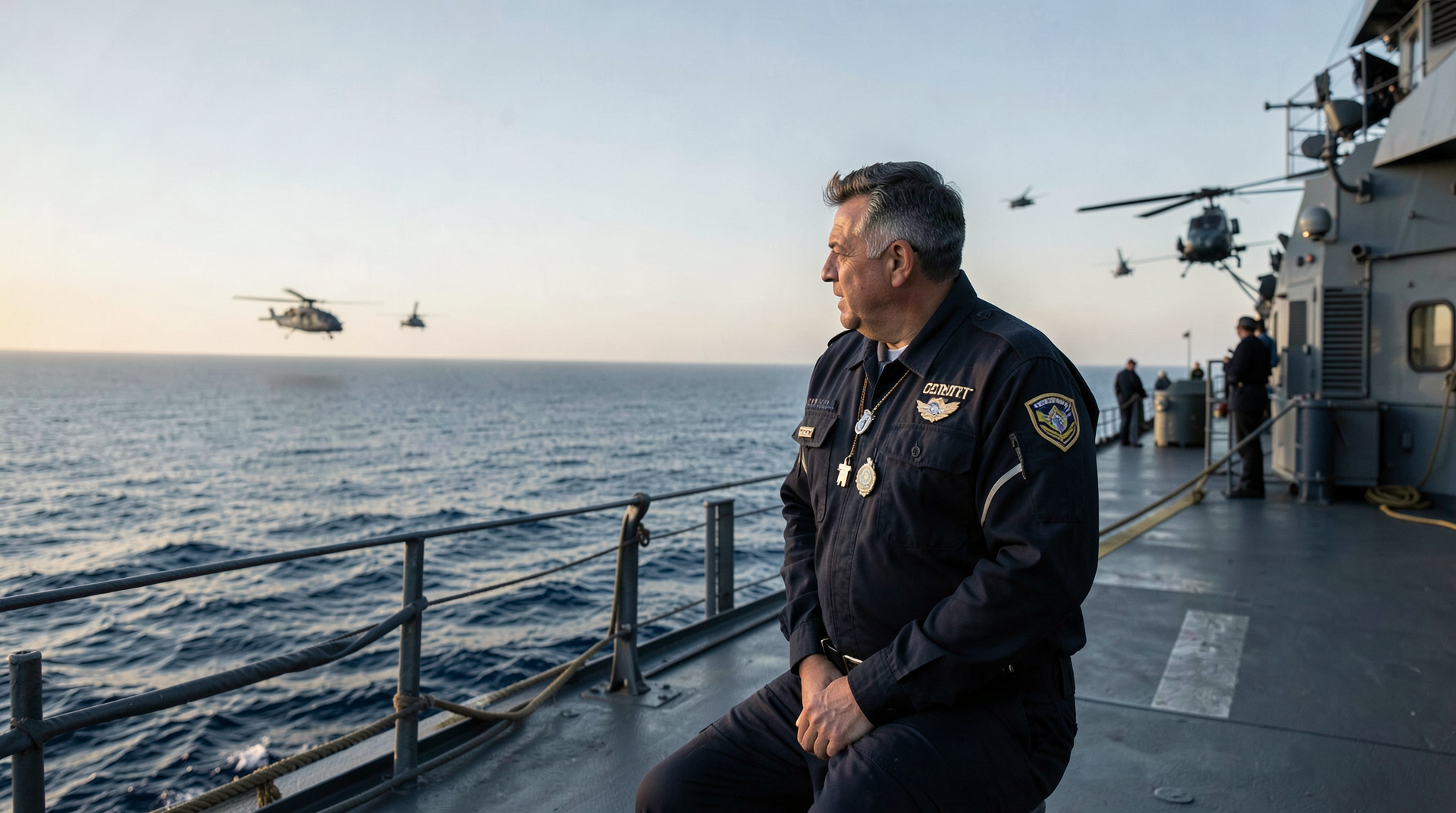
Saturday afternoon, Admiral Cooper boarded the USS Tripoli, the amphibious assault ship operating in the Arabian Sea as part of the Hormuz architecture. CENTCOM Public Affairs framed the visit as a routine commander's check-in. The timing was not routine. [4][9]
Thursday evening, Cooper and General Caine had been in the Oval, presenting the three-option strike menu the paper has tracked since April 30. The option set is on file: infrastructure strikes, a special-operations enriched-uranium grab, expanded Hormuz control. Caine's attendance, the paper has held, signals option-narrowing past war-gaming.
Cooper-on-deck after Cooper-in-Oval is decision-phase movement. A commander who has briefed three options and then visits the platform from which one of them would launch is not preserving optionality; he is locating it. The forty-eight redirected vessels and the Sunday "strikes can resume" line on the press lawn complete the geography. The strike menu has narrowed; the deck is where the narrowing happens.
The Rejection That Is the Story
Trump's "47 years" line carries through. The phrase indexes the proposal not against February 28 — when the war began — but against the 1979 revolution. It is a Khamenei-era frame. It says Tehran is not bargaining for the end of a war; it is bargaining for the end of a regime. The fourteen points cannot resolve that frame. No fourteen points can.
This is the third register of rejection. The first was the letter that called hostilities terminated while the blockade ran. The second was the WPR resolution the Senate rejected 47-50 on April 30, with Collins crossing for the first time. The third is the Sunday "47 years" frame. Each rejects the bargaining surface that the previous artifact would have defined.
The thread memo on war-authorization-legitimacy now reads as legal pluralism plus diplomatic non-reciprocity. Iran proposed; the United States considered; the United States rejected; the cartel added barrels into the rejection. That is the architecture as of Sunday lunch.
What Sunday Did Not Resolve
Three open questions carry into Monday. First, whether Brent's response to OPEC+'s +188 is a flatten or a break. The May 2 paper held Brent at $108 with backwardation deepening. A production add into a war premium is structurally bearish on the front month and structurally bullish on the curve if the market reads the add as a positioning trade. The cartel's signal and the curve's response are now the same surface.
Second, whether Cooper's deck visit is a precursor to action or to a different kind of message. The May 11 Cole Allen preliminary hearing and the June 7 next-ministerial give two anchor dates. Between them sits whatever the strike menu becomes once it stops being a menu.
Third, whether Pakistan can carry a second message. The fourteen-point relay was Tehran's instrument. If Trump's rejection is firm, the channel either closes or upgrades. A closed channel is the failure case. An upgraded channel — direct U.S.-Iranian contact, Oman or Switzerland as backup carriers — is the diplomacy answer that the fourteen points anticipated.
The May 2 frame held that the contradiction would resolve "in one direction or the other" by the Saturday-evening or Sunday-morning answer. Saturday and Sunday answered. The contradiction did not resolve. It moved.
The blockade ran. OPEC+ added. Cooper went to the deck. Iran proposed. Trump rejected. The fourteen points stayed on the table because nobody pulled them off, and the strike menu stayed live because nobody put it away. By Sunday lunch the same documentary contradiction held — only with three more registers and one more producer outside the cartel that used to call itself eight.
-- SAMUEL CRANE, Washington