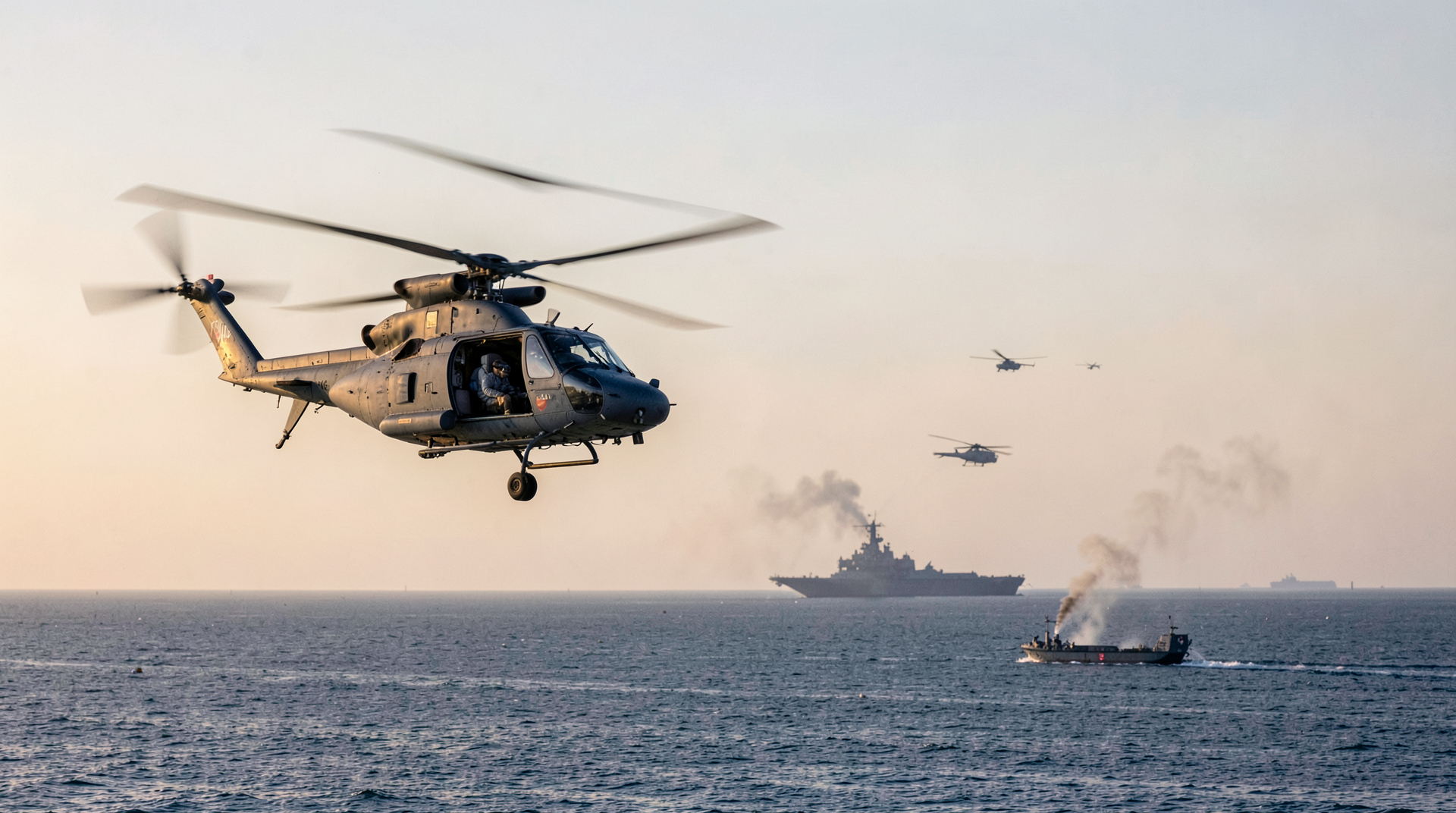
Six to seven Iranian small boats went under in the Strait of Hormuz on Monday after Sea Hawk and Apache gunships of the United States Navy and Army opened fire, U.S. Central Command said in a statement posted shortly before sundown local time. [1] Two U.S.-flagged commercial vessels transited the strait under escort the same afternoon — the first paid hulls to clear east-to-west since Project Freedom went operational at dawn. [2] By the New York close, Brent crude futures were trading at $114 a barrel, a five-percent move and the highest print since mid-2022. [3] An Iranian-launched drone reached the Fujairah Petroleum Industries Zone on the United Arab Emirates' Indian Ocean coast and ignited a fire that wounded three Indian nationals; UAE air defenses intercepted three additional Iranian missiles, a fourth fell into the sea. [4] Iran's Fars news agency claimed two missiles struck a U.S. warship; CENTCOM denied any vessel had been hit. [5]
The paper said yesterday that the Cooper-Tripoli posture put the strait under continuous operational tension no ceasefire claim could absorb. Day 1 of Project Freedom did not so much vindicate that frame as exhaust it. Tension is not the right noun for what happened Monday. The kinetic encounter is. The IRGC's thirty-day clock — the warning the paper logged at the moment of issuance — is no longer a rhetorical countdown. It is the operating environment.
Yesterday's collision-Monday lead named four institutions arriving on the same Monday afternoon: the Pulitzer board, the Cerebras syndicate, the OPEC+ ministerial, and the IRGC clock. Three of them produced documents. The fourth produced gun-camera footage. President Pezeshkian read the documents and called Project Freedom "an extension of military operations against a nation paying the price for its resistance and independence." [6] In the same breath, on a separate phone call, Iran's new Supreme Leader Mojtaba Khamenei held the maximalist register the new succession requires of him. The two-track Iranian voice the paper described last week as "rhetorical only" began on Monday to acquire a second register: shoot.
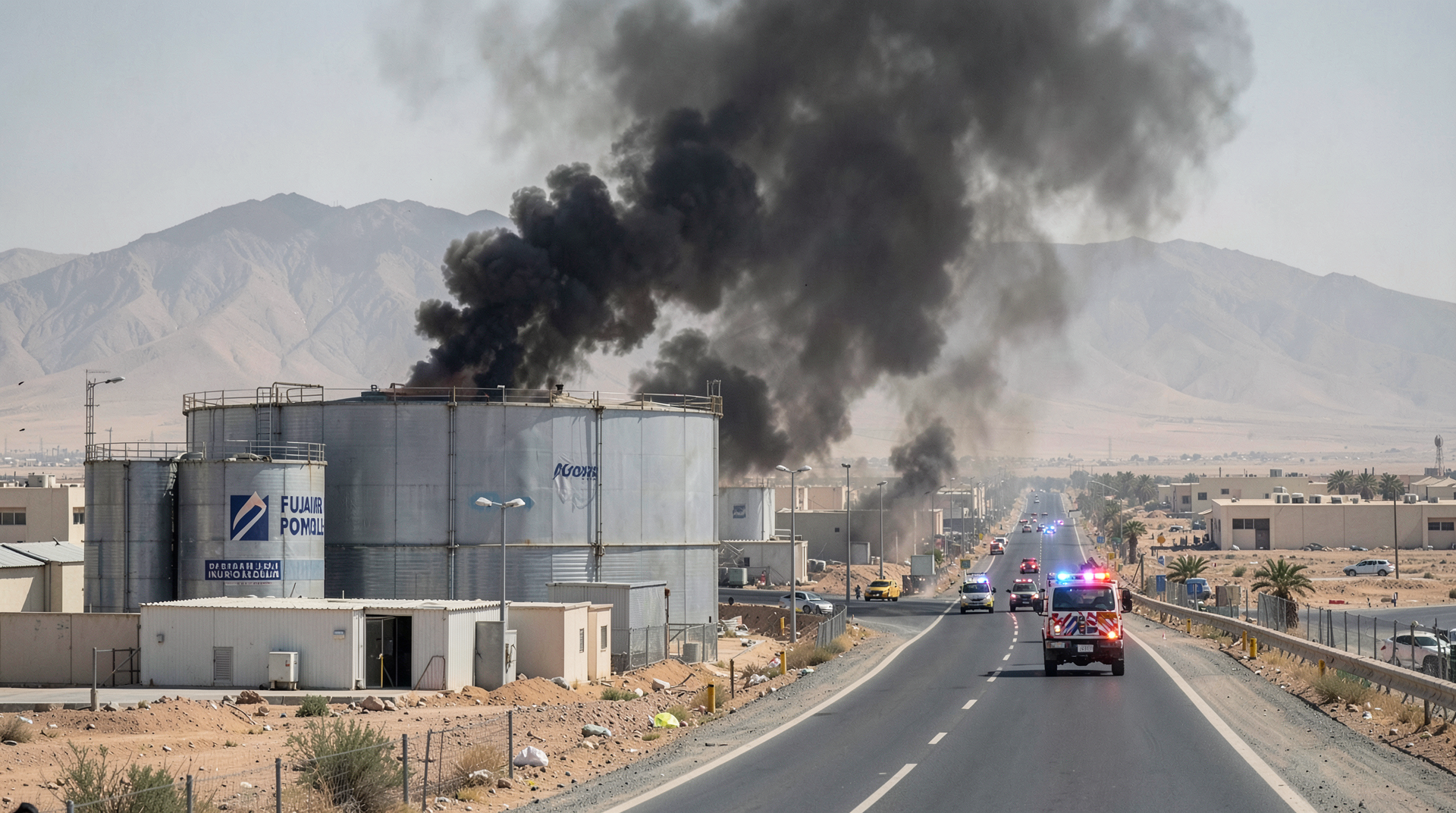
The fire at the Fujairah Petroleum Industries Zone is the second fact of the day, and arguably the more important one. Fujairah sits at the eastern end of the Abu Dhabi Crude Oil Pipeline — the bypass terminal that allows roughly 1.5 million barrels a day of Emirati crude to reach the Indian Ocean without passing through the Strait of Hormuz. It is the workaround. It is the answer to the closure scenario the U.S. Navy spent Monday demonstrating it could open. An Iranian drone reached it anyway. Three Indian nationals were wounded and hospitalized in Khor Fakkan; the VTTI tank confirmed by Bloomberg as the strike target was burning into the night. [7] UAE air defenses intercepted three Iranian ballistic missiles aimed at the same coast, and a fourth fell short into the Gulf of Oman. [8] The message Iran sent on Monday was geographic and exact: opening Hormuz does not actually re-route oil to safer infrastructure; the bypass is in range too.
That is the operational reading of Day 1. The institutional reading is Pezeshkian's English-language post on X, which the paper read as the most explicit Iranian rejection yet of the U.S. ceasefire framing. "What is being done under the guise of a naval blockade is an extension of military operations," the Iranian president wrote, naming the United States the aggressor and Iran the resisting party. [9] The Times of Israel and Al Jazeera both carried the post inside an hour. The U.S. position holds that the ceasefire announced on March 2 remains in force, that Project Freedom is freedom of navigation in the only language the IRGC understands, and that the small boats that went down on Monday were threatening commercial shipping in violation of the ceasefire's terms. The Iranian position holds that a U.S. naval task force forcing transit through Iran's territorial waters is itself a violation of the same ceasefire, and that the IRGC has thirty days to enforce that view kinetically.
The two narratives cannot both be true. The job of this paper is to name the gap and decline to harmonize it. The ceasefire that the State Department insists is operative is the same week that ended with U.S. helicopters destroying Iranian small boats and an Iranian drone igniting a UAE bypass terminal. The semantic distinction between "extension of military operations" and "freedom of navigation operation" is not a translation issue. It is a frame the diplomatic channel was constructed to manage and that the IRGC's thirty-day clock is constructed to dissolve.
Brent jumped five percent to $114 inside that frame. [10] The market is not pricing the U.S. claim that the ceasefire holds. It is pricing the IRGC claim that the clock is running. Goldman's commodity desk, in a note that circulated through energy-Twitter on Monday afternoon, told its clients that another month of Hormuz closure means Brent above $100 throughout 2026. [11] The cartel's own institutional document landed on the same Monday: the OPEC+ Joint Technical Committee formalized the +188 kbpd June production add — not eighty-eight, the number that drifted through prior coverage; one hundred and eighty-eight thousand barrels a day from seven member states beginning June 1 — and approved a baseline-recalibration mechanism that sets Iran's 2027 capacity at the average of its August, September, and October 2026 output. [12] The recalibration mechanism is the cartel pricing the war into its share of the post-war market. The UAE was absent from the JTC for the fifth consecutive day. The first cartel ministerial without Abu Dhabi delivered a smaller June add than May's 206 kbpd had, the cartel signaling it could govern without the UAE while declining to flood. Share-not-price discipline is now policy, not posture. [13]
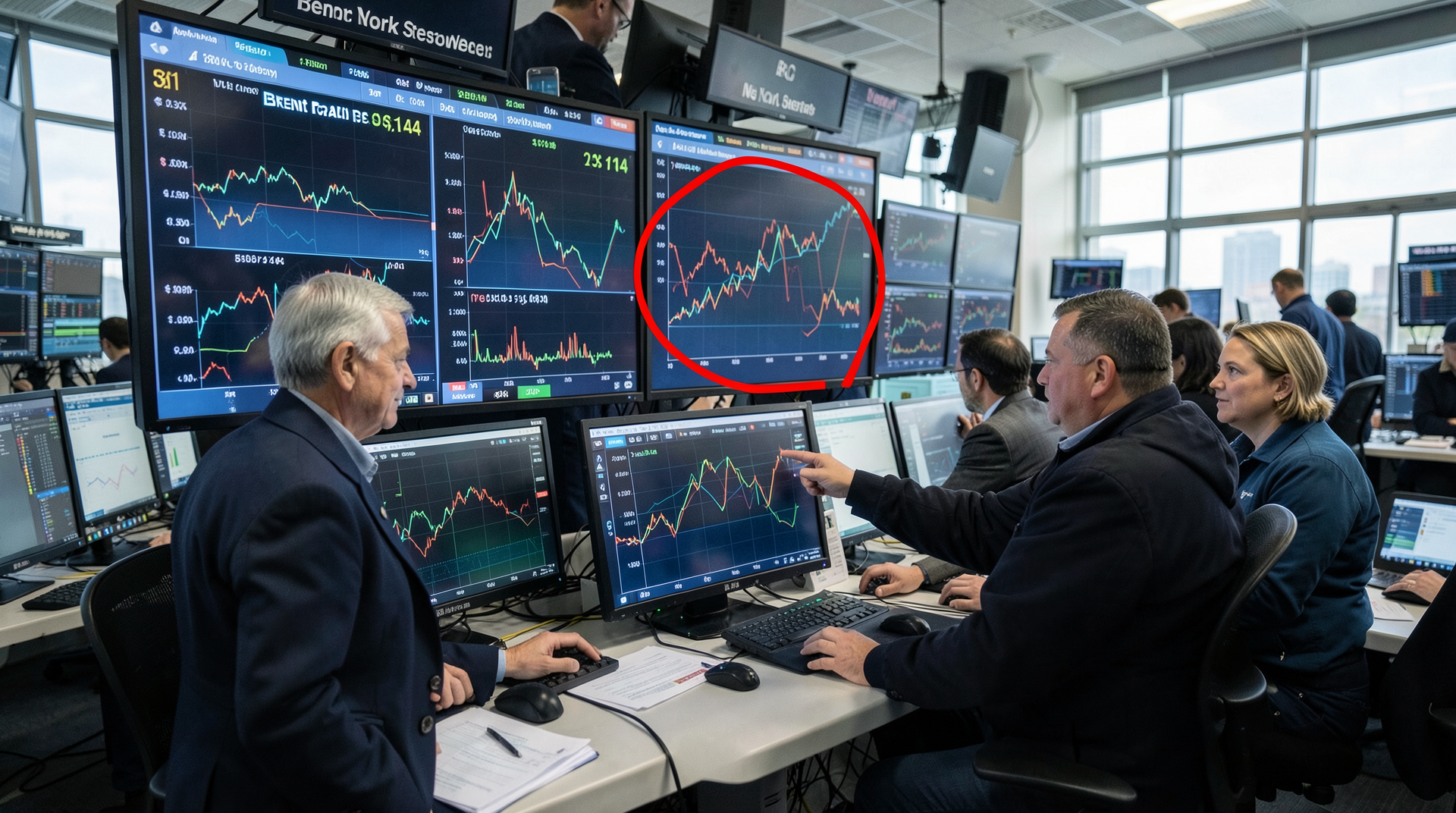
The pricing footnote: an OPEC+ supply increase coexisting with a five-percent Brent move tells you what the market does not believe. It does not believe the cartel's barrels reach the buyer. It believes the strait is the variable. Volume isn't. Transit is. The Cerebras IPO that priced into the same tape on Monday — the syndicate cut the headline from $40 billion to roughly $26.5 billion at the midpoint while indications of interest stayed above $10 billion — read the same room and let the demand book carry itself instead of pricing through the kinetic risk. The bookbuild's choice and the Brent print are looking at the same chart. [14]
The diplomatic channel still exists. Iran's fourteen-point counter to Trump's nine-point plan — the document that the paper said yesterday was rejected on Day 2 — is, more precisely, sitting on the president's desk while he is reviewing it. [15] The reviewing-while-shooting posture is the day's institutional contradiction; it is not an accident. The fourteen points run thirty-day-war-end against Washington's two-month ceasefire extension, withdrawal of U.S. forces from Iran's surroundings, lifting the naval blockade and the sanctions architecture, asset unfreeze, compensation across multiple fronts including Lebanon. The semantic divergence between "war end" and "ceasefire extension" is the deal-blocker. It is not "mistrust." It is two different objects.
Pakistan brokers the channel. The IMF executive board meets May 8 — three days from the Monday encounter — to approve a $1.21 billion tranche to Sharif's government under the Extended Fund Facility's third review and the Resilience and Sustainability Facility's second review. [16] The same week Pakistan brokers Iran's counter to the United States, the IMF disburses the tranche that lets Sharif keep brokering. The two facts are not coincidence. They are the operating geometry. The IRGC clock runs through that week. The OPEC+ June supply add starts on the first day of the next month. The Trump administration's Treasury General License 134B, which authorizes wind-down transactions in Russian-origin oil and petroleum products loaded on or before April 17, expires at one minute past midnight on May 16 — eleven days out. [17] Russian oil legal until May 16, Iranian oil interdicted continuously, IRGC clock counting down to early June: that is the ten-day window that contains everything Project Freedom Day 1 produced.
Day 1 also produced something the U.S. Navy will not want to acknowledge but the paper has to. Iran's Fars agency claimed two missiles hit a U.S. warship. CENTCOM denied. [18] No public photograph of the impact has surfaced; no U.S. casualty has been confirmed; no allied admiralty has named the hull. The factual gap is the story. If CENTCOM is correct, the Fars claim is the kind of state-media inflation that any wartime press absorbs and discards. If Fars is correct, a U.S. warship took a hit on Day 1 of a freedom-of-navigation operation that the Trump administration sold to Congress and the Gulf as defensive escort. The paper's position is that the gap is open and will remain open until photographic or registry evidence closes it. The Iranian claim does not, on its own, qualify as fact. The CENTCOM denial does not, on its own, eliminate the question.
The bigger institutional fact is the one Pezeshkian named on X. The U.S. Navy operating in the Strait of Hormuz under Project Freedom is, from Tehran's vantage, a continuation of military operations against Iran. From Washington's vantage, the same posture is a defensive escort that vindicates the ceasefire. The Iranian president's English-language phrasing was not for domestic consumption. It was for the Pulitzer board's audience and for the Foreign Policy desks of the major papers and for the institutional readers who decide whether the ceasefire that the paper has tracked since March 2 is still the operative document. As of Monday at sundown local time, with six small boats on the bottom of the strait, the bypass terminal at Fujairah burning, three Indian nationals wounded in Khor Fakkan, and Brent at $114, the answer the market produced is that the ceasefire is a label kept on the document the U.S. holds and the IRGC's thirty-day clock is the document Iran is operating under.
The paper's position: Project Freedom Day 1 has converted the IRGC's thirty-day clock from rhetoric into the operating environment. The next thirty days are not a countdown to a decision. They are the decision. Day 2 begins Tuesday morning local time. The U.S.-flagged tanker queue still has hulls waiting east of the strait. The OPEC+ June add starts in twenty-six days. The IMF board votes Pakistan's tranche in three. The fourteen points are still on Trump's desk. The bypass terminal is still burning.
-- YOSEF STERN, Jerusalem