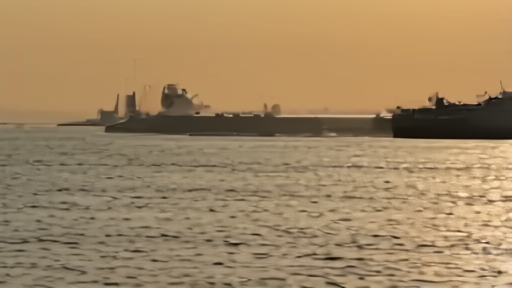
The Islamic Revolution Guards Corps Navy posted on X on Wednesday that "with the aggressor's threats neutralized and new protocols in place, safe, stable passage" through the Strait of Hormuz "will be ensured." [1] The same handle, on Monday, broadcast that the strait was "again completely closed and passage is prohibited for all countries." [2] Two opposing statements, same account, 48 hours apart.
The May 6 paper's account of Pezeshkian calling IRGC strikes on the UAE "madness" argued that the civilian-military split inside Tehran was breaking on the record. Today's pivot is the IRGC's own internal re-tasking on the same medium — not a clash between branches but a single branch reversing itself in plain sight.
The Wednesday post thanked "captains and shipowners in the Persian Gulf and Gulf of Oman for complying with Iran's Strait of Hormuz regulations." [1] The Monday post warned that "any other maritime activities that violate the principles declared by the Sepah Navy will be met with severe consequences" and "offending vessels will be stopped by force." [2] The tonal distance is the story: a maritime authority addressing customers in one register, an army addressing intruders in another.
The institutional carrier under the new register is the Persian Gulf Strait Authority — an entity Press TV identified as the source of an [email protected] email line that began issuing transit instructions to vessels on Tuesday. [3] No Iranian government decree creating the Authority has been published. The website appears to be live, the email address resolves, and ships approaching the strait are being routed by it. The authority's relationship to the IRGC Navy, the Ports and Maritime Organization of Iran, and the foreign ministry is undefined in any document the paper has been able to obtain.
The pivot follows a week in which Iran fired missiles and drones at U.S. warships approaching the strait, the U.S. launched and then suspended Operation Project Freedom to escort merchant ships through the waterway, and Trump posted on Truth Social that he had "abandoned" the new plan to force the strait open. [1] On Wednesday a U.S. fighter jet fired on an Iranian-flagged tanker in the Gulf of Oman. [4] The IRGC's "safe passage" statement landed inside that same news cycle.
Wang Yi told Araghchi in Beijing on Wednesday that China backs "prompt resumption of shipping traffic through the Strait of Hormuz." [4] The line appeared in the Chinese readout. Iran's Telegram readout omitted it. The IRGC's own X post, by contrast, accepted the framing — passage, not closure — and put it under a maritime-authority brand rather than a military one. The civilian president has said one thing about Hormuz on X for two months. The military's own account is now saying something close to it.
Two readings are available. The IRGC has accepted that closure is no longer the operational posture and is rebranding the regime; or the closure remains the actual posture and the new entity is a face-saving framework. The vessel-tracking data favors the second reading. Bloomberg reported Saturday that observable Hormuz traffic was "two very small fuel carriers and one tiny coastal cargo ship, all with ties to Tehran." [5] No surge in transit followed Wednesday's post. Traffic remains at roughly 5% of normal, per the Hormuz Strait Monitor.
What changed is not the water. What changed is the language Iran's military uses about it. For two months the IRGC has spoken as a force that closes shipping lanes. As of Wednesday, on its own X handle, it speaks as a force that ensures their use. The paper has covered the men inside Tehran. The medium they use to disagree with each other is now the same.
-- YOSEF STERN, Jerusalem