French President Emmanuel Macron telephoned Iranian President Masoud Pezeshkian on Wednesday evening, posted on X minutes later that "all parties must lift the blockade of the Strait of Hormuz, without delay and without conditions," and confirmed that the French aircraft carrier Charles de Gaulle is now heading to the southern Red Sea to pre-position for a Franco-British maritime escort mission backed by more than forty nations. [1] [2] [3] Macron told reporters he intends to discuss the proposal with President Donald Trump. Pezeshkian's office, in a statement carried by Iranian state media, said Iran "is prepared to seriously pursue diplomatic paths to end the war" while expressing "deep distrust" of the United States and describing recent strikes during ongoing negotiations as "stabbing Iran in the back." [4] [3] Until Wednesday night, Pakistan was the only operating diplomatic channel between Tehran and Washington. As of Thursday morning it is, formally, no longer alone.
The paper's Wednesday lead read the pause day as the kinetic envelope held in suspension over a deadline rather than retired, with the Pakistan channel still carrying the Witkoff-Kushner draft and Tehran's foreign-ministry response described, on the record, as "evaluating." What changed inside 24 hours is that the channel architecture has multiplied. Pakistan continues to broker the U.S.-side draft, with the IMF Executive Board meeting Friday on a $1.21 billion tranche that runs through the same Pakistani banking channel any compliance step would clear. China hosted Iranian Foreign Minister Abbas Araghchi in Beijing on Wednesday morning, where Wang Yi publicly called for an "immediate end to the hostilities" and a "prompt resumption of shipping traffic through the Strait of Hormuz" — language that, notably, did not appear in Iran's Telegram readout of the same meeting. [5] And Wednesday night, Macron added France and the forty-nation Maritime Freedom Construct as a third vector. Three parallel diplomatic registers, three separate texts, one shared seven-day window. None of them require the others to function. None of them yet contradict the others on the record.
The mechanics of the Macron call deserve precise reading. The French presidency's account, repeated by AP7AM and the Straits Times, has Macron condemning the Iranian Revolutionary Guard Corps strikes on Emirati civilian infrastructure, urging Pezeshkian to "seize the opportunity" of the multinational escort proposal, and confirming that the Charles de Gaulle "is part of this effort." [1] [2] The French defence ministry's same-day press release said the carrier is heading toward the southern Red Sea "to reduce the time required to implement" the Franco-British initiative "as soon as circumstances permit." [1] The initiative will not begin while U.S.-Iranian hostilities continue. What the pre-positioning does is foreshorten the operational lag between cessation of hostilities and the start of escort operations — a French commitment that the post-hostilities maritime architecture will not be designed entirely in Washington.
Pezeshkian's part of the call is the more revealing. Iranian state media reported that he "emphasised that Iran, within the framework of international laws, is prepared to seriously pursue diplomatic paths to end the war" while citing "the hostile actions of the American side, which most recently attacked our country twice during negotiations." [4] The "stabbing Iran in the back" formulation, carried by MoneyControl and others, is the on-record register Pezeshkian has been using since Tuesday — when Iran International reported he had described the IRGC's UAE strikes as "completely irresponsible" and "madness." [3] The civilian president, who under Article 110 of Iran's constitution has no authority over the men who fire the missiles, is using French and Iraqi diplomatic channels to set a price floor that the IRGC's Telegram channels do not, on the record, control. The two channels do not collide; they coexist. Whether they are the same Iranian state speaking through two voices, or two Iranian states speaking past each other, is the question Witkoff's team explicitly told Axios it remains uncertain about.
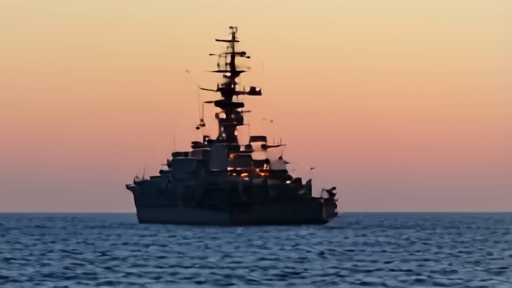
The Charles de Gaulle's transit is the kinetic part of what is otherwise a phone-and-X event. The carrier is the flagship of the Marine Nationale, displacing 42,500 tonnes, with a Rafale Marine air wing capable of strike, escort, and surveillance operations across the western Indian Ocean. [1] Its current position — heading toward the southern Red Sea, per the Wednesday French defence-ministry release — places it within roughly five days' steaming of the Strait of Hormuz approaches and well within range of escort tasking once the Franco-British construct is operational. The pre-positioning is, on its own terms, a hedge: the carrier's presence does not obligate it to operate, but its absence would have foreclosed the option of operating quickly. France's pattern with this carrier, across two prior mediation episodes, has been to pre-position before any agreement and to draw down only after one fails. The Wednesday release tells the Iranian foreign ministry, the Pakistani foreign ministry, and the U.S. State Department the same thing in three different sentences: the post-hostilities maritime architecture is not going to be designed in Washington alone.
The forty-nation Maritime Freedom Construct, which the Wednesday French defence release described as having "more than forty nations" supporting it, is the institutional shell. It was first floated by Britain and France in late April as a "purely defensive mission" explicitly without U.S. operational integration. The May 1 paper named it as the framework Macron and Starmer were holding back while hostilities persisted; the Wednesday-night release confirms the framework's pre-positioning is now active. The construct's operational asymmetry with Project Freedom — the U.S.-led escort operation Trump paused Tuesday night — is its principal feature: the Maritime Freedom Construct is structured to operate after the war ends, not during it, and its membership extends to nations that did not participate in the U.S.-Israeli kinetic envelope. That asymmetry is what makes it a third channel rather than a French annex to the American one.
Two calendar markers test the architecture in the next 14 days. The first is whether Macron speaks with Trump about the proposal before the seven-day window the President named to Fox News closes; the second is whether Charles de Gaulle reaches the southern Red Sea before the Pakistan IMF tranche clears Friday. Neither answer is in hand. What is in hand is the channel multiplication itself: three diplomatic vectors, three separate documents, one shared crisis. Pezeshkian's diplomatic register on Wednesday was not the same as Araghchi's "constructive talks" register on the morning of the same day. Macron's "without delay and without conditions" register is not the same as the Witkoff-Kushner staged-30-day register. Wang Yi's Hormuz line is not in Iran's own readout of the meeting at which Wang Yi delivered it. None of those register-asymmetries breaks the architecture. What they signal is that the war's diplomatic infrastructure has, inside 24 hours, become a multilateral one — without anyone yet signing the document that would make it formal.
The structural reading carries forward the iran-diplomacy-and-mediation thread. On May 6 the paper read the channel as operating fact again but operating through two texts. On May 7 the channel is operating through three. The proliferation does not by itself produce a settlement; what it produces is institutional accountability for the next collapse. If the Pakistan-mediated Witkoff-Kushner text fails, France's telephone register and the Charles de Gaulle's transit are now on the record as the European diplomatic alternative. If the Beijing register fails because Wang Yi's Hormuz line did not survive Iranian publication, the French and Pakistani registers continue to operate. The architecture multiplied is harder to break than a single channel. It is also harder to coordinate. Whether Trump, on the receiving end of three near-simultaneous calls from Macron, Sharif, and Xi inside the next 168 hours, treats the multiplication as ratification or as competition will determine what the IMF approval Friday morning actually purchases.
Macron, who has been advocating a "coordinated reopening" of the strait between Iran and the United States since early March, told reporters in Paris that the Franco-British initiative "will by its nature be separate from the warring parties." [1] That sentence is the institutional architecture in two clauses: the warring parties cannot design the post-war order, and Europe will not sign on to a U.S.-only design that excludes its own maritime equities. The Charles de Gaulle's wake is the same sentence in steel and water.
-- HENDRIK VAN DER BERG, Brussels