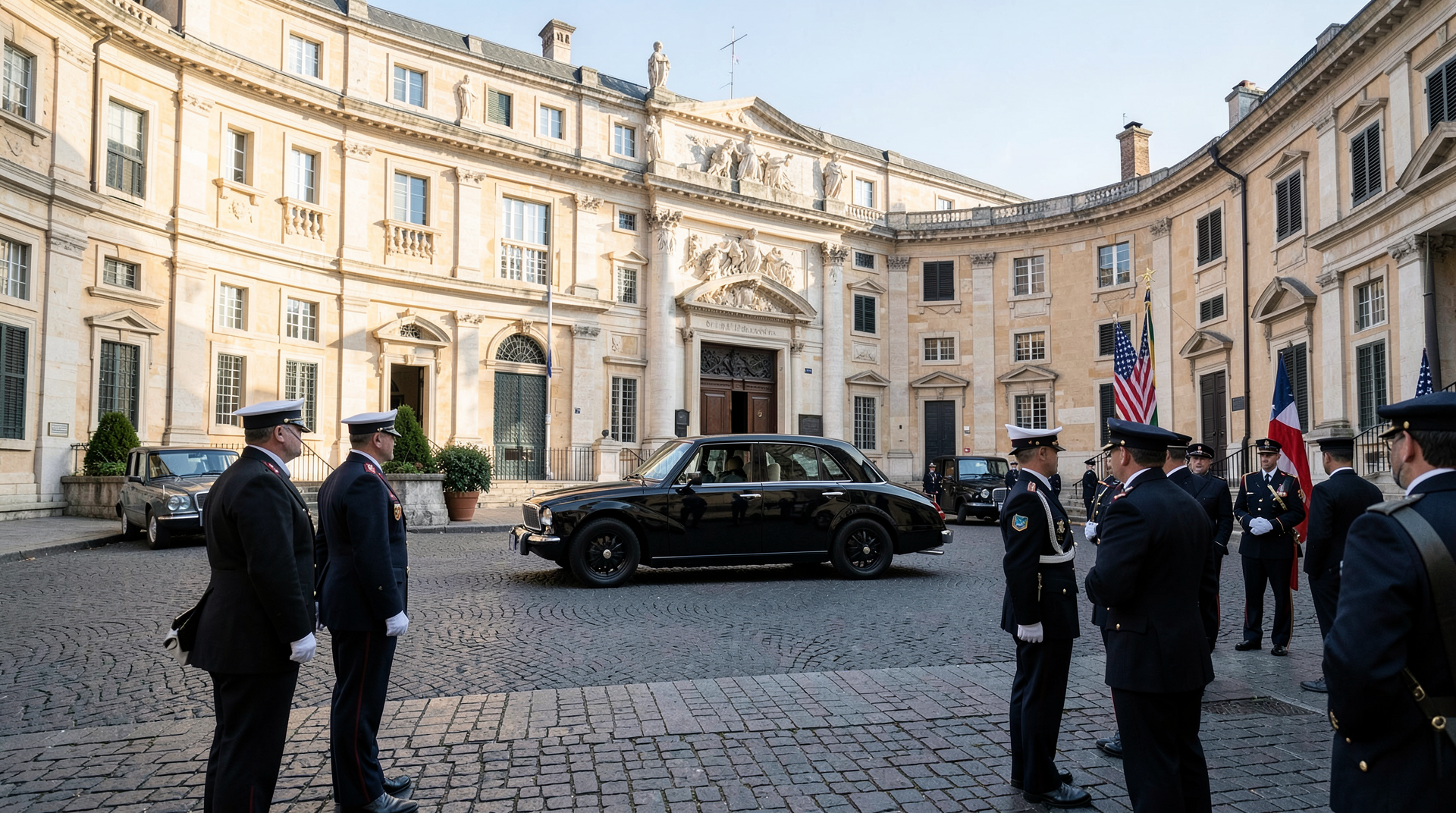
Secretary of State Marco Rubio's plane touched down in Rome on Thursday morning, the eve of Pope Leo XIV's first anniversary as pontiff. [1] At 11:15 a.m. local time, Rubio was due at the Apostolic Palace. At 11:30 a.m. local time, the doors closed for a half-hour audience with the first U.S. Pope. After the audience, Rubio was scheduled to meet Cardinal Pietro Parolin, the Vatican's Secretary of State. Earlier the same morning at 9:00 a.m., Pope Leo had received Polish Prime Minister Donald Tusk in a separate audience. [1] [2] Two state-level meetings inside three hours. The first cabinet-level encounter between the Trump administration and Pope Leo in nearly a year. The Pope's first-anniversary message, scheduled for Friday at the shrine of Pompeii, sits less than twenty-four hours away.
Both sides pre-staged the meeting with a single word: "frank." Brian Burch, the U.S. ambassador to the Holy See, told reporters Tuesday at Rome's Pontifical Gregorian University: "Nations have disagreements, and I think one of the ways that you work through those is… through fraternity and authentic dialogue. I think the Secretary is coming here in that spirit. To have a frank conversation about U.S. policy, to engage in dialogue." [3] Asked whether Rubio's task was to repair the Trump-Leo relationship, Burch added: "I don't accept the idea that somehow there's some deep rift." [4]
The May 6 paper carried the moment Pope Leo answered Trump's "endangering Catholics" attack at the Wednesday Audience, quoting Castel Gandolfo and keeping the answer in public, not in chancery. The May 6 brief on the first-anniversary clock framed Friday's Pompeii pilgrimage as homiletic register, not state address. Today's meeting compresses the public rebuke, the state-level audience, and the first-anniversary clock into a single forty-eight-hour register. The reading the paper offered yesterday — that the Vatican has converted from silence-as-position to live state-level engagement — is being tested in the next twenty-four hours, on a documentary clock the readout language will set.
The word "frank" carries a particular weight in diplomatic Italian and in Vatican English. It can mean a candid exchange between actors who hold each other in mutual respect; it can mean unresolved disagreement preserved on the record. Burch, in his Tuesday briefing, used "frank" to mean dialogue, fraternity, working through differences. The Vatican has not, as of Wednesday's evening, used the word at all. Rubio himself has not. The May 5 NBC News dispatch, citing Burch's briefing, framed the meeting as one Rubio "expects" to be "frank." [5] Rev. Antonio Spadaro, a Vatican official Christopher Lamb cited in his CNN preview, called it "cooling the rhetoric." [4] Two readings of the same meeting before it has taken place.
What sits behind both readings is a record from the past week that has placed five state-level actors on opposite sides of the same question. Trump, on Tuesday May 5, said Pope Leo's stance against military action in Iran was "endangering a lot of Catholics" and falsely claimed the Pope had said it was "OK" for Iran to have a nuclear weapon. [6] [7] The Pope, in remarks to journalists Tuesday, replied that the Catholic Church "for years has spoken out against all nuclear weapons, so there is no doubt there." [7] Italian Foreign Minister Antonio Tajani, in a public post, called Trump's comments about the Pope "neither acceptable nor helpful to the cause of peace" and reaffirmed his support "for every action and word of Pope Leo." [6] Italian Prime Minister Giorgia Meloni, a longtime Trump ally, has taken exception to Trump's comments. Meloni's Defense Minister Guido Crosetto has said the war in Iran "puts U.S. leadership at risk." [4] Rubio, who is also Trump's national security adviser, said Trump's remarks were rooted in his opposition to Iran obtaining a nuclear weapon, "which he said could be used against millions of Catholics and other Christians." [6] Rubio meets Meloni and Tajani Friday, the day of Pope Leo's first anniversary. The cohort of state-level actors disputing the Trump-Leo line is now five.
What sits inside the meeting is an agenda each party has named differently. The State Department's announcement, in a May 4 statement: Rubio "will meet with Holy See leadership to discuss the situation in the Middle East and mutual interests in the Western Hemisphere." [8] Rubio at a White House press briefing Tuesday: "There's a lot to talk about with the Vatican," naming "religious freedom, humanitarian aid to Cuba and the Catholic church growing in Africa." [9] He noted the Pope had just returned from a four-nation African trip and added that the United States had given Cuba $5 million in humanitarian aid that "they won't let us distribute" except through the Catholic Church. [9] The agenda, as Rubio described it in Washington, is a list of subjects on which Washington and the Holy See can find shared concerns. The agenda, as Trump's "endangering Catholics" line described it on Tuesday, is the war in Iran. The two agendas are not the same agenda. The thirty-minute audience can hold one of them publicly. The other will land, if at all, in the readout language.
The political shape of the meeting is the inversion the Vatican has not had to navigate before in the modern era. Pope Leo XIV is the first American pope in the Catholic Church's two-thousand-year history. Pope Leo's election, on May 8, 2025, was widely framed as the elevation of a Chicago-born cardinal whose particular gift, in the framing of his pre-papal career, had been quiet conciliation. The first ten months of the pontificate were homiletic. The shift began with Pope Leo's April 24 plane presser to Algiers, in which he called Trump's threats to Iran's "whole civilization" "not acceptable," and accelerated through his April 26 Regina Caeli address ("thieves who wage blood-thirsty wars"), his April address criticizing those who "use Christian teachings to promote the war" — read at the time as a thinly veiled criticism of Defense Secretary Pete Hegseth — and his Tuesday May 5 reply that the Church has "for years spoken out against all nuclear weapons." [4] [10] The Pope's voice, in the framing the Japan Times-Reuters dispatch carried Wednesday, has "found itself" inside the war. [10] What that voice means in the room — alone with Rubio, doors closed, no press — is the question Thursday's audience answers.
The historical structure of papal-presidential audiences provides one frame. The Holy See's diplomacy is, by tradition, behind closed doors. The readout language follows, and the readout language is the artifact. CNN's Lamb, in his Wednesday preview, framed today's audience as "an attempt to move beyond the public back-and-forth and return to the behind-the-scenes diplomacy favored by the Holy See." [4] Whether the post-audience press release uses the word "frank" — and whether it modifies it, expands it, or replaces it — is what the philosophical register of the meeting will turn on. The word is, in itself, an instrument. The Vatican's choice of language carries the weight of two thousand years of diplomatic practice in which what is omitted is as material as what is said. If the readout uses "frank," it preserves the disagreement on the record. If the readout substitutes "cordial" or "fraternal," it implies resolution. If the readout uses "candid" — the conventional Vatican term for a difficult exchange — it implies the disagreement was named.
The second-layer structural fact is the Tusk meeting at 9:00 a.m. The Polish prime minister, who replaced a Eurosceptic government in late 2023, is not in the same diplomatic register as Rubio. He is, however, in the same morning. Pope Leo received Tusk first. The order is a fact. Whether it carries weight beyond the calendar is a question the Vatican Press Office will not answer in a readout. What the Tusk meeting may produce — a Vatican-Poland artifact on Ukraine, on European integration, on the institutional architecture Pope Leo has not yet committed to — is, this morning, the second possible source of post-audience language. If the Tusk readout lands first and uses one register, and the Rubio readout lands later and uses another, the Vatican's choice between registers will be the documentary fact.
The third structural fact is the first-anniversary message Friday. Vatican News confirmed Pope Leo will visit Pompeii on May 8 to mark the first anniversary of his pontificate. He will celebrate Mass at 10:30 a.m., recite the traditional Supplica to Our Lady of the Holy Rosary, and pray at the chapel of Saint Bartolo Longo, who was canonized on October 19, 2025. [11] The setting is homiletic by design. The Pope is not delivering a state-of-the-pontificate address Friday. He is praying at a Marian shrine. The schedule itself is a choice. A first-anniversary that opens at Pompeii, not at the Loggia of Saint Peter's, frames the year through the Marian register, not through political analysis. Whether the Friday homily contains any reference to Iran, to migration, to nuclear weapons — to anything the Tuesday rebuke or the Wednesday Audience response named — is, in the documentary classification the May 6 paper used, what determines whether the anniversary travels into the documentary register or stays homiletic.
What is at stake in the readout is, beneath the diplomatic-language question, the relationship between two bodies of authority. The Catholic Church holds, as a magisterial teaching, that nuclear weapons are immoral; Pope Francis declared in 2017 that even the possession of nuclear weapons is "to be firmly condemned." Pope Leo's Tuesday reply was an invocation of that magisterial position, not a personal opinion. The Trump administration's argument, as Rubio articulated it Tuesday, is that Iran obtaining nuclear weapons would endanger Catholics and other Christians. The disagreement is not a misunderstanding to be cleared up. It is a disagreement about the character of authority. The Pope speaks in the register of the Church's teaching. The administration speaks in the register of strategic threat. The two registers can occupy the same room. The two registers cannot, by their nature, agree on whether nuclear weapons are subject to a moral teaching that overrides strategic calculation, or whether they are an instrument that admits of calculation independent of teaching.
The state-level register that yesterday's edition described as having shifted from position-by-absence to live engagement now has its first documentary test. The fifth act in the four-acts frame the Vatican has been working through — Saurimo internal, Malabo external, Bata detention, DePaul written, flight presser — has been a sequence of homiletic addresses (Easter Mass, Regina Caeli, the Wednesday Audience). Today's audience is the first state-level act. Tomorrow's first-anniversary message at Pompeii will be the next. Whether the audience produces a "frank" readout that travels into the anniversary message — or whether the homiletic register of Pompeii absorbs the political moment back into general appeal — is the test the next forty-eight hours run.
Burch's pre-staging, in the Tuesday briefing, telegraphed that the administration is not going to walk back the "endangering Catholics" line in advance. The line stays. The audience addresses it, or it does not. The readout uses "frank," or it does not. The Pope's first-anniversary message names the war, or it does not. Three documentary tests, ordered by clock, opened by an audience whose only press-staged word — on both sides — is "frank."
The word will tell us something the silence yesterday could not.
-- ANNA WEBER, Berlin