Novo Nordisk's Q2 print landed a day later in the U.S. tape than in Copenhagen, and the number that mattered was not the topline. It was the share. Of the 1.3 million Americans who filled a Wegovy-pill prescription in the first quarter, roughly 80 percent had never taken a GLP-1 medicine before — a figure CEO Mike Doustdar disclosed on Wednesday's call and U.S. franchise head Jamey Millar repeated to investors. [1] [2] By April 17, weekly U.S. prescriptions had reached 207,000. [3] More than two million prescriptions have been written since the January 5 launch, against more than one million patients now on therapy. [3] Novo's Copenhagen-listed shares closed Wednesday up 6.7 percent and traded as much as 9.2 percent higher intraday. [4] The U.S. tape opened Thursday with the question of whether the European pop holds; by mid-morning the answer was that it mostly did.
The paper's Wednesday read on the 65-percent new-script share called the only-pill window closed and the volume real. Tuesday's brief on Foundayo's 5,612 third-week scripts against Wegovy's 134,000 put the head-to-head at roughly 24 to 1. What Thursday's Day-2 numbers add is the patient register: not 80 percent of the volume going to people switching from a shot to a pill, but to people the obesity-medicine literature has been calling "untreated obesity" for two decades.
The arithmetic of the launch is easier to read once the share number is in hand. About 100 million American adults meet the CDC criteria for obesity or weight-related illness. The injectable Wegovy class, before the pill, had reached perhaps three million of them — fewer than three percent. The pill is now adding roughly 200,000 new starts a week, almost all of them, by the company's own count, to people who had not previously been on therapy. Doustdar called it a "turnaround situation" on the earnings call; the more precise word is conversion. The patient cohort the company has been chasing for fifteen years has, in three months, started showing up at the pharmacy counter.
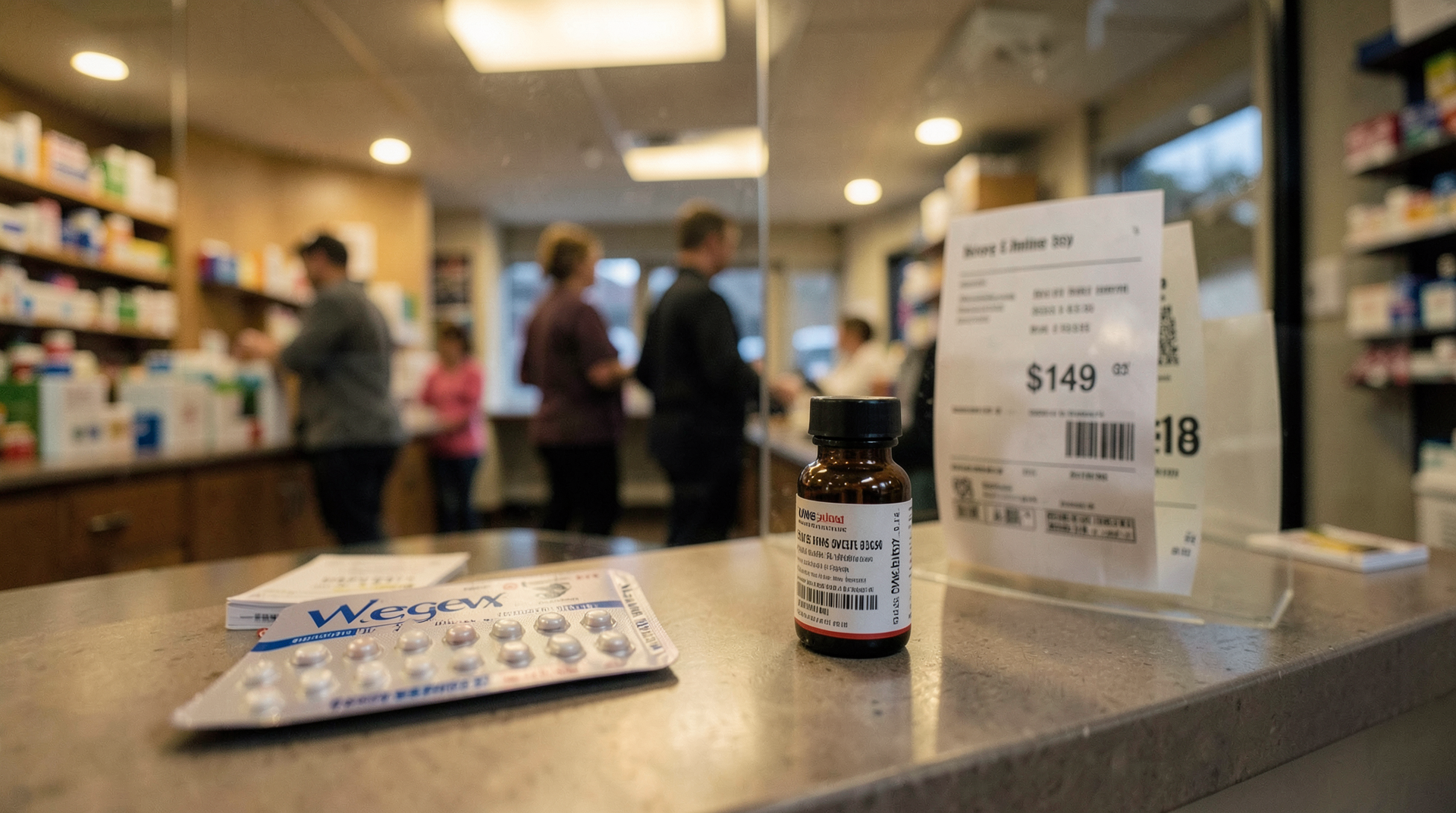
Underneath the share number is a price number that is doing the actual work. The Wegovy-pill starting dose, 1.5 milligrams, costs $149 a month at retail; the 4-milligram dose costs the same through August 31, then rises to $199; the 9-milligram and 25-milligram doses run $299. [5] Roughly 450,000 of the 1.3 million Q1 fills were the $149 starter dose, according to BMO Capital Markets analysts who flagged that revenue, at about $355 million for the quarter, came in around 12 percent below the $1 billion-ish revenue line some sell-side desks had carried into the print. [6] Volume real, dollars compressed: the same launch that beat the analyst-tracked pill-revenue line by 95 percent — 2.26 billion Danish kroner versus a 1.16-billion consensus — undershot the broader top-of-funnel revenue expectation by a noticeable margin. [4] [7] Novo's response was to raise full-year guidance from a constant-currency revenue decline of 5 to 13 percent to a decline of 4 to 12 percent, a one-point widening of the upper bound and a two-point lift of the floor. [4] Doustdar called the pricing tier a "sweet spot." It is also a structural commitment: half of U.S. Wegovy sales now come through self-pay, up from "just over 10 percent a year ago." [4]
What this looks like at the kitchen counter is the part the financial press tends to underplay. The five U.S. patients CNBC interviewed in April said they had held off on the injection class because of fear of needles or out-of-pocket cost. [2] The pill removes both barriers. The 80-percent naive figure means most of the people now starting therapy are not switching from Zepbound or Ozempic; they are starting from the place a hundred million Americans have been sitting for years. The clinical literature on obesity treatment has, for a decade, divided populations into "treated" and "untreated"; what the Wegovy-pill quarter discloses is that the untreated cohort is, in volume, willing to pay $149 a month for a daily tablet that requires waiting half an hour before breakfast.
The competition matters less than the headline framing implies. Eli Lilly's Foundayo (orforglipron) won FDA approval April 1; week three IQVIA data put fills at 5,612 against Wegovy's 134,000 the same week. [8] RBC Capital Markets's Trung Huynh has bracketed Foundayo's 2026 sales expectation at $1.3 to $1.5 billion contingent on the drug reaching more than 90,000 weekly prescriptions by week 12 to track the $1.4-billion run rate. [8] Foundayo's week-four IQVIA print, due Friday or Saturday into the same trading window, is the next concrete number against which the model can be marked. Lilly executives on the April 30 earnings call said more than 20,000 patients had been treated with Foundayo and that 80 percent of those patients were also new to GLP-1s — the same demographic Novo is reaching, on a smaller scale and through a narrower distribution channel. [8] Doustdar told reporters Wednesday that the head-to-head competition has not affected the Wegovy-pill trajectory: "We have now been competing with our competitor for about a month — and so far, so good." [4] Both companies are now reporting strong volumes from new-to-class patients. The market is expanding faster than either company is taking share from the other; what Friday's IQVIA print tests is whether the gap compresses materially or extends.
A second print is landing on the same week. The Lancet Psychiatry, which the paper covered Tuesday in a 100,000-person GLP-1 cohort showing depression incidence down 44 percent, has now placed the Swedish 95,490-individual within-person cohort study in the policy register: semaglutide associated with an adjusted hazard ratio of 0.58 for worsening mental illness, 0.56 for worsening depression, 0.62 for anxiety, 0.53 for substance-use disorder, and 0.56 for self-harm. [9] On the same Thursday a comparator-class study published on ScienceDirect found the opposite directional signal — semaglutide associated with elevated psychiatric risk versus SGLT2 inhibitors and DPP4 inhibitors as the comparator pool, rather than versus periods when patients were not on GLP-1 therapy. The two designs answer different questions, and they answer them in opposite directions. The FDA, which approved the pill December 22 with the same boxed warning the injection carries, now has on its desk two contemporaneous cohort designs producing opposite signals on the same drug class as the population in active prescription crosses one million. The post-marketing surveillance pool is large enough to detect rare adverse events. It is also large enough to detect rare benefits. What it is not yet large enough to do is settle the labeling question Novo's Q1 print just made urgent.
The injection portfolio is a footnote in the volume story but a structural one in the dollar story. Wegovy injection sales rose 12 percent year-on-year to 18.2 billion kroner — slightly below LSEG expectations. [4] Novo launched the higher-dose Wegovy HD (semaglutide 7.2 milligrams) in April; the STEP UP trial showed 20.7 percent mean weight loss, comparable to Lilly's Zepbound. [4] CFO Karsten Munk Knudsen told reporters they are not seeing significant patient drop-offs from injection to pill. The pricing architecture is what is doing the work: the company has deliberately put the pill below the injection at retail, which means the pill is not cannibalizing the shot; it is reaching patients who were not in the room. The 10,000-person franchise headcount reduction Novo has been executing inside the same twelve months sits beside this volume as the structural cost of building the new launch model — the obesity-medicine portfolio is now organized around two formulations, two price points, and two distribution channels (telehealth and retail) that did not exist together a year ago.
The structural reading of the 80-percent naive number is the demographic-winter receipt. The paper has been writing the demographic-winter thread as an institutional register — Title X language, NEST blueprints, USCCB silences — and as a fertility register tied to the body-composition science the obesity literature has accumulated over fifteen years. What the Q1 print converts the thread into is an operating one. The volume is now real enough to be a population-health variable; the naive share is high enough that this is mostly net new GLP-1 demand, not switching; and the price tier is low enough that the population effect is happening in households, not benefit plans. Half the U.S. Wegovy revenue now bypasses the PBM architecture entirely. Express Scripts, Caremark, and OptumRx have built their negotiating leverage on covered-life concentration; a self-pay-dominant market is one where the PBM is the cost-of-entry, not the gatekeeper. Industry attorneys have warned the channel shift will eventually trigger a DOJ or FTC inquiry into rebate structures. None has surfaced.
Two calendar markers compress the next 14 days. The Foundayo week-four IQVIA print arrives Friday or Saturday into the same U.S. tape that has just paid Novo the +6.7-percent close. If Lilly's print holds at or below the week-three baseline, the 24-to-1 ratio extends and Huynh's $1.4-billion FY model is in trouble; if it steps up materially toward 90,000 weekly, the gap is compressing. Either way, the model is now marked against an externally announced milestone. The second marker is structural: Novo has filed for European approval of the pill with the EMA and other regulators, with launches expected in the second half of 2026 into a single-payer system where self-pay rates are lower and the demographic curve is older. The U.S. launch is the dress rehearsal for a market the European obesity literature has been calling "untreated" for the same two decades.
The clinical implication of the 80-percent naive share deserves a closing sentence on its own terms. When most of the people starting GLP-1 therapy in any given week are doing it for the first time, the medicine's population-level effects — body composition, blood pressure, fertility, mental health, addiction — start landing on cohorts the literature has not previously observed at scale. The 1.3 million Q1 prescriptions and the one million patients on therapy mean the questions the GLP-1 literature has been asking in journal articles are now being answered in pharmacy data. The volume is real. The dollars compress. The patients are mostly new. What the August call will disclose is whether the maintenance-dose conversion rate from the $149 starter holds at any disclosed level — that conversion is the unannounced variable on which Novo's full-year revenue line will turn. The pill that arrived in January as a launch is, on Thursday, an operating fact about how 100 million Americans are about to be touched by the same molecule.
-- NORA WHITFIELD, Chicago