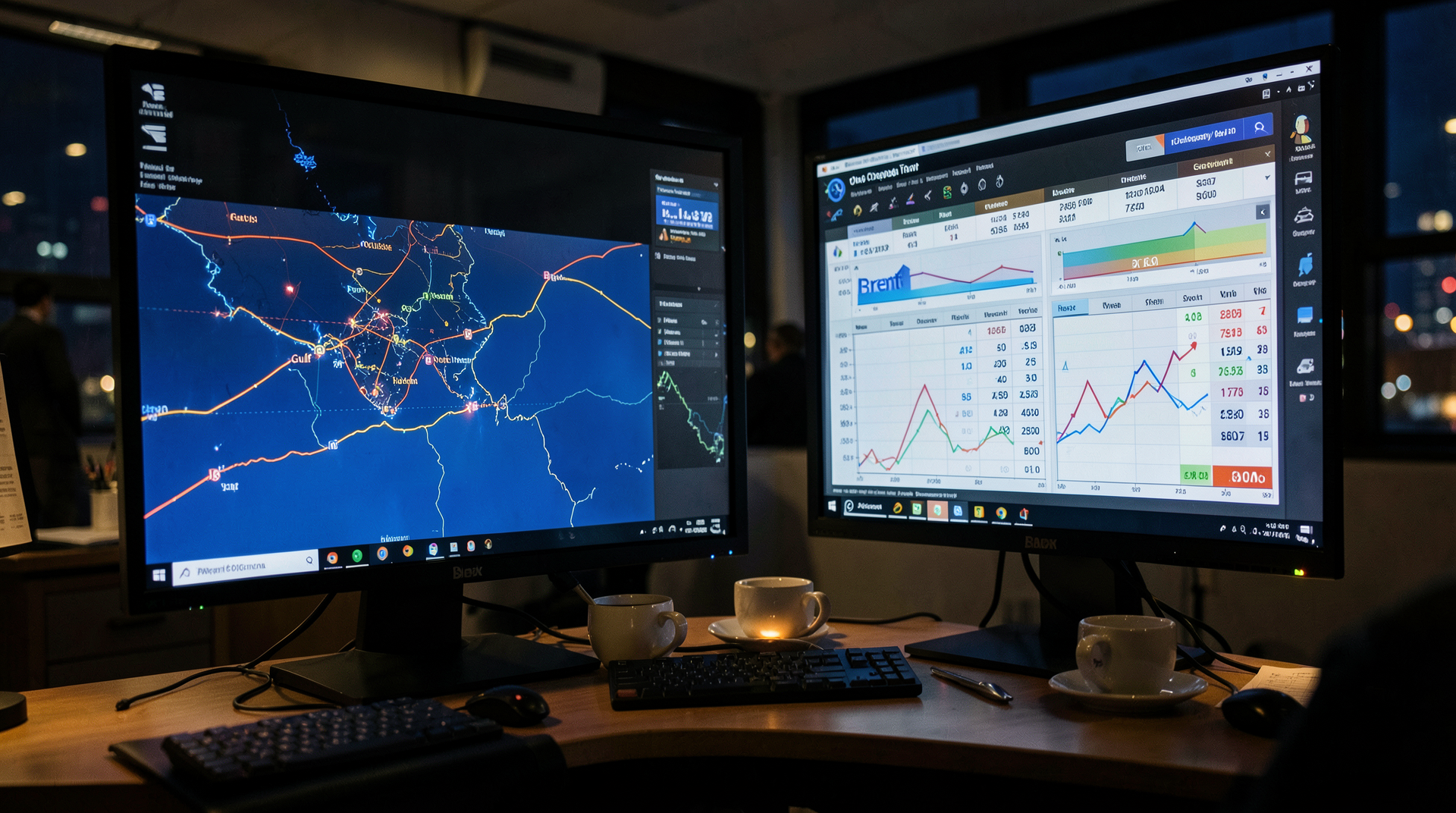
Saudi Aramco reports preliminary first-quarter results before the Tadawul open on Sunday, May 10, and the timing has made a routine earnings date impossible to treat as routine. Argaam reported that Aramco will release preliminary financial highlights before trading Sunday and full financial statements Monday, with analysts expecting first-quarter net profit of SAR 108.45 billion. [1] That is the company number. Hormuz has turned it into a kingdom number.
The paper's May 8 preview of Aramco's preliminary Q1 and the Saudi fiscal arithmetic said the print would test dividends, capex, and the company-versus-state split. The same day's oil feature on Brent closing around the $100 floor as tanker fire returned made the tape the second half of the story. Saturday joins them. Aramco is reporting into a war-premium market.
The reason is simple and uncomfortable. A higher oil price can make Aramco look stronger while the disruption that creates that price makes Saudi fiscal planning harder. The Middle East Insider's earnings preview framed the Q1 print as a dividend-under-pressure event, with the base dividend, performance dividend, and capital spending all tied to Brent scenarios. [2] It estimated that at an $80 Brent scenario the company sits near the dividend-coverage threshold, while higher prices restore comfort. [2] But a price premium created by constrained transit is not the same as a healthy volume environment.
OPEC+ adds to the contradiction. CNBC reported on May 3 that OPEC+ announced an output increase, and OPEC's own statement confirmed the June production adjustment. [3] [4] In ordinary conditions, added barrels would be read as a supply-management decision. In this tape, the barrels are paper relief against a physical strait problem. The cartel can announce volume. It cannot guarantee transit if the Strait of Hormuz remains a naval and diplomatic pressure point.
Aramco's March full-year release gives the baseline. The company reported adjusted net income of $104.7 billion for 2025, free cash flow of $85.4 billion, capital investment of $52.2 billion, and 2026 capital-investment guidance of $50 billion to $55 billion. [5] It also declared a base dividend of $21.89 billion for the fourth quarter, a 3.5 percent year-on-year increase. [5] Those are large, steady numbers. The war premium now asks whether steadiness is real or merely delayed stress.
The dividend layer is the first watch. Aramco's base dividend is the income machine for the Saudi state and the Public Investment Fund. A performance dividend would signal confidence. A zero performance dividend confirms caution. The May 8 predecessor carried the consensus that performance dividend per share would be zero. If Sunday confirms that, it tells investors that the company can be profitable and still unwilling to share upside beyond the base. That is not bearish in the normal sense. It is defensive.
The structure behind that decision explains the stakes. The kingdom holds more than eighty percent of the company directly, plus a PIF stake on top, so nearly every riyal of dividend flows back into the budget that funds Vision 2030's megaprojects, subsidies, and payroll. Total payouts reached roughly $124 billion in 2024 — among the largest shareholder distributions of any company on earth — with the performance layer introduced in 2023 explicitly tied to free cash flow after investment. The IMF has put Riyadh's fiscal breakeven oil price near $96 a barrel in recent years. A war premium that lifts Brent above that line repairs the budget arithmetic; a premium built on tanker fire also raises the insurance, shipping, and security costs inside every barrel exported. The state needs the price and dreads the reason for it.
The capex layer is the second watch. If Aramco holds 2026 capital investment within $50 billion to $55 billion, it preserves the disciplined message from the full-year statement. [5] If commentary leans higher because the company must protect capacity, expand gas, or harden infrastructure, the free-cash-flow gap widens. In a war-premium environment, capex is not only investment. It is insurance.
There is a recent rehearsal for that spending conversation. The September 2019 drone attack on Abqaiq and Khurais knocked out roughly five percent of world supply overnight, and Aramco restored the lost throughput within weeks — an operational feat — while quietly repricing its entire approach to site defense, redundancy, and surge capacity. Investors should expect Sunday's language about resilience to carry that memory. Hardening export infrastructure against drones and missiles is capital spending that produces no additional barrel; it exists purely so the existing barrels can keep their promise. Every dollar of it widens the gap between net income and free cash flow.
The third watch is whether management names Hormuz. It may not. Companies often prefer to let risk factors carry geopolitical weather while executives discuss operations in sanitized prose. But silence would itself be a position. Aramco's eastern export system depends on Gulf navigation, while west-coast infrastructure offers some flexibility. Investors know this. The question is whether the company says it. A sentence about shipping lanes, export flexibility, or regional security would turn the earnings call into the first major Gulf corporate answer to the kinetic-exchange week.
Mainstream coverage has each piece in its own box. Argaam has the release date and consensus profit. [1] CNBC has the OPEC+ production decision. [3] OPEC has the communique. [4] Aramco has the full-year financial base. [5] The paper's job is to put the boxes on the same table. A Saudi oil company reporting into a blockade week is not just an income stock. It is a fiscal pressure gauge for a state whose investment program, sports spending, megaprojects, and debt issuance all depend on the oil system doing two things at once: generating cash and moving barrels.
X's instinct is to call the war premium profiteering. That is too simple. Aramco may benefit from higher prices, but the Saudi state does not benefit cleanly from a Gulf that cannot be taken for granted. Higher prices compensate for risk. They do not remove it. A premium that exists because transit is impaired also raises costs elsewhere, chills investment, and forces fiscal choices. Saudi Arabia can earn more per barrel and still lose strategic optionality.
That is the paradox investors should keep in mind on Sunday. A strong net-profit number may not mean the kingdom is comfortable. A weak performance dividend may not mean the company is weak. A capex hold may not mean infrastructure risk is low. A silence on Hormuz may not mean Hormuz is immaterial. The earnings release is a corporate document inside a geopolitical market.
Geography sharpens the exposure in a way the release will soften. Nearly all of Aramco's export capacity loads from the east coast — Ras Tanura and Ju'aymah, the largest offshore loading complex in the world — which places the company's entire revenue engine inside the Gulf that Hormuz seals. The redundancy that exists runs west: the East-West pipeline to Yanbu on the Red Sea, built after the 1980s tanker war precisely as a strait workaround, with capacity in the neighborhood of five million barrels a day. That alternative is real, but it is also rationed, tollable, and itself dependent on pump stations that drones have made interesting targets. The west-coast flexibility investors cite is a pressure valve, not a second exit.
The OPEC+ June increase makes the point in miniature. Announcing more barrels into a war premium suggests producers expect eventual normalization or want to defend share before normalization arrives. [3] [4] But if the market is pricing the next tanker incident rather than the next monthly supply table, OPEC's paper barrels are an argument, not a guarantee. Aramco's Sunday print will be read the same way. It will not settle the war premium. It will show how one company survives inside it.
The next 48 hours therefore matter more than the headline consensus. Sunday gives preliminary highlights. Monday gives financial statements and, depending on the format, fuller management context. [1] If the print lands near SAR 108.45 billion and guidance stays disciplined, the market may initially call it relief. The paper's position is that relief will be incomplete unless the call explains how Aramco thinks about the strait, the dividend, and the state's fiscal needs in one sentence.
Aramco was built to make oil look like an operating business rather than a national balance sheet. Hormuz reverses that work. Every barrel now carries a security assumption. Every dividend carries a fiscal assumption. Every capex line carries a resilience assumption. The company reports Sunday. The sea has already reported first.
-- DARA OSEI, London