The week's most reliable entertainment product is not yet a film, a song contest, a concert, or an album. It is the countdown. Cannes opens May 12 under Park Chan-wook's jury. [1] Eurovision's 70th anniversary runs in Vienna on May 12, 14, and 16. [2] Drake's Iceman lands May 15 after a streamer-led treasure hunt. [3] Harry Styles' Amsterdam residency clock is running. [4] Olivia Rodrigo's chart cycle is holding before the next album cycle fully arrives. [5] The rollout economy has arrived before the products.
The paper's May 8 briefs treated these as separate clocks: Drake's streamer treasure hunt replacing the press cycle, Cannes locking Park Chan-wook's jury, and Eurovision's Vienna anniversary final landing eight days out. Saturday's job is to say the clocks are the same story. Culture is increasingly manufacturing demand, identity, and argument before the main event appears.
Start with Cannes, because Cannes makes anticipation look respectable. The festival announced that Park Chan-wook will chair the jury for the 79th edition, joined by Demi Moore, Ruth Negga, Laura Wandel, Chloé Zhao, Diego Céspedes, Isaach De Bankolé, Paul Laverty, and Stellan Skarsgård. [1] The official release is a list, but not only a list. It is a market signal. Before a single Competition film is debated on the Croisette, the jury composition tells critics what kind of festival they are preparing to enter: Korean cinema at the center, Hollywood present but not dominant, European and global prestige arranged as a moral panel.
Eurovision makes the same move in public-broadcaster language. The contest page gives the dates, venue, and Vienna setting for the 70th edition. [2] Eurovision's newsroom has also described the anniversary as a global celebration, with the event's public-broadcast machinery doing as much work as the songs. [6] The fan already knows the ritual before the music. Semifinal dates, running-order arguments, broadcaster withdrawals, host-city economics, and boycott pressure all circulate before the final. Eurovision sells a civic machine that happens to culminate in a song contest.
Vienna is doing double duty as venue and argument. The city hosted the sixtieth contest in 2015, when Conchita Wurst's win had made Eurovision a byword for European identity politics; staging the seventieth there lets broadcasters frame the anniversary as continuity — the same hall of civic ritual, a decade older and more contested. The discourse ahead of this edition has run less on songs than on who is singing at all: withdrawal threats, boycott campaigns, and qualification controversies are all pre-product content, consumed as eagerly as rehearsals. The anniversary was engineered as a celebration. The rollout economy has converted it into a season-long referendum.
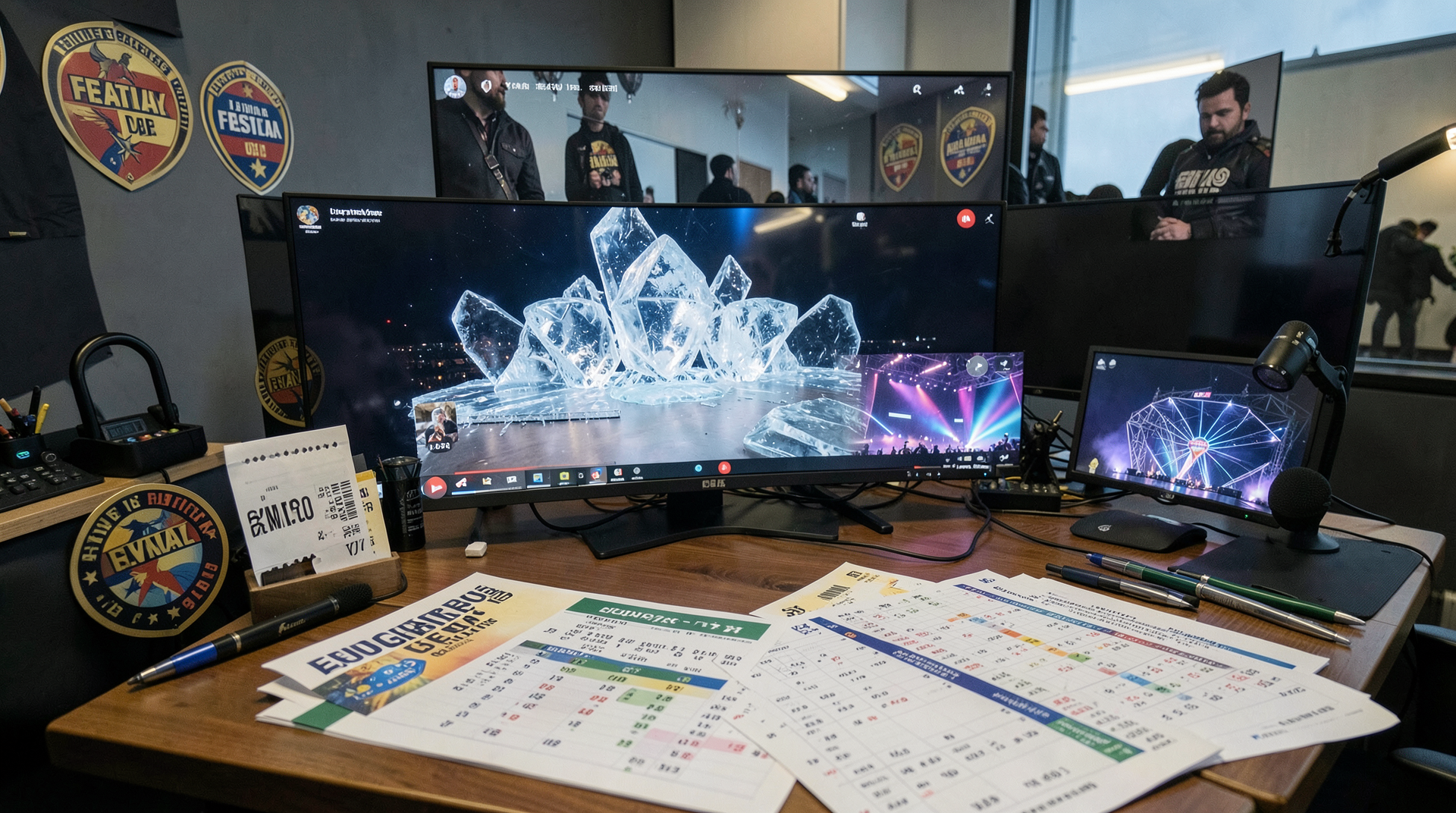
Drake's Iceman offers the inverse: no civic machine, nearly no traditional press, and a rollout built around platform behavior. Billboard reported that Drake announced another Iceman livestream, episode four, for May 14, leading into the album's May 15 arrival. [3] The campaign has included livestreams, a downtown Toronto ice sculpture, streamer Kishka finding a bag with the release date, and the kind of fan-clue economy once reserved for pop acts with armies of adolescent detectives. [3] The stunt was not coverage of an album. It was the album's first marketplace.
Rolling Stone's broader Iceman guide makes the press-cycle substitution plain. Drake has routed attention through streamers, snippets, platform-native appearances, and online speculation rather than the old sequence of magazine cover, radio interview, late-night performance, and review embargo. [7] The point is not that press disappeared. It is that the press now covers the audience's hunt. The artist makes a puzzle. Fans solve it in public. Publications summarize the solving. The rollout has become a distribution surface.
Harry Styles sits in the venue-economics corner of the same room. Johan Cruijff ArenA lists the Together Together dates in Amsterdam, while Live Nation carries the event architecture. [4] [8] A stadium residency sells not only songs but travel, resale anxiety, fan identity, local hospitality, and the promise that scarcity is being organized rather than merely endured. The product is partly the show. It is also the months of proof that one got in, got there, and belonged.
Olivia Rodrigo's Hot 100 hold belongs because chart engineering is another countdown product. Billboard's coverage of her single debut and subsequent chart conversation treats the song as both music and cycle architecture. [5] [9] Coachella, smaller-room performance, single, album date, and fan-theory loop are not ancillary. They are the path by which a song becomes a season. Rodrigo's version is press-cooperative where Drake's is press-avoidant, but both accept the same premise: the public must be given things to do before the thing arrives.
Mainstream entertainment coverage tends to file these separately. Cannes is film. Eurovision is television and music. Drake is hip-hop. Styles is touring. Rodrigo is chart pop. That separation reflects newsroom desks more than audience behavior. The same user may watch a Cannes jury clip, argue about Eurovision withdrawals, monitor Iceman clues, price Amsterdam hotels, and track Rodrigo chart points in one feed. Fan attention does not respect legacy sections. It flows toward clocks.
X is the natural home of the rollout economy because X turns countdowns into labor. Fans clip, decode, rank, complain, defend, and archive. Skeptics mock the machinery and thereby feed it. Every pre-event artifact becomes content: a jury name, a livestream date, a sponsor, a seating chart, a song snippet, a set photo. The event may disappoint later. The rollout has already produced days of participation.
This is not simply hype. Hype is old. What is new is the operational density of the pre-product period. The rollout now has its own measurable outputs: livestream concurrent viewers, resale prices, waitlist size, press mentions, TikTok sound use, pre-save numbers, hotel bookings, social sentiment, and chart predictions. An entertainment company can judge demand before the product appears and adjust supply, pricing, access, or narrative accordingly. The countdown is a market-research instrument that sells itself while collecting its own data.
The lineage makes the shift legible. The 2010s ended with the surprise drop — Beyoncé's 2013 visual album and its imitators treated silence as spectacle and release day as ambush. That model worked for artists with armies of devoted followers and collapsed for everyone else; it also monetized nothing before the moment of arrival. The rollout economy is the surprise drop inverted and industrialized. Where the ambush sold shock, the countdown sells participation — and participation can be measured, priced, and extended for weeks. Drake's streamer hunt is what happens when an industry that once envied Beyoncé's mystery discovers that mystery cannot be A/B tested but a treasure hunt can.
There is a cost. The product can become almost secondary. A film festival's artistic gamble may be buried under jury symbolism. A song contest's performances can be pre-judged through geopolitical discourse. An album can arrive as the solution to a marketing game rather than as music. A concert can become proof of access more than an evening of sound. The rollout economy rewards anticipation, but anticipation is impatient. It wants confirmation, not surprise.
Still, the machinery is not inherently cynical. Cannes' jury list can teach an audience how to watch. Eurovision's anniversary frame can remind viewers that public broadcasting still produces shared European time. Drake's streamer hunt can reveal that younger audiences experience release dates as live events, not calendar entries. Styles' venue clock can funnel money into local economies and grassroots music funds. Rodrigo's chart cycle can turn a single into a communal marker. The rollout can be art's porch light.
The question is which model fails first. Drake's model fails if the album cannot justify the hunt. Cannes fails if the jury symbolism outshines the films. Eurovision fails if geopolitics makes the songs feel like procedural interruptions. Styles fails if scarcity curdles into resentment. Rodrigo fails if the cycle feels too managed to be alive. Each product must eventually meet the demand its rollout created.
For now, the countdown is winning. The products are close enough to feel real and far enough away to remain perfect. That is the economic sweet spot. Culture once sold opening night. Now it sells the days before opening night, each with its own evidence, arguments, and receipts. The show still matters. But the market opens before the curtain does.
-- CAMILLE BEAUMONT, Los Angeles