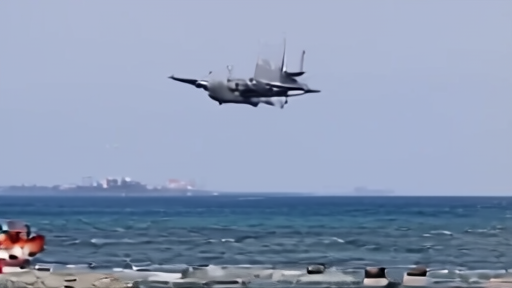
U.S. Central Command disclosed Saturday afternoon that F/A-18E/F Super Hornets from the carrier strike groups built around the USS Abraham Lincoln and the USS George H. W. Bush conducted strafing runs against three Iranian-flagged tankers in the Gulf of Oman on May 6 and May 8, using 20mm M61 Vulcan cannon fire and precision-guided munitions to disable the propulsion and steering systems of M/T Hasna, M/T Sea Star III, and M/T Sevda without sinking any vessel and with the crews offloaded to a USS Bush helicopter detachment in advance of the attacks. [1] The CENTCOM release was the first formal U.S. acknowledgment that naval aviation has been employed in the Hormuz blockade enforcement campaign, ending three weeks of plausible deniability about whether the disabled-tanker incidents that had been appearing on AIS tracking data were the work of small craft or air assets.
Three Super Hornet strafing runs from two distinct carrier strike groups in forty-eight hours is the operational answer to "the ceasefire is holding." The kinetic exchange that President Trump declared "terminated" in his April 7 letter to congressional leadership is in fact running at carrier-aviation tempo. The paper's Saturday account of Iran's Ocean Koi seizure as a counter-blockade receipt — the sea ledger as symmetric in form even if asymmetric in capacity — has been answered Sunday by the disclosure that the American side of the ledger is being run by carrier aviation, not by the smaller surface assets that until now had carried the public attribution.
What CENTCOM published
The CENTCOM statement, released at 1620 GMT Saturday from the public affairs office in Tampa and republished by U.S. Naval Forces Central Command in Bahrain, runs to four paragraphs. It identifies the three target vessels by name and by the cargo each was carrying — between 1.1 and 1.4 million barrels of Iranian crude per vessel, all bound for refineries in the People's Republic of China. [1] The statement asserts that all three vessels were "intercepted under the Hormuz Sanctions Enforcement Authority" derived from Executive Order 13902 and the December 2024 amendments, that all crews were warned in Farsi and English and offloaded to U.S. helicopters, and that the strafing runs targeted only propulsion and steering systems "to render the vessels non-navigational without environmental release."
What the statement does not contain is the detail that confirms the operational tempo: which carrier-air-wing squadrons launched the strikes, what the time-on-target intervals were, and whether the targeting cells were operating from the Lincoln and Bush directly or from CENTCOM's joint air operations center in Qatar. The Army Recognition open-source defense outlet, which has cultivated CENTCOM relationships across both the Biden and Trump administrations, reported Sunday morning that the May 6 strike against the Hasna was conducted by a four-aircraft section from VFA-147 "Argonauts" off the Lincoln, and the May 8 strikes against Sea Star III and Sevda by two-aircraft sections from VFA-87 "Golden Warriors" off the Bush. [2] Neither squadron has acknowledged the action publicly; both names appear in the public Air Wing Eleven and Air Wing Eight rosters.
The two-carrier presence
The U.S. Navy's standing posture in the U.S. Fifth Fleet area of responsibility is one carrier strike group on rotation. The dual presence of the Lincoln (Carrier Strike Group Three, deployed from San Diego in November) and the Bush (Carrier Strike Group Ten, deployed from Norfolk in February) is the largest U.S. naval-aviation footprint in the Gulf of Oman since the 2019 surge during the original Iranian tanker-seizure campaign. The Lincoln was scheduled to return to homeport in May; the deployment was extended on April 8, the day after the President's "destroy Iranian civilization" remarks at Joint Base Andrews. The Bush was deployed in February in what was publicly described as a "training rotation" through the Eastern Mediterranean; its movement into the Fifth Fleet area in late April has not been the subject of a Pentagon public-affairs statement.
The carrier-aviation footprint matters operationally because it allows for sustained, distributed targeting at a tempo small surface assets cannot match. A single Arleigh Burke-class destroyer can intercept a tanker; it cannot intercept three tankers in forty-eight hours across an 800-nautical-mile arc of the Gulf of Oman. Two carriers operating in coordination can. The carrier presence also matters politically because it places approximately 11,000 American sailors and aviators in the area of an active blockade enforcement campaign that has not been authorized by Congress under the War Powers Resolution.
The Trump letter contradicted
The President's "hostilities terminated" letter, sent to congressional leadership on April 8 to comply with the War Powers Resolution's reporting requirement after the brief April 7 ceasefire, has been overtaken by every CENTCOM disclosure since. The May 6 and May 8 strafings, by the strict reading of the statute, would qualify as "introduction of United States Armed Forces into hostilities" requiring fresh notification within 48 hours and triggering a 60-day clock for congressional authorization. No such fresh notification has been transmitted; the May 8 forty-eight-hour window expires Sunday at 0837 EDT, three hours before the time of writing.
Senator Lisa Murkowski has signaled she will introduce an Iran AUMF when the Senate returns the week of May 11, citing the President's failure to maintain a War Powers Resolution-compliant posture. Representative Tom Barrett, the Michigan Republican who filed a House AUMF on Wednesday, named the strafing campaign in the bill's findings section. The carrier disclosure Saturday is now part of the documentary record on which the AUMFs will be debated, if they reach a floor.
What X read first
The X discourse on the disclosure Saturday afternoon and Sunday morning is anchored on the carrier-attribution detail, which the Clash Report account and the open-source aviation tracker @StealthArchitect aggregated within ninety minutes of the CENTCOM release. The reading is that the dual-carrier presence and the named-squadron attribution make the strafing record incompatible with the President's "terminated" framing in a way that previous, attributable-to-anyone disabled-tanker incidents were not. Mainstream U.S. coverage Sunday morning has filed the disclosure as routine blockade enforcement; CNN's Sunday segment described the runs as "limited interdiction" and did not reach the carrier-attribution detail. [3]
The Iranian response has come not as a counter-text to the strafing record but as a kinetic-register threat: IRGC Aerospace commander Maj. Gen. Mousavi's Saturday-evening declaration that Iranian "missiles and drones are locked on the enemy and we are waiting for the firing order" cited the strafings as the proximate provocation. The Ocean Koi remains in Iranian custody Sunday. A third U.S. carrier strike group has not been disclosed in the area of responsibility. The window the President set on April 29 closes Wednesday.
-- YOSEF STERN, Jerusalem