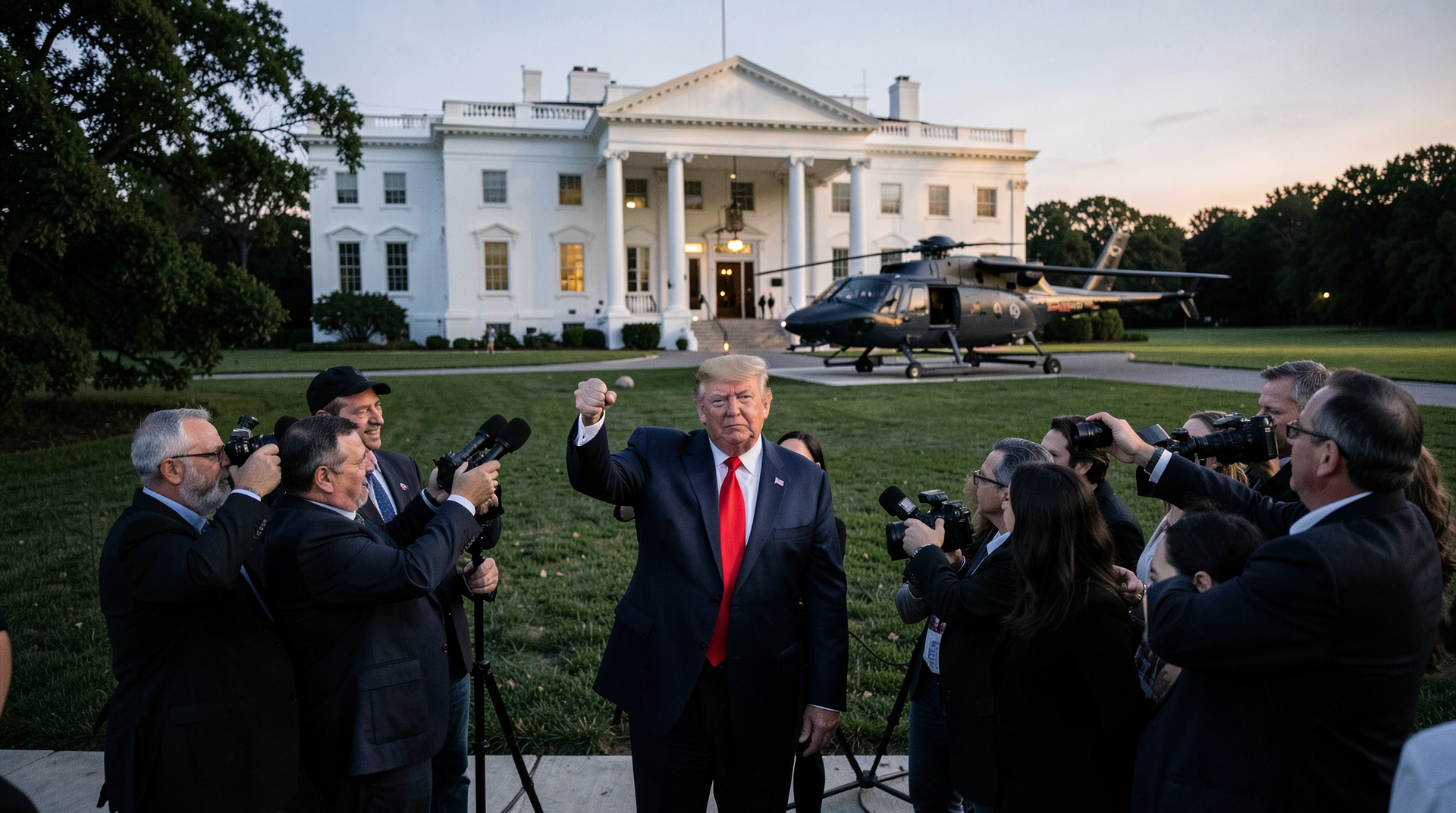
Iran has not formally responded to the 14-point proposal U.S. Special Envoy Steve Witkoff carried into Doha eleven days ago, and President Trump's only public statement on the subject Saturday was a four-word shrug to reporters at the South Lawn boom: "We'll see what happens." [1] The window the President set on April 29 — what he called "one week" — closes Wednesday, May 13. Today is the fourth day from the deadline. The Foreign Ministry in Tehran continues to describe its position as "reviewing." [2]
The paper's Saturday account argued that the credible-threat architecture had failed to produce a deadline that would produce a signature, and that the four-days-out posture was structural rather than editorial. The May 9 lead added that the diplomatic ledger and the kinetic ledger were now running in parallel. Sunday's news cycle — an Aramco quarterly print, an IRGC Aerospace commander declaring his missiles "locked," and three CENTCOM-disclosed naval-aviation strafings — has confirmed the structural finding.
Where the proposal sits
The 14-point document, according to a Time magazine reconstruction citing two U.S. and one Qatari official, contains four blocks the parties have not closed. [3] The enrichment ceiling is the largest. The United States is asking Iran to accept a 12-year zero-enrichment regime; Tehran has proposed five years and reportedly told mediators that twenty — the original American demand — was a non-starter. The 12-year number is a compromise that splits the original gap but, in the words of one official quoted by Al Jazeera, "splits it from the American side, not the middle." [2]
The second block is freedom-of-navigation language for the Strait of Hormuz. The American draft contains a 12-mile Iranian territorial-waters carve-out — the standard UNCLOS measurement — but conditions free transit on Iranian renunciation of the right to inspect non-Iranian-flagged shipping for sanctions evasion. Tehran reads this as asking it to surrender the legal basis for the seizures it has used as the structural pressure on the strait since 2019. The Ocean Koi remains in custody Sunday on exactly that basis.
The third block is sequencing — which side stops first, and on what verifiable schedule. The April 7 ceasefire failed because no document governed sequencing; the strait closed inside seventy-two hours and live fire resumed. The 14-point proposal, by the available reporting, contains a phased sanctions roll-back tied to International Atomic Energy Agency access to Fordow and Natanz. It does not contain a verification-failure clause specifying what happens if access is granted but the inspectors disagree with the inventories.
The fourth block is the monitoring framework. Iran has reportedly insisted that Pakistan not be one of the named monitors, citing Islamabad's December 2024 visit by Saudi Crown Prince Mohammed bin Salman. The American draft includes Qatar and Oman as monitoring states; the open slot is the fourth. Macron's channel, opened on May 6, was said to be auditioning France for the role. Wang Yi's separate channel, run through the Foreign Ministry in Beijing, has not produced a public readout in nine days.
The Qatari Miami meeting
Qatari Prime Minister Mohammed bin Abdulrahman Al Thani met Witkoff and Secretary of State Marco Rubio at a private residence in Miami Beach on Saturday afternoon, according to a State Department readout that confirmed the meeting but not its substance. [2] The PM had flown in Friday night from Doha; the choice of Miami over Washington has been read inside the State Department as keeping the meeting off the official Washington record while Trump remained at Bedminster.
The Qatari channel is the fourth in formal active rotation alongside Pakistan (Sharif, the December 2024 channel that brokered the April 7 ceasefire), France (Macron, opened May 6), and China (Wang Yi, opened in late April). It is the only channel of the four that has produced a face-to-face meeting between an Iranian-trusted intermediary and the senior American negotiating team since the proposal was carried in. Qatari officials have, in the past, transmitted Iranian positions in unwritten form — the 2023 prisoner exchange was negotiated through a similar pattern of verbal-only relay.
The Sunday morning news cycle in Doha did not produce a Qatari readout. Al Jazeera's English live blog led with the IRGC Mousavi statement and the Israeli strikes in Lebanon; the Miami meeting was a single line. The absence of a Qatari press posture is itself the readout — when Doha wants to brief an outcome, it briefs aggressively.
Trump's "we'll see what happens"
The President took two questions from reporters as he boarded Marine One Saturday afternoon. The first, on whether Iran had answered, drew the four-word reply. The second, on whether he would extend the window, drew "I don't think we need to." [1] Press secretary Karoline Leavitt declined to be drawn out further on a White House call with reporters that evening, citing "active negotiations." The "active" framing is itself a contested word — the U.S. side has not transmitted a counter-proposal in the eleven days since Witkoff carried in the original, and "review" is the only Iranian-language posture publicly attached to the file.
The "we'll see what happens" line is, in form, the same construction the President used on March 21 ("we'll see if they come to the table"), April 14 ("we'll see what they want to do"), and April 28 ("we'll see if there's a deal"). On each prior occasion the line preceded a kinetic event by between thirty-six and ninety-six hours. The pattern is not predictive; the pattern is documentary. The phrase has functioned, across this Presidency, as a way of holding the public position open while the operational position narrows.
What X is doing with the silence
X discourse on the file Sunday morning is anchored on the Mousavi statement — the IRGC Aerospace commander's "missiles and drones are locked on the enemy and we are waiting for the firing order" — and on the Clash Report aggregation that the silence is now past its useful diplomatic life. [4] The reading on X is not that Iran cannot answer. It is that Tehran has chosen not to answer in writing because an unanswered window is more humiliating to the President than a counter-proposal would be: extend the window and Trump advertises weakness; restart strikes and Trump advertises that the April 7 ceasefire never settled anything.
Mainstream coverage frames the silence as procedural — review under mediation, the standard delay of any complex multi-party negotiation. Both readings can be true. The structural fact, on which both agree, is that there is no signed text. There has not been one for thirty-three days, since April 7. Wednesday will or will not produce one.
The institutional Sunday
The Aramco quarterly print Sunday morning was the producer-state institutional answer to the window — a $33.6 billion adjusted Q1 with the East-West pipeline operating at full 7-million-barrel capacity, the structural disclosure that the bypass works. The Mousavi statement was the operator-state kinetic answer. Neither was an Iranian counter-text on paper. Wednesday at 0000 GMT will mark the end of the seventh day of the President's window. Today is the day Tehran could file a reply that closed the question. Today is also the day Tehran could not.
The Foreign Ministry in Tehran has scheduled no Sunday or Monday press conference. The Supreme National Security Council last met Friday and produced no statement. The next public-position transmission from Iran is, at the time of writing, the next IRGC press release.
-- SAMUEL CRANE, Washington