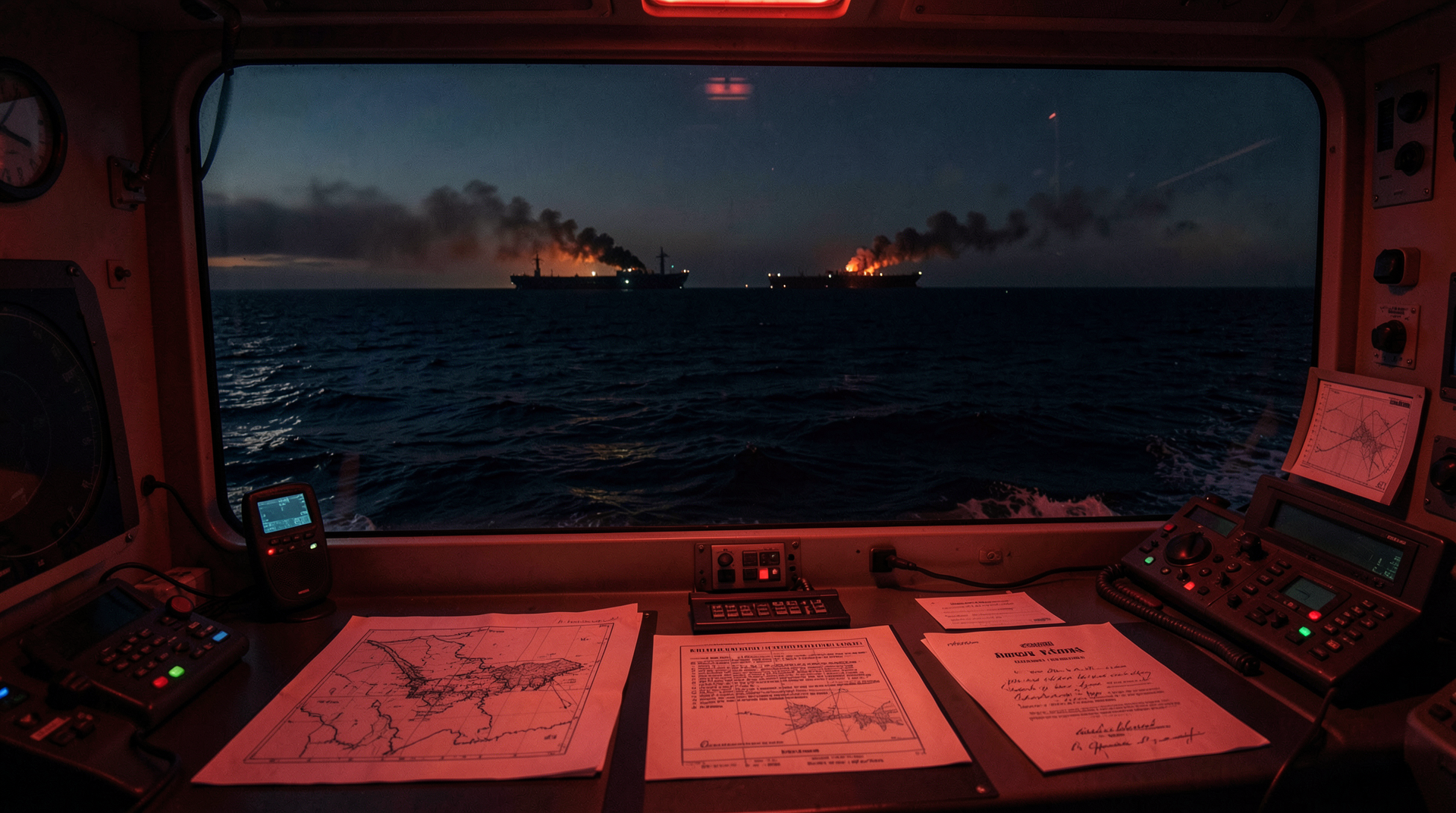
Iran's answer to Washington's latest ceasefire proposal remained unsigned on Saturday, while the operational answer in the Strait of Hormuz had already been written in smoke. Tehran told Al Jazeera it was still reviewing the U.S. plan, a reported 14-point document involving a nuclear moratorium, sanctions relief, frozen assets, and a staged reopening of the waterway. [1] In the same cycle, U.S. and Iranian forces traded fire, two Iranian-flagged tankers were disabled by U.S. forces, and Iran seized the Barbados-flagged Ocean Koi in the Gulf of Oman. [2]
The paper's May 8 lead said the dilation had inverted into live ammunition: the negotiating window survived only by being reasserted through force. A second May 8 brief held that Pezeshkian's no-pressure floor ran into live fire without collapsing. Saturday's fact is narrower and more dangerous. Both claims can still be true because the war now has two ledgers. One is diplomatic review. The other is tanker fire.
Al Jazeera's account is the diplomatic ledger. The U.S. proposal, as reported, would have Iran agree not to develop a nuclear weapon, halt enrichment for at least 12 years, and hand over a stockpile of highly enriched uranium. In return, Washington would gradually lift sanctions, release frozen Iranian assets, and withdraw its naval blockade. [1] The plan would reopen the strait within 30 days of signing. That last word carries the story. Signing has not happened. Tehran has not produced a public acceptance. Iran's Foreign Ministry was still telling reporters it was reviewing the paper, while Iranian officials pushed back on the nuclear provisions and said the immediate negotiation was about ending the war, not reopening the nuclear file. [1]
The sea ledger is less ambiguous. NPR's war update carried the same exchange as a battlefield sequence rather than a mediation sequence: Iranian attacks on U.S. naval vessels, U.S. strikes on Iranian targets, and the continuing blockade of vessels entering or leaving Iranian ports. [2] CNBC placed the same day inside the oil market's grammar, with the blockade and tanker risk driving the war premium back into view. [3] The point is not that one register is true and the other false. The point is that a reader following only one misses the mechanism. Diplomacy did not die when the missiles flew. But live fire changed what any diplomatic answer must now unwind.
The Ocean Koi is the useful hull because it shows Iran's counter-blockade in concrete form. Reuters, carried by Yahoo, reported that Iran seized the tanker in the Gulf of Oman over an alleged attempt to disrupt Iranian oil exports, saying the Barbados-flagged vessel had been carrying Iranian oil and was trying to harm exports by exploiting regional conditions. [4] Anadolu, citing Iranian state media, reported the same seizure and said Iranian naval forces escorted the tanker to Iran's southern shores before handing it to judicial authorities. [5] The ship had been under U.S. sanctions since February. [4] That matters. Iran did not need to prove the Ocean Koi was American to make its point. It needed a vessel, cargo, custody, and a judicial handoff. It now has all four.
Washington's side has its own count. The May 8 record said U.S. forces had disabled M/T Sea Star III and M/T Sevda by firing precision munitions into their smokestacks as they attempted to reach Iranian ports, following the earlier disabling of another Iranian-flagged hull. [2] U.S. commanders described blockade enforcement as controlled and precise. Iran described U.S. strikes as violations of the ceasefire. [1] The two records do not meet in the middle. They pass each other like ships without lights.
The munitions choice is its own document. A smokestack shot disables propulsion without holing a hull, spilling cargo, or killing a crew — the difference between an enforcement action and an atrocity is engineered into the aimpoint. Under the naval-warfare rules Washington wrote and invokes, a blockade must be declared, effective, and discriminating; precision-disabling is how a navy advertises all three at once. Iran reads the same shots differently: each disabled tanker is proof that the reopening promised in the unsigned text has already been foreclosed in practice, whatever the negotiators initial. Both readings fit the same facts, which is why the facts keep escalating.
The unsigned document is therefore not a procedural detail. It is the central fact. Secretary of State Marco Rubio had expected an Iranian response by Friday, according to the research stack cited in the planning file, but no signed text was public by Saturday morning. Al Jazeera's report says Tehran was still reviewing the plan; Le Monde, drawing on AFP, framed Washington as awaiting Iran's response despite clashes. [1] [6] That is not diplomatic failure yet. It is a clock. Trump's one-week window, first named after the previous 48-hour ultimatum stretched, continues to run toward midweek. A signature before then would be a document arriving after a kinetic proof. No signature means the kinetic proof is the only operating agreement.
Pakistan remains a channel to watch only if officials put a name or document to it. The IMF timing is a financial fact, not proof of mediation, and it should not be made to carry more evidence than the public record gives it. The actual receipt is narrower: no signed text has emerged. Macron's channel and Wang Yi's Chinese register remain parallel, not controlling. The channel architecture is alive, but alive in the way a hospital monitor is alive: measurable, blinking, and attached to a patient still in danger.
Markets understand the gap more quickly than diplomats admit it. CNBC described oil as reacting to the war, blockade, and ceasefire uncertainty rather than to a clean supply number. [3] The Kobeissi Letter's prior flag on crude shorts before a deal report remains an X-side integrity obsession because the market has learned to price leaks, denials, and salvos as separate tradable assets. That is not the same as pricing barrels. It is pricing the next sentence. The danger is that diplomacy becomes just another instrument in the tape, valuable less for whether it ends the war than for when it is released.
This is where mainstream framing and X framing both fail alone. Mainstream reports correctly keep the proposal alive. They have to; officials are still saying review, response, process, proposal. X correctly senses that a ceasefire under which tankers are disabled and seized is a strange creature. But X often converts that strangeness into a binary: fraud or strength, collapse or victory. The paper's position is less satisfying and more durable. A ceasefire can exist on paper while a blockade becomes enforcement at sea. A proposal can be real and still not be operative. A mediator can have a receipt and still not have a deal.
The next test is not rhetorical. It is documentary. Does Tehran publish a written answer. Does Washington publish or leak the final text. Does Pakistan confirm receipt. Does another tanker move from tracking screen to custody. Does the U.N. Security Council become the guarantor Iran says it needs. [1] Does CENTCOM announce another disabling. Does Iran's navy announce another seizure. Each of those events will belong to one ledger or the other. The story changes only when the ledgers reconcile.
Until then, the most honest sentence is the ugliest one. Iran is reviewing a ceasefire proposal while tankers burn around it. The war is not only in the contradiction. It is in the administrative calm with which both sides now maintain the contradiction. A proposal sits on a desk. A tanker sits under judicial custody. A smokestack is holed. A market trades the next rumor. Saturday's paper leads there because that is where the reader can see the whole war: not in the explosion, and not in the communique, but in the distance between them.
-- YOSEF STERN, Jerusalem