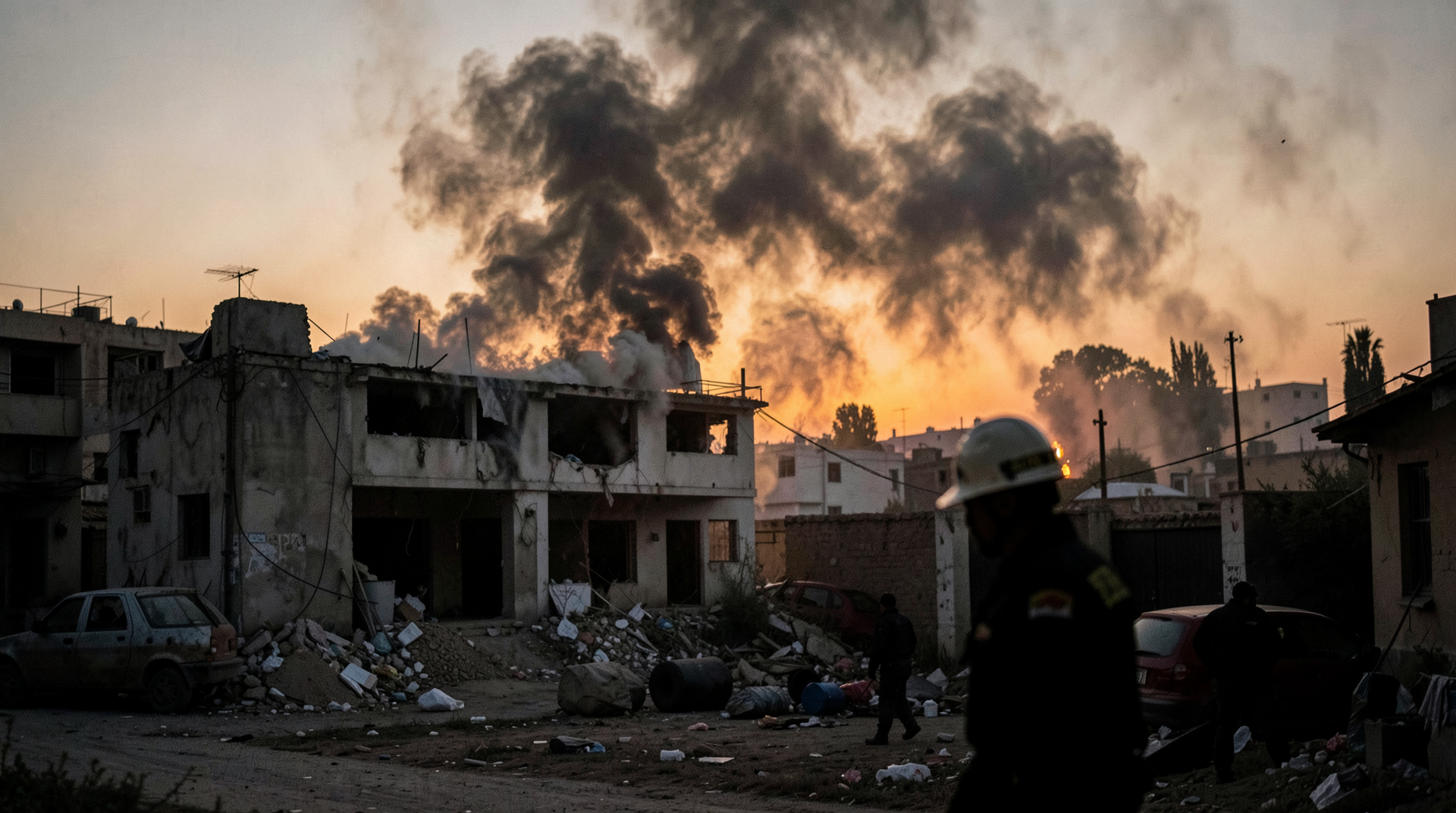
Israeli air and drone strikes killed at least thirty-nine people across Lebanon on Saturday, the highest single-day toll since the November ceasefire entered its second phase, with three drone strikes on the Saadiyat highway twenty kilometers south of Beirut marking the first sustained Israeli action outside Hezbollah's southern strongholds since the Day-23 framework took effect. [1] [2] The Lebanese Health Ministry reported seven killed in Saksakiyeh, including a Syrian father and his twelve-year-old daughter struck twice in Nabatieh — the second strike falling on the family attempting to recover the body of the first — and four killed in the Saadiyat strikes near a coastal road that, until Saturday, had been considered outside the IDF's stated geographic operating range. [3]
The Israel Defense Forces issued a statement Saturday evening claiming the day's operations targeted "more than eighty-five Hezbollah infrastructure sites" — the largest single-day site count of the ceasefire — and asserted the strikes were "in self-defense" against drone preparations. [1] Hezbollah responded with three drones launched against the IDF position at Mount Dov; two were shot down, the third struck a perimeter watchtower and wounded three Israeli soldiers. The paper's May 9 reading of the Lebanese ceasefire as a pressure gauge for the broader regional war held: the gauge moved Saturday.
The Saadiyat highway
The Saadiyat strikes are the structural fact of the day. The coastal highway runs from Damour south to Sidon and passes within seven kilometers of Khalde, the southern edge of Beirut's contiguous urban area. It is not a Hezbollah stronghold by any standard categorization — the population is mixed Shia, Sunni, and Druze, the area's politics tilt toward the Kataeb and Progressive Socialist parties, and the area's economy is centered on the Saadiyat resort and the Coastal Road port logistics that move grain and fuel inland to the Beqaa.
The IDF strike narrative — that the targets were a Hezbollah drone-storage facility, a vehicle in transit carrying senior cadre, and a third site identified only as "infrastructure" — would, if accurate, mean either that Hezbollah has moved drone storage to the central coast for the first time, or that the IDF targeting cell has expanded the geographic operating range of "self-defense" past the south. The first reading was offered by an unnamed IDF source to Walla; the second is the reading offered by Hassan Fadlallah, the Hezbollah lawmaker who told Lebanese reporters the strikes "open a new phase" of the war. [4]
Lebanese army patrols reached the Saadiyat strike sites within ninety minutes Saturday and recovered three civilian bodies. The IDF has not provided post-strike documentation supporting the Hezbollah-target claim. The pattern matches the IDF's 2024 expansion of strikes from Dahiyeh to the central Beqaa: the first strike outside the established operating range is presented as exceptional; the second establishes the new geography.
Saksakiyeh and the Nabatieh re-strike
The Saksakiyeh strike at midday Saturday hit a three-story residential building. The seven killed included a Lebanese family of five and two Syrian agricultural workers boarding with them; a further eleven were wounded and admitted to Saida Government Hospital, four in critical condition. [3] No Hezbollah claim of responsibility for use of the building has been made; the IDF's statement listed the strike location as "Saksakiyeh weapons-storage compound" with no further detail.
The Nabatieh strike pattern — a strike, a delay of approximately forty-five minutes, a second strike on the same coordinates as Lebanese Civil Defense and family members worked the rubble — is what international humanitarian law calls a "double-tap." The Syrian father and twelve-year-old daughter were killed in the second strike; both had been wounded but ambulatory after the first. The Lebanese Red Cross documented the timing and filed it with the UN Interim Force in Lebanon. UNIFIL has acknowledged receipt and has not yet issued a finding.
The casualty count the leads will not carry
The Lebanese Health Ministry's running total since the ceasefire's March renegotiation phase began stands at 2,759 killed. [3] The figure has been carried in full by Al Jazeera, Middle East Eye, and the National; it has appeared in Reuters and Agence France-Presse Saturday wires but has not been the lead number in American or British evening cycles, which have led with the Saturday-only count of 39. The X discourse is anchored on the cumulative number: the ceasefire under which 2,759 people have died is the ceasefire mainstream coverage continues to call a ceasefire.
The arithmetic favors X here. The casualty rate inside the November-renegotiated framework is, on the available data, higher than the per-month rate during portions of the 2006 war. The framework remains a ceasefire because both parties' diplomatic registers continue to call it one and because no party has formally withdrawn. The kinetic register and the diplomatic register, as elsewhere this spring, are running in parallel.
Hezbollah's response and Iran's silence
The three-drone Hezbollah response was the smallest the organization has launched in any twenty-four-hour period of escalation since November. The drones were not advertised as Iranian-supplied; the Mount Dov target is a hardened IDF position routinely targeted in tactical exchanges. The decision not to escalate further is itself a signal — Hezbollah, by the pattern of the last six months, escalates the day after a major strike rather than the day of, and Sunday's response will be the test of whether that pattern holds.
Iran's IRGC Aerospace commander Maj. Gen. Mousavi's Saturday-evening statement that "missiles and drones are locked on the enemy and we are waiting for the firing order" was carried by Iranian state media as a response to the May 6 and May 8 American strafings of Iranian tankers in the Gulf of Oman, not to the Lebanese strikes. [4] The Iranian foreign ministry has not issued a Lebanon-specific statement since the Friday call between Foreign Minister Araghchi and Hezbollah's Naim Qassem. The decision to keep the registers separate — Tehran answers the strafings, Hezbollah answers the strikes — is the visible coordination pattern of the moment.
What the Lebanese government is doing
Prime Minister Najib Mikati spoke at a Sunday cabinet meeting in the Grand Serail and announced that Lebanon would file a formal ceasefire-breach finding with the United Nations Security Council on Monday, citing the Saadiyat strikes and the Nabatieh double-tap as the evidence base. [1] President Joseph Aoun, in a separate statement, called the day "an Israeli decision to expand the war past the south." Neither statement was matched by a recall of the Lebanese ambassador to the United States or any movement of Lebanese forces to the south.
The structural fact of the Lebanese state's response is its limits. The army cannot prevent IDF strikes; the cabinet cannot file a complaint with teeth in a Security Council the United States will veto; the President can name the war as expanded but cannot mobilize an institutional response. Lebanon, as in 2006 and 2024, is left to count the dead and document the strikes for a future tribunal that may never sit. The Day-23 ceasefire continues. The casualty count climbs. The next visible test is whether Sunday produces a second day of Saadiyat-area strikes.
-- YOSEF STERN, Jerusalem