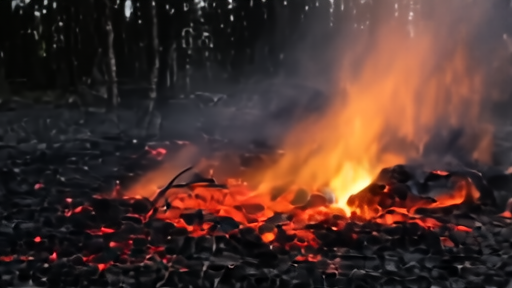
The Pineland Road Fire in Clinch County, Georgia, was reported flat on Saturday at 32,575 acres and 70 percent containment — the same acreage and containment figure carried Thursday and Friday and well below the 40,000-acre threshold the paper's earlier brief had watched for. [1] The fire is now in its twenty-second day. The wind-driven crown-fire phase has ended; the operational story is the underground burn moving through peat in conditions classified by the US Drought Monitor as D4 exceptional drought. [2] [3] The Georgia Forestry Commission has set full containment at June 1.
The paper's May 8 feature on Pineland Road Fire Day 19 holding 65 percent as the Pacific Wildland Lab gap quantifies and the May 9 standard on the fire turning from acreage into household infrastructure carried the framing forward. Sunday's framing accepts that the acreage has stabilised. The lead is now the peat.
Peat-bog fires are different from the surface and crown fires that dominate Western fire-regime coverage. Peat is partially decomposed organic material that, when dry enough, will smoulder slowly through the subsurface — sometimes for weeks, sometimes for months — without producing the visible flames that command aerial-photography attention. Subsurface temperatures in an active peat burn can exceed 600 degrees Celsius. The fire moves underground at speeds measured in metres per day rather than per hour. Containment lines drawn at the surface do not control it. Suppression requires either flooding the affected layers or excavating to the mineral soil, both of which are operationally expensive and ecologically costly.
The Hotshot Wakeup's reporting from this week describes the operational texture: Georgia Forestry Commission crews using bulldozers to expose burning peat layers, water-tender shuttles drawing from local impoundments that themselves are running low under D4 drought, and infrared spotting flights that have identified hotspots well outside the surface containment line. [3] The "re-burn" risk that the Sunday framing leads with is the specific danger that scorched pine needles and other surface fuel, falling onto subterranean hotspots that vent through cracks in the soil, will reignite a surface fire at any point along the perimeter. The June 1 full-containment estimate assumes no major reignition event between now and then. Field staff describe the estimate as "operationally optimistic" if April-into-May rainfall remains below the seasonal norm.
WCTV's Saturday reporting confirmed 32,575 acres and 70 percent containment, with 35 structures lost since the fire began on April 18. [1] Fox 49's earlier reporting, before the containment reached 70 percent, described the fire as 32,575 acres at 40 percent contained. [2] The acreage has not moved. The containment percentage has improved by 30 percentage points in roughly five days. That improvement reflects work on the surface containment line; it does not yet address the subsurface burn.
The Southeast has historically not been the geography in which subsurface peat fires command extended attention. The Okefenokee complex, in which the Pineland Road Fire is located, has burned in periodic large-event years — the 2007, 2011, and 2017 fires were comparable in surface acreage — but the duration of the subsurface burn under the current drought conditions is at the long end of the recent record. Climate scientists who have written about the Pacific Northwest fire regime increasingly describe a Southeast variant in which the combination of warmer winters, drier springs, and more intense lightning seasons produces conditions in which the longleaf-pine and pond-cypress ecosystems begin to behave more like fuel-rich Western landscapes. The Pineland Road Fire is one operational data point in that emerging picture.
The institutional context is also relevant. The Pacific Wildland Fire Sciences Laboratory funding gap that the May 8 feature quantified — roughly $4.7 million in postponed appropriations during the current fiscal year — has reduced the federal research program's capacity to study Southeast peat-fire dynamics in the season they are most active. The Georgia Forestry Commission's own research budget is small. The combination produces an operational gap in which the suppression crews on the Pineland Road Fire are largely working from institutional knowledge developed during prior Okefenokee fires rather than from new research targeted at the specific peat-fire physics the current event presents.
For Clinch County's residents, the operational story is more immediate. The 35 lost structures are concentrated in two clusters along the eastern perimeter. Highway 441, which had been closed for three days at the height of the wind-driven phase, has been re-opened; smoke advisories remain in effect for southern Georgia and northern Florida. The county sheriff's office has not issued new evacuation orders since Tuesday. Insurance assessment teams are working through the affected properties. Whether Georgia formally requests a federal disaster declaration before June 1 will depend partly on the assessment teams' total-loss estimates and partly on the political calculus around Georgia's relationship with the federal emergency-management apparatus during a contentious budget period.
X reads the fire's stabilisation as good news and the underground burn as the under-reported part of the story. That reading is approximately right on both points. The 70 percent containment is real, and the absence of growth across three days under continued drought conditions is a significant operational achievement. The peat burn is real, and the containment metric does not capture it. Mainstream coverage has been measured. [1] [2] The Hotshot Wakeup's specialist coverage carries the texture the local-television coverage cannot. [3] The cleanest sentence is the operational one. The surface fire is contained. The underground fire is the next three weeks.
-- DARA OSEI, London