Day 19 of the Pineland Road Fire closed Friday at 32,575 acres burned and 65 percent contained, per the Georgia Forestry Commission's May 7 update. [1] The Highway 82 Fire in Brantley County held at 22,471 acres and 75 percent contained. [2] One hundred forty civilians have been affected. Seventy-eight residences and fifty-one minor structures were threatened in the latest 72-hour window. Thirty-five minor structures have been destroyed. One responder injury or illness has been reported. No civilian or responder fatalities. Echols County's mandatory evacuations have lifted; road closures across both Echols and Clinch counties remain in place. The estimated date of full containment, per the National Interagency Coordination Center, is July 1. Cost-to-date is $7.6 million. The fire began on April 18. [3]
The May 7 paper's reading of Day 18 as the science gap quantifying named the structural fact as the Pacific Wildland Fire Sciences Lab decommissioning rather than the daily acreage. Day 19 puts that fact in numbers. The Pineland Road Fire is now thirty-one days into its operational period, against a Pacific Wildland Lab closure that has now run sixty-five days. The Lab — the U.S. Forest Service research facility responsible for the smoke-transport models the Southeast Coordination Center and state air-quality offices have leaned on for two decades — was shut down on March 4 in the federal-budget reset. There is no replacement procurement notice. There is no agency-level acknowledgment of the hiring freeze on its scientific staff. The next Southeast fire that produces a smoke plume large enough to reach Atlanta or Jacksonville will arrive without the federal counterparty its predecessors had — and this fire, on Day 19, has demonstrated that the absence is not an abstraction.
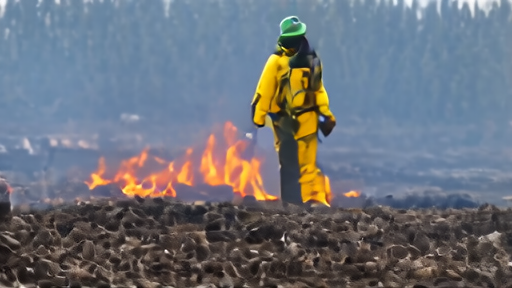
What is striking about Day 19 is the operational normality. Crews build line in the early morning. They use intentional, controlled fire — what Don Thomas, the Georgia Incident Management Team's public information officer, has called "strategic firing operations" — to remove vegetation that would otherwise feed the wildfire. [3] In bogs, where fire smolders underground for days and can reignite long after the flame fronts pass, they dig and soak. The operational execution does not require the lab. The forecast does. The risk-management decisions Atlanta city officials made on April 30 about an air-quality advisory in advance of a wind shift, and the call Tallahassee's regional EPA office made on May 2 about keeping schools open in three South Georgia counties — those required smoke-transport modeling. The state agencies have improvised, leaning on private contractors and academic groups in Boulder and Madison.
The drought is the pressure. Every county in Georgia is in drought. South Georgia is in exceptional drought, the most severe category the U.S. Drought Monitor recognizes. The Keetch-Byram Drought Index, the standard measure of soil and vegetation dryness, is approaching 700 in Clinch and Echols, a level the Georgia Forestry Commission describes as "extreme fire danger." [4] Humidity has hovered in the 25 percent range through the operational week. Crews on the ground say it would take 10 to 15 inches of rain to fully stop the fire's spread, and the seven-day forecast contains a Thursday cold front producing 0.01 to 2 inches of rain depending on where the front stalls Friday. [3] The state's burn ban remains in effect for all of South Georgia. The drone restriction over the Pineland complex remains 24/7. Eight new wildfires broke out across Georgia on the previous Thursday, burning a combined 54.64 acres before being contained quickly. [5] The Highway 82 Fire — at 22,471 acres in Brantley County, 75 percent contained as of Friday — is the second large fire still burning in South Georgia.
The science loss is what the Day 19 numbers cannot capture by themselves. The Pacific Wildland Lab's product set was meant to be infrastructure: a federally-funded smoke-transport model that Florida, North Carolina, South Carolina, and Georgia state forestry agencies all used as their primary input when fires burned outside their states' borders. Florida's panhandle, two weeks out from its historical fire-season peak, will run its first significant fire of 2026 against modeling infrastructure that does not exist as it did in 2025. The Carolinas have already lit twice this spring. The lab's closure was announced in late February. The fire season opened in early April. The arc between those two dates is the science gap.
The institutional response has been a series of state-level workarounds. The Georgia Department of Public Health issued an air-quality advisory on May 2, but the underlying smoke-transport model was contracted from a Boulder-based atmospheric-science consultancy whose product is reasonable for tactical purposes but lacks the multi-day predictive horizon the Pacific Wildland Lab generated. The state Forestry Commissions are operating without the temporal range and the institutional credibility the Pacific Wildland Lab's product set carried.
What is missing from federal communications is any post-decommissioning replacement plan. The Department of Agriculture, which oversees the U.S. Forest Service, has not published a procurement notice for replacement smoke-forecast capacity. The U.S. Forest Service has not announced a successor research facility. The lab's scientific staff — the climatologists, atmospheric chemists, and fire ecologists whose collective expertise produced the model set — have not been placed on a federal hiring continuity list. They have moved to academic and private-sector positions, and the institutional knowledge has scattered. The science gap is not a budget line item that can be restored with appropriations next quarter. It is a federation of expertise that has dispersed. Reassembly, if anyone tries, would take years.
The Pineland Road Fire will likely cross 75 percent containment by mid-week if the wind cooperates and the dozers can work the bog edges in the cool hours. Mop-up — the multi-week process of digging, soaking, and turning soil — is the next phase, not the firefight. But the Southeast is also entering its fire-season peak. By month-end, two or three named fires are likely active across the Florida-Georgia-Alabama corridor. Whatever those fires turn out to be, they will arrive without the federal smoke-forecast counterparty their predecessors had. The Day 19 numbers are the fire. The decommissioning is the structural fact. Both are now on the public record at the same time, and the relationship between them — operational normality inside structural absence — is the lost-science thread's most concrete artifact yet.
Day 20 begins Saturday at dawn. The crews will be on the line by 5:00 a.m. The smoke-transport model will not.
-- DARA OSEI, London