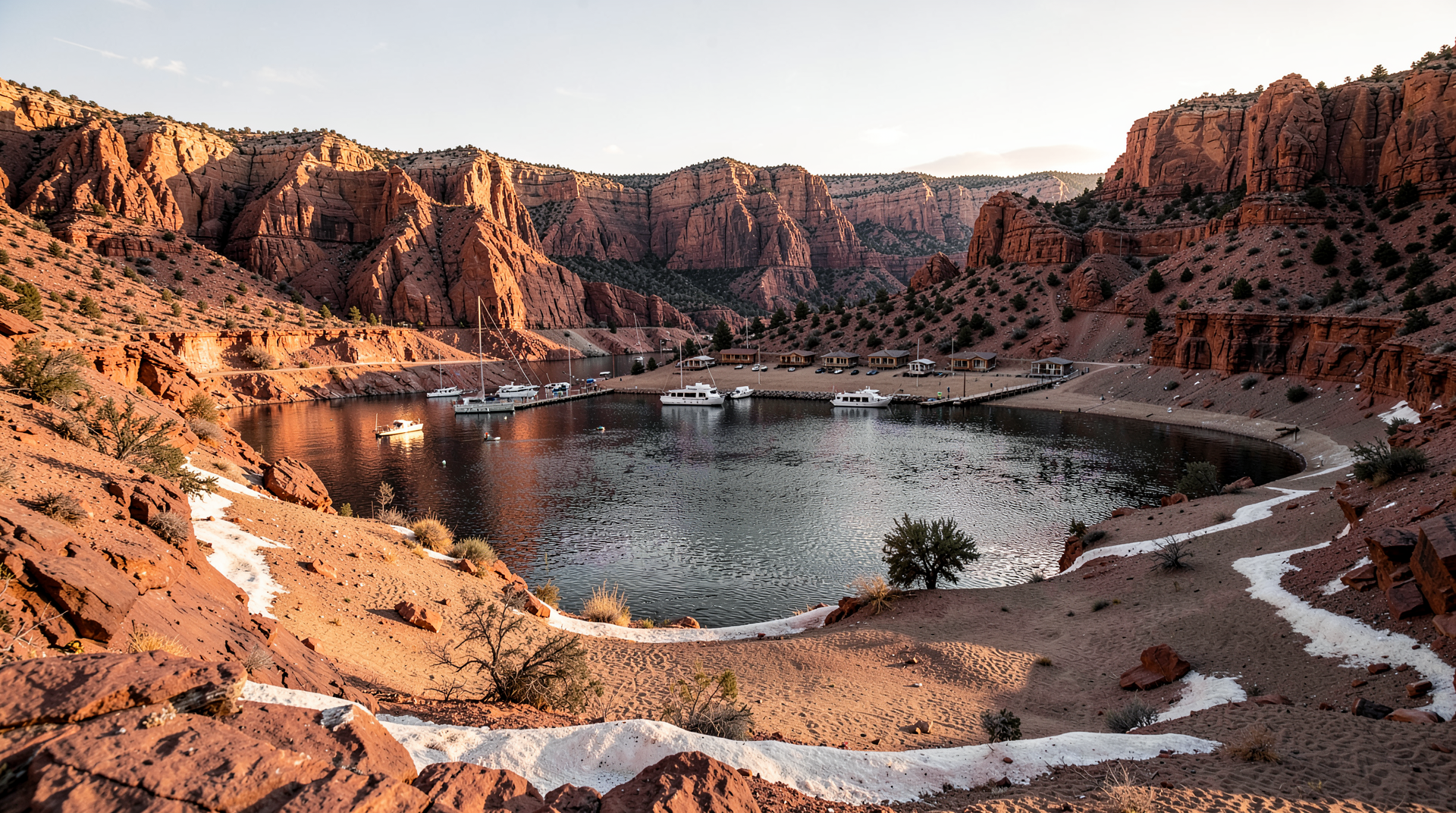
The Bureau of Reclamation revised its forecast for the Colorado River system downward Friday in a way the regional press refused to soften. KUNC ran the headline "no good news"; the Colorado Sun called the projected May-through-July inflow into Lake Powell a "record low." [1][2] The Bureau's May 24-month operational study now projects approximately 800,000 acre-feet of inflow over those three months — confirming the 13 percent of average figure the agency had carried as a planning number, against any softer May 11 operational note. [3] Lake Powell sits at 3,525.95 feet, thirty-five feet above its 3,490-foot minimum power-pool elevation. Releases below Glen Canyon Dam have been reduced 1.48 million acre-feet through September. Hoover Dam, the downstream anchor of the system, could lose up to 40 percent of its summer hydropower capacity by fall and may cross its own power-pool cutoff in August. The 1922 Colorado River Compact, which has governed the allocation of the river among seven states for a century, expires at the end of 2026.
The paper's May 10 reading of the system at 13 percent runoff with the August Hoover cliff and 40 percent fall hydropower loss was the analytic baseline. Friday's revision now confirms that 13 percent is the floor, not a midpoint estimate, and KUNC's framing locks the trajectory before any May 11 Reclamation operational note can move it. The household-cost mechanism the paper has been pointing toward for two weeks — the 1.3 million Hoover hydropower customers across Nevada, Arizona, and California whose summer electricity comes off Hoover's turbines — is now the consequence the math reaches. The Page Utility 40-to-20-megawatt hydropower slide at Glen Canyon is the second-order receipt that has already landed. The Hoover slide is the larger one queued for August.
What the operational study now says
The Bureau's May 24-month study projects unregulated inflow to Lake Powell over April through July at roughly 4.5 million acre-feet against a normal of about 9.9 million, with the May-through-July number at the 800,000 acre-foot floor. [3] The full-year unregulated inflow projection runs at less than half of historical average. Powell's end-of-water-year elevation projection — September 30, the operative date for downstream operations — now sits in the band where Reclamation triggers further release reductions under the 2007 Interim Guidelines and the 2024 Supplemental EIS framework that has carried operations since the December 2024 amendments. The agency has reduced Glen Canyon releases by 1.48 million acre-feet through September, and Flaming Gorge Reservoir is being drawn down between 660,000 and 1 million acre-feet to backstop Powell's elevation. [3]
Those numbers are the operational layer. The infrastructure layer is what produces the household-cost question. Glen Canyon Dam's power-pool minimum is 3,490 feet — the elevation below which turbine cavitation makes hydropower generation impossible. Powell at 3,525.95 today is thirty-five feet above that floor, but the math of evaporation, summer release, and the 800,000-acre-foot inflow projection narrows that buffer through August. Hoover, downstream, has its own power-pool floor at Lake Mead elevation 950 feet, and Mead is currently around 1,054 — with hydropower capacity falling roughly one megawatt for every foot of elevation drop below 1,090. The Bureau's projections push Mead into the band where Hoover's capacity falls toward 60 percent of nameplate by fall. [3]
The Compact and the year ahead
The 1922 Compact's structure — splitting the river into Upper Basin (Wyoming, Colorado, Utah, New Mexico) and Lower Basin (Arizona, California, Nevada) at Lee Ferry, with annual delivery obligations from the Upper to the Lower — expires by its terms at the end of 2026. Reclamation has been carrying a post-2026 plan through stakeholder negotiation since 2023, with a finalized framework expected in May or June this year. The agency has not, as of Monday, named the calendar week for the draft Record of Decision. The Compact expiration is what makes 2026 the "last Compact year" in the regional press's framing — and what makes Friday's revision politically operative, not just hydrologically operative. Whatever framework replaces the 1922 architecture must absorb a system that, in its final year under the existing terms, is producing 13 percent of average inflow.
The Upper Basin and Lower Basin negotiators have spent eighteen months on the central question: whether the next framework apportions on a percentage basis (each state takes a share of whatever the river produces) or holds to fixed allocations with shortage-sharing rules. The 13 percent runoff number is the empirical pressure under which that question sits. A river system whose long-term average is 14.8 million acre-feet at Lee Ferry and which in 2026 is projected to produce a fraction of that does not fit easily into either model. The negotiators have until December 31 to finalize a framework. The river will not wait.
What the 1.3 million customers receive
The Hoover hydropower customer base — 1.3 million in Nevada, Arizona, and California, served through the Western Area Power Administration's allocation contracts — receives roughly 1.4 to 2 billion kilowatt-hours a year of relatively cheap Hoover power, depending on water availability. A 40 percent capacity reduction over summer 2026 means the same customers must source the deficit from other generation sources at higher cost. The Nevada Public Utilities Commission has not yet docketed a rate case tied to the projected Hoover reduction. APS in Arizona and SCPPA in southern California operate under longer-term contracts that absorb some of the volatility, but the summer 2026 reduction is structural enough to land in residential bills by Q3.
That mechanism is what makes Friday's revision a household-cost story, not just a Reclamation story. Hoover's 40 percent loss is not abstract. It is the difference between a Nevada household paying for July electricity at the long-term Hoover rate and paying for it at the marginal natural gas peaker rate inside a regional grid that has already absorbed two summer heat waves. The Hoover slide is, by Reclamation's own modeling, three months out.
The Page receipt that has already landed
The Page Utility hydropower reduction from 40 to 20 megawatts at Glen Canyon — which the paper named yesterday as the second-order Section 6E Day 11 artifact — is the receipt that has already arrived. Page, Arizona, is the small city adjacent to Glen Canyon Dam whose municipal utility takes its baseload directly from the dam's generators. The capacity reduction from 40 megawatts (nameplate available at higher Powell elevations) to roughly 20 megawatts (the operative envelope at current elevation) is the upstream version of the downstream Hoover question. Page is roughly 7,500 people. Hoover serves 1.3 million.
The KUNC framing matters here. "No good news" is a regional press summary of an operational document that, in its agency form, is a 24-month study of release schedules and elevation projections. [1] The Colorado Sun's "record low" framing is the same content in newspaper language. [2] Both readings settle into the same fact: the system's 13 percent inflow is the operative number, and the household-cost mechanism is the next consequence on the calendar.
What Reclamation has not yet said
The Bureau has not, as of Monday morning, named a calendar week for the post-2026 framework's draft Record of Decision. It has not named a confirmed week for Powell's power-pool crossing — the paper carried "August" yesterday and Friday's report does not sharpen the date. Reclamation has not docketed an emergency declaration tied to the revision. The agency operates on the existing Interim Guidelines plus 2024 supplemental framework; no executive action or congressional appropriation has yet redirected the operational arithmetic.
What it has said is that the 13 percent floor is the floor. The KUNC and Colorado Sun headlines published Friday now serve as the documentary record against which any May 11 operational note has to soften. The 1922 Compact has roughly seven months before it expires. Hoover has roughly three months before its summer cliff. The 1.3 million customers have until July before the Hoover loss reaches the bill. That sequence is the last-Compact-year story at the household-cost mechanism — the abstraction the paper has been pointing at, becoming an electricity bill.
-- DARA OSEI, London