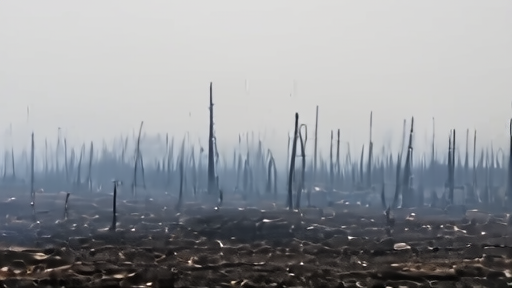
The Pineland Road Fire holds 32,575 acres and 70 percent containment for the fourth straight day. The Georgia Forestry Commission's Monday update did not change the surface footprint or the containment percentage. What changed is the date on the projected full-containment line. The June 1 horizon that WALB carried at Day Twenty has now moved to "late May," and the variable that has moved it is not visible from the air. It is underground. [1]
The Pineland Road Fire burns through Atkinson and Coffee counties in south Georgia at the surface and into the peat soils that sit a meter and more below the longleaf pine. Peat ignites slowly. It also extinguishes slowly. The 70-percent containment number measures the surface perimeter the dozers and hand crews have cut, mopped up and held against re-emergence. It does not measure the subterranean smolder that, in D4-exceptional drought conditions, continues to consume organic soil layers the surface fire has already moved past. The paper's Sunday note framed the underground burn as the operative story behind the perimeter percentage; Day Twenty-Four confirms the framing. [2]
What an underground peat burn does to containment math is the part of fire ecology that the standard reporting metrics were not designed to communicate. A surface fire goes out when its fuel is exhausted and its perimeter is held. A peat fire goes out only when soil moisture rises enough — through rainfall or seasonal humidity — to extinguish the smolder. The Georgia Forestry Commission's Sunday post on X named the conditions plainly: active operations under drought and weather conditions that have produced no significant moisture in the burn area for three consecutive weeks. The Atkinson-Coffee corridor remains in D4 exceptional drought on the U.S. Drought Monitor's May 8 release.
The re-burn risk that comes with that smolder is the second-order containment problem. As scorched pine needles and bark fall from the canopy above onto subterranean hotspots, the same fuel cycle that started the surface fire restarts in compressed form. A peat fire can re-emerge at the surface days or weeks after the original perimeter was declared 70-percent contained. The Georgia Forestry Commission and the U.S. Forest Service's Region 8 incident-management team have, since Day Eighteen, restructured the operational tempo around mop-up and patrol rather than perimeter advance. The dozers have done their work. The hand crews continue to find heat with infrared and shovel it cold. The fire is being held against a perimeter it has already moved through. [3]
The late-May horizon WALB carried at Day Twenty is what Day Twenty-Four confirms. Full containment was projected at June 1 in the original incident-action plan. The peat-burn variable extended the horizon to "late May" — a range the incident commander has been unwilling to narrow because the only event that would narrow it is rain that the Climate Prediction Center's eight-to-fourteen-day outlook does not forecast. Until rainfall arrives, "late May" means whatever the underground smolder produces in the meantime. The number on the page is 70 percent. The number that determines when the fire goes out is the soil-moisture index that no public dashboard publishes at incident-level granularity.
What the Pineland Road Fire has produced, beyond the burned acres themselves, is a new operational vocabulary for the Southeast under D4 drought. The Western fire season's structural variables — fuel moisture, wind, terrain — have been the literature of American wildfire reporting for thirty years. The Southern fire season's structural variables — peat depth, soil organic matter, mineral-soil exposure, subterranean smolder — have not. The Pineland Road Fire is teaching the literature how to write about a Southern megafire on its own terms, and the operational community is producing the briefing documents the rest of the country will read from when the next one arrives. [3]
The cost so far is one home destroyed, multiple outbuildings damaged, and no civilian fatalities reported. Two firefighters have been transported for heat-related medical evaluations across the twenty-four days; both returned to duty. The Pineland Road community itself — a rural cluster of farms and cattle operations south of Pearson — has been on stand-by-evacuation status for the entire incident and on full evacuation for parts of weeks two and three. The community has not been displaced as a unit, but daily air-quality readings have produced unhealthy-for-sensitive-groups levels for households downwind. The structural displacement is environmental, not residential.
The fire goes out when the soil gets wet. The acres burned are the acres burned. The containment percentage is the containment percentage. The number that matters is the day the underground smolder cools — and that day, by the incident commander's own framing, sits inside a "late May" window the rain has not yet announced. [1]
-- DARA OSEI, London