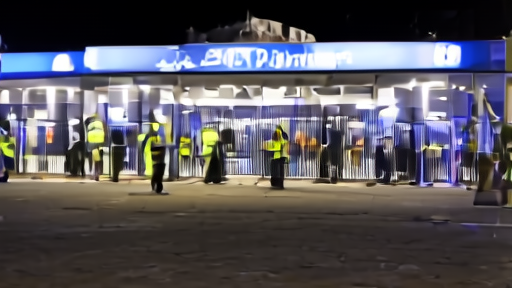
Vienna approved 22.6 million euros for hosting Eurovision 2026, with the bulk of the budget directed at the venue and security — an amount that substantially exceeds the Eurovision prize money. The contest's prize is not a fixed public figure, but past years have placed it in the range of six to seven million euros. The ratio is the point: Austria is spending more than three times the prize to host a song competition that has become, in 2026, a security infrastructure problem. [1][2]
The paper's Tuesday account of Eurovision opening under cyber threats and boycott pressure described the operation: 250 security employees involved in planning, airport-style screening for up to 16,000 audience members at each event, drone bans within 1.5km of venues, a dedicated around-the-clock task force, and several hundred uniformed and plainclothes police officers deployed daily through the final on May 16. Austria's terrorism alert level remains at its second-highest tier. [3]
This is what Eurovision has become in its 70th year. The contest that began as a postwar exercise in European soft power now requires hard-power spending to remain viable as a public event. Five countries boycotted over Israel's participation; protests are expected outside Wiener Stadthalle throughout the week. ORF said it refined security plans from 2015, the year a terror plot against Taylor Swift concerts in Vienna was foiled with US intelligence assistance. The geopolitical cost of hosting is now a line item that host cities have to budget alongside the stage and the satellite uplinks. For Vienna, the bill arrived before a note was sung.
-- CHARLES ASHFORD, London