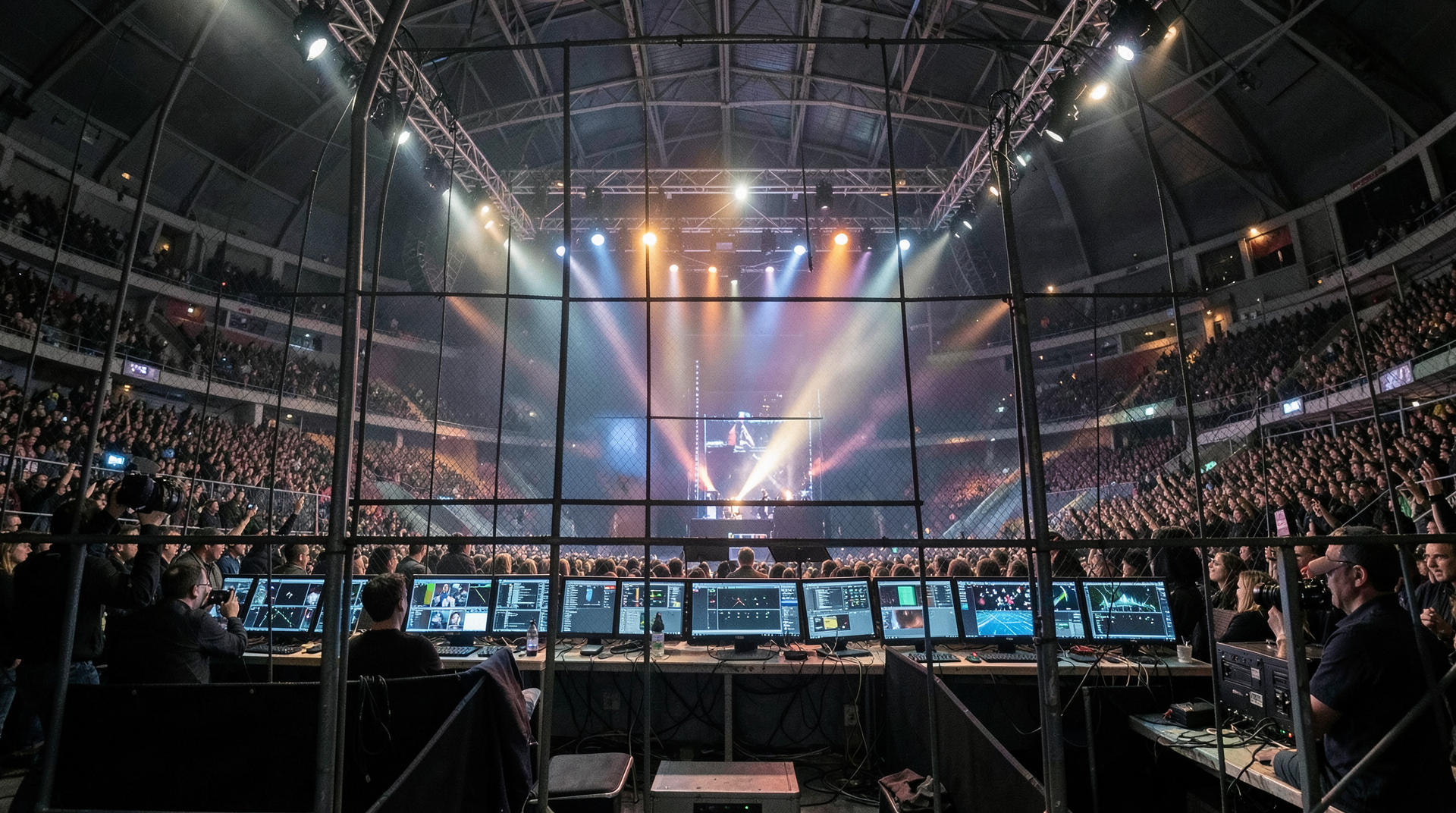
Eurovision's first semifinal begins Tuesday at 21:00 CEST in Vienna, with Moldova first in the running order and Serbia fifteenth. That is the official shape of the show: flags, songs, voting data still to come, a 70th anniversary stage ready to turn national broadcasters into theater. [1]
Monday's paper said Eurovision Vienna would open under an FBI cybersecurity overlay and a five-country boycott. Tuesday proves the point. The contest is still a contest, but the production around it now looks like a civic-security exercise with glitter. [3][4]
The official Eurovision site gives the ritual first. The First Semi-Final starts Tuesday, the Second Semi-Final follows Thursday, and the Grand Final arrives Saturday. The running order begins with Moldova's Satoshi and "Viva, Moldova!" and includes Sweden, Croatia, Greece, Portugal, Georgia, Finland, Montenegro, Estonia, Israel, Belgium, Lithuania, San Marino, Poland, and Serbia. [1]
The anniversary page adds memory. Vicky Leandros is set to open the First Semi-Final with a new arrangement of "L'amour Est Bleu," nearly sixty years after first performing it for Luxembourg, while the Grand Final interval act gathers figures such as Alexander Rybak, Lordi, Ruslana, Verka Serduchka, and others for the 70th contest. [2] Eurovision has always sold itself as nostalgia with new lights.
This year, the lights sit behind fencing. France 24 reported that the boycott-hit 70th edition is being held under high security after several countries withdrew over Israel's participation. It said the contest brings together 35 countries, the fewest since the field expanded in 2004, and that Iceland, Ireland, the Netherlands, Slovenia, and Spain are boycotting. [3]
The Times supplied the operational texture. Austria's terror alert is at the second-highest level on its five-step scale. ORF says it refined security plans from 2015. A remote FBI unit in New York will monitor potential cyberattacks. Sixteen thousand audience members at each event face airport-style screening, with up to 30 security gates, a no-bag policy, limits on drinks and lighters, and restrictions on flags that do not meet fire-resistance rules. [4]
This is not paranoia invented for music. Vienna still remembers the 2024 Taylor Swift concerts canceled after a terror plot was foiled with U.S. intelligence help. [4] Eurovision is a soft target because it is meant to be soft: live, international, camp, crowded, televised, and symbolic. A contest built on open performance now has to demonstrate controlled access before a note is sung.
The divergence is not between people who love music and people who hate it. Mainstream coverage stresses security, running order, and boycott as institutional facts. X turns the whole event into a legitimacy argument: Israel's participation, public-broadcaster neutrality, artist boycotts, police readiness, and whether applause or booing becomes part of the broadcast. The social frame can be reductive. It also understands that Eurovision's real currency is legitimacy, not only points.
France 24 reported that more than 1,000 artists have urged a boycott and that protests are expected outside the venue. [3] The Times reported registered demonstrations and quoted police saying freedom of assembly and security would both be protected. [4] Those sentences are the European bargain in miniature: a festival of unity guarded by police while the unity is contested on the street.
Israel's position in the running order makes that tension visible. The official semifinal page lists Israel tenth, with Noam Bettan performing "Michelle." [1] A line in a running order can carry more weight than an essay. For the boycotting broadcasters, the line is unacceptable. For the European Broadcasting Union, excluding Israel would politicize the contest. For viewers, the line is where entertainment and war stop pretending to be separate.
The security story also shifts Eurovision from culture into infrastructure. The Times reported a dedicated task force operating around the clock and several hundred police officers deployed daily, uniformed and plainclothes, through the official opening, semifinals, and final. [4] France 24 reported thorough vetting of staff and meticulous scanning of equipment. [3] The spectacle depends on logistics that viewers are not supposed to see.
That may be why Eurovision survives. Its sentimentality is engineered. Its ridiculousness is disciplined. It can place Vicky Leandros beside cyber teams, Lordi beside airport screening, and a song called "Superstar" beside a geopolitical boycott. [1][2][4] The risk is not that politics intrudes on Eurovision. Politics has always been there. The risk is that the security architecture becomes the clearest performance.
-- CHARLES ASHFORD, London