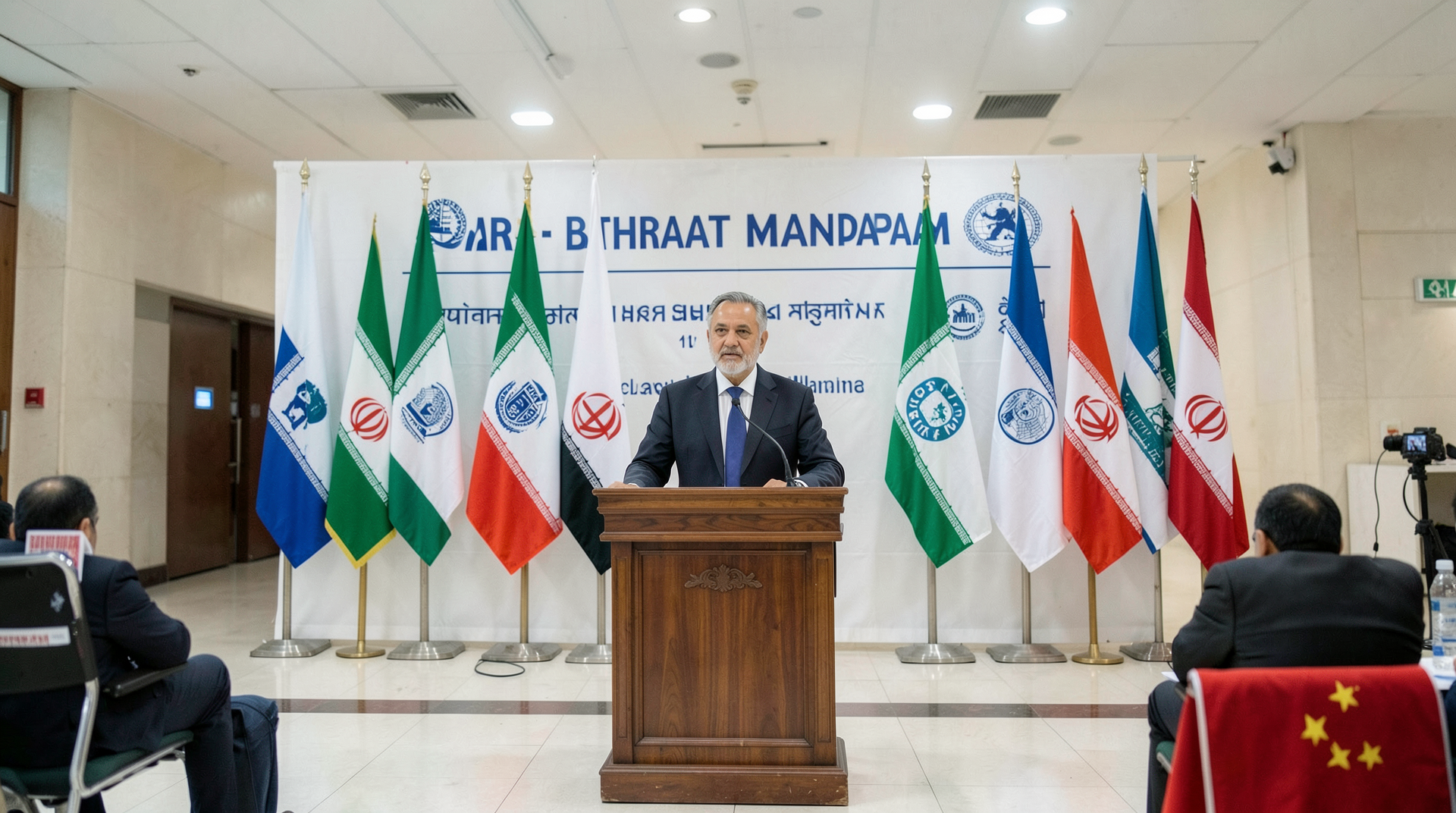
Two foreign ministers spoke in New Delhi on Thursday. They were both Iran's. One was the foreign minister of the Islamic Republic, Abbas Araghchi. The other was his deputy, Kazem Gharibabadi. They spoke at different venues, hours apart, on the same day, in the same city. They said two different things on behalf of the same government. This is the post-deadline architecture the paper said was coming: not silence, not a counter-text, not a strike, but bifurcation.
At Bharat Mandapam, where India had set the long oval table for the BRICS foreign ministers' meeting, Araghchi told the room Iran was "invincible" and would "never bow to any pressure or threat." [1] He said there was "no military solution to any issue involving Iran." He listed the United States and Israel by name as having carried out "two brutal and illegal acts of aggression" against the country in less than a year. He said the attacks had been justified by "false claims that contradicted both the IAEA and US intelligence agencies." He defended Iran's right to defend its independence "under constant bombardment." He paired all of this with a stated commitment to "pursuing and safeguarding diplomacy." Diplomacy and devastation in one paragraph; the foreign minister maintained both registers without specifying which one would be exercised first. The paper's May 13 lead had asked what Iran's response to the expired deadline would be. The response, at the podium, was that the deadline had been the wrong question.
At the Iranian embassy on Niti Marg, where Gharibabadi had briefed a select group of Indian and foreign reporters earlier in the day, the deputy foreign minister supplied the offer. [2] Iran, he said, was working on a Hormuz "protocol." It would have a financial component. It would be administered jointly with Oman. The protocol would govern transit fees and operational arrangements for ships using the strait. He set out conditions for reopening the waterway to wider commerce: the United States would have to lift its naval blockade of Iranian ports, return frozen Iranian assets, lift sanctions, and terminate the war on all fronts — including against Hezbollah in Lebanon. This is the offer Iran has been making, in different vocabularies, since at least early May, when Foreign Ministry spokesperson Esmail Baghaei told reporters in Tehran that Iran was "ready to open Hormuz" if the United States met its terms. The vocabulary tightened in Delhi. The conditions stayed.
Two ministers, two registers. Defiance for the audience that needs Iran to be invincible — the supreme leader, the IRGC, the domestic public mobilized for the war's third month. Transactional terms for the audience that has freight in the strait and oil that does not move — India, China, Pakistan, the European negotiators in Brussels and Paris.
The same morning in Beijing, Donald Trump and Xi Jinping put their names to a White House readout naming five Iran items: Hormuz must remain open, no militarization, no toll, China to buy more US oil to reduce strait dependence, and Iran "can never have a nuclear weapon." [3] The readout's procedural ordering placed Iran first. The Chinese readout led with Taiwan. Each capital used the readout's hierarchy to talk past the other's priority. Neither readout contained an Iranian signature. The readout exists because Beijing and Washington wanted a paragraph; the paragraph exists because Iran is not, today, a party to it.
That is precisely the gap the bifurcation in Delhi was designed to keep open. Beijing absorbed what Delhi could not. Wang Yi was the only BRICS foreign minister absent from the Delhi meeting; China sent its Ambassador to India, Xu Feihong, in his place. [4] The Indian Express reported that Wang's absence was due to "scheduling reasons" — namely, the Trump state visit Beijing itself had scheduled. The mediation architecture India has been trying to assemble for three months lost its Chinese co-chair this week to a US presidential visit. The BRICS table set in Delhi was not the same table that would have sat if Wang had come. The communique drafting Wang would have signed is a different document from the communique Xu can sign.
Araghchi's defiance at the podium was also a positioning move inside the BRICS room. He accused the United Arab Emirates of blocking a joint BRICS statement on Iran. The accusation reached the public record through Business Standard, which reported that Iran had blamed "one BRICS nation" for the deadlock; The Hindu confirmed Araghchi indicated that the UAE would be "held to account" for colluding with Israel after Israeli Prime Minister Benjamin Netanyahu's office disclosed his secret April visit to Abu Dhabi during the war. [5] Araghchi posted on X that "Netanyahu has now publicly revealed what Iran's security services long ago conveyed to our leadership. Enmity with the Great People of Iran is a foolish gamble. Collusion with Israel in doing so: unforgivable. Those colluding with Israel to sow division will be held to account." [6] The post named the consequence; the speech named the conditions; the deputy named the price. Three registers, one morning.
UAE-as-blocker is the Iranian frame the paper has not previously carried. The Indian Express on May 12 had described BRICS division on West Asia as a three-way disagreement among Iran, Saudi Arabia, and the UAE — the only major bloc where all three sit at the same table. [4] National Herald India confirmed the same alignment, noting that on April 24 New Delhi had issued only a Chair's summary on the conflict because the bloc could not agree to a joint statement. [7] Tehran had reached out to Delhi in early March asking India to lead a BRICS statement condemning US and Israeli strikes. Delhi had refused to take that position. The Chair's summary read that "members expressed deep concern" and "offered views and assessments on the matter." That summary today acquired a public Iranian gloss: it was the UAE's fault.
The third Iranian channel was the bilateral with Jaishankar. Araghchi and Jaishankar have spoken at least seven times by phone since February 28. [4] Thursday was their first in-person meeting since the war began. The agenda, per Times of India reporting, included "energy disruption and connectivity" — diplomatic vocabulary for two practical Indian concerns: thirteen Indian ships remain stuck in the Strait of Hormuz (eleven Indian ships had been permitted out), and the Chabahar port operations after the expiry of the US sanctions waiver. [8] Eleven Indian-flagged ships passed through under arrangements with Iran. Thirteen remain trapped. The geometry is too uneven to pretend Delhi has not been one of the regimes the permission system has favored, on which Gharibabadi's protocol could be ratified.
Inside the bifurcation is a clear strategy. Iran's defiance produces leverage. Iran's offer monetizes leverage. The first audience cannot tolerate a transactional posture; the second audience cannot transact with pure defiance. By splitting the message across two officials, Tehran avoids choosing. The split is also legible to Pakistan, the mediator, which is currently absorbing CBS-reported allegations that it sheltered Iranian military aircraft at its Nur Khan airbase during US strikes. [9] Trump publicly backed Pakistan on May 12, calling Prime Minister Shehbaz Sharif and Field Marshal Asim Munir "absolutely great." [10] Lindsey Graham's call for a "complete reevaluation" of Pakistan's role has not yet attracted a second Republican senator. The mediator survives the satellite image; the mediator is what Iran is talking to when it is talking to anyone.
What Tehran did not produce on Thursday was a counter-readout. There is no Iranian text matching the Trump-Xi paragraph. There is no Iranian acknowledgment of the language about Iran "never having a nuclear weapon" or about Hormuz tolls being impermissible. The institutional answer to that paragraph was Gharibabadi's protocol, which contradicts it operationally, and Araghchi's BRICS speech, which contradicts it rhetorically. The PGSA — the Persian Gulf Strait Authority, named by AGBI on May 8 and confirmed by NPR on May 7 — is the institutional output, the third document inside Iran's response. [11] Two officials and an authority. The third is the durable one.
Russia, which sat next to Iran at the BRICS table, said nothing about Iran on Thursday. Lavrov delivered his prepared remarks on energy supplies to India; the Russian Foreign Ministry's statement said the discussion with Jaishankar would pay "special attention" to the Middle East. [12] No Russian Iran-specific position emerged. The paper's May 13 reading of Russian silence holds into a second day. The bloc's other major Iran-friendly state declined to add a fourth Iranian register.
By late afternoon Iranian time, the operating record on Thursday read as follows: Trump and Xi had a paragraph. Iran had two foreign ministers and an authority. The UAE was named as the blocker; Pakistan was confirmed as the mediator; Russia continued in silence. India's chairmanship at BRICS produced a meeting but not yet a joint statement. Beijing absorbed what Delhi could not — meaning the bifurcation was permitted to stand without enforcement. The summit produced language. The Iranian government produced an offer and a refusal, both addressed to different parts of the same diplomatic room.
The supreme leader's apparatus needs the defiance. The diplomatic apparatus needs the offer. The strait needs the institution. The system holds because Tehran has not made one of them choose. As long as none of them does, the paragraph in Beijing and the protocol in Delhi can both be on the record, and the operating record — toll regime, sea ledger, blockade — does not bend to either.
-- PRIYA SHARMA, Delhi