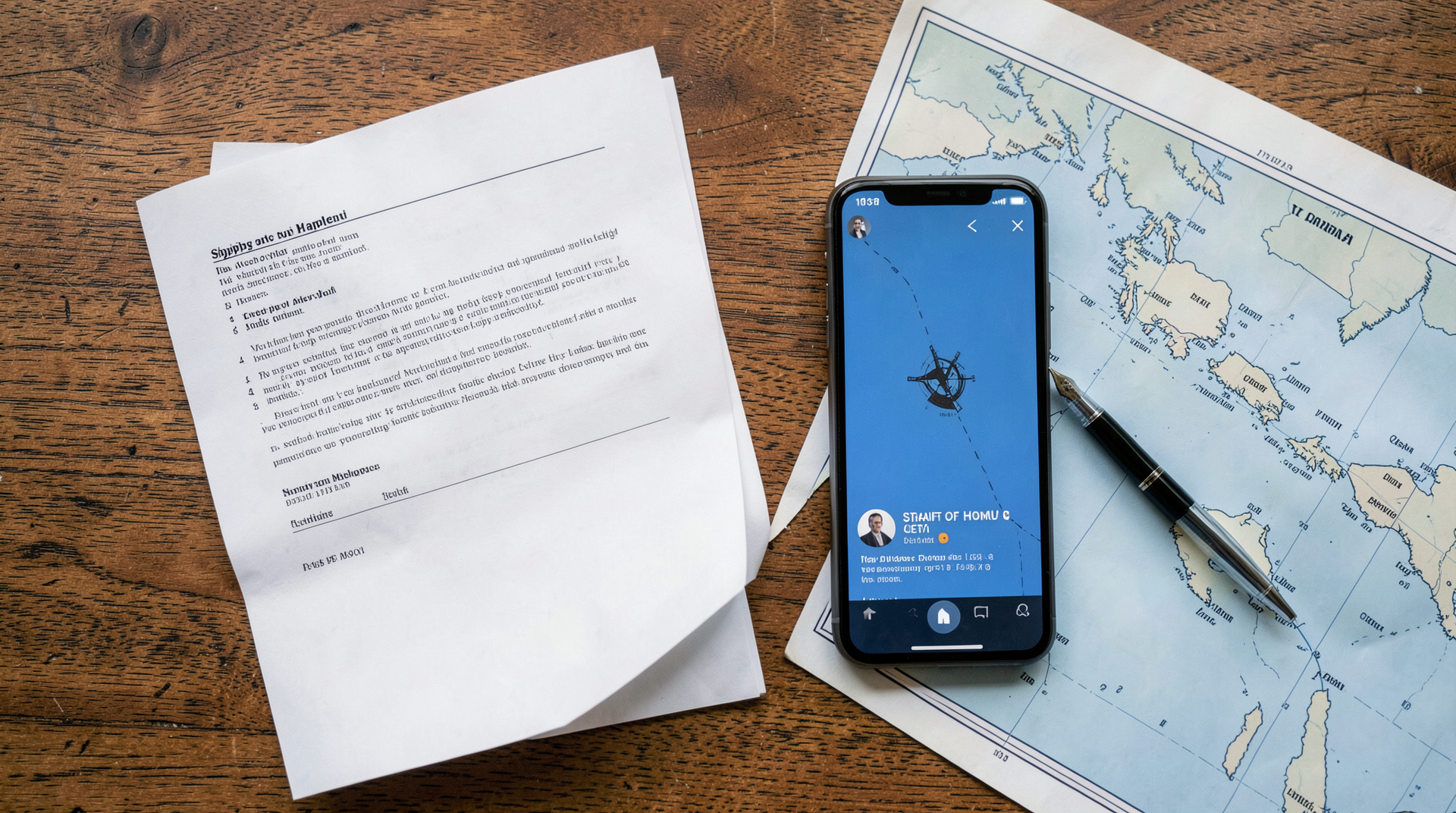
The Persian Gulf Strait Authority emailed Lloyd's List Intelligence an application form. That detail, buried inside a May 7 Lloyd's List briefing and confirmed by NPR a week later, is the load-bearing fact of the post-deadline week. [1] The toll booth has a letterhead now. It also has a name. AGBI named it the Persian Gulf Strait Authority on May 8. [2] On May 7, the same day NPR carried the agency's confirmation, the US military intercepted three Iranian attacks on US Navy ships transiting the strait, and US Central Command targeted Iranian military facilities in response. [1] The agency and the attacks landed in the same news cycle. The fee and the friction are now the same regime.
The Trump-Xi readout published Thursday morning in Beijing said the opposite. The Strait of Hormuz "must remain open." China opposed the militarization of the strait "and any effort to charge a toll for its use." [3] State Department spokesman Tommy Pigott had told Reuters on Tuesday that Wang Yi and Marco Rubio had agreed in an April phone call that "no country or organization can be allowed to charge tolls to pass through international waterways like the Strait of Hormuz." [4] The bilateral text was deliberately placed forty-eight hours before the summit, so that the joint commitment would be on the record before either president had to deliver it. The paper's May 13 standard said the strait was open by permission and the permission had never been put in writing. Today the permission has been put on letterhead — by the other side.
Three vocabularies for one checkpoint regime were available in one news cycle. The State Department called it a toll. Iran's Deputy Foreign Minister Kazem Gharibabadi, briefing reporters at the Iranian embassy in New Delhi before the BRICS foreign ministers' meeting, called it a "protocol" with a financial component, administered jointly with Iran and Oman to cover safe-passage costs. [5] Lloyd's List, in the most operational vocabulary, called it a toll-collection agency that was "positioning itself as the only valid authority to grant permission to ships transiting the strait." [1] The institution describes itself through application forms and clearance codes. The Iranian state describes the same institution through service-fee diplomatic language. The American state describes the same institution as illegitimate by treaty.
The numbers are documented. Lloyd's List Intelligence's senior risk and compliance analyst Bridget Diakun told NPR in April that her firm knew of at least two ship payments and that the suggested fee was upwards of $2 million per vessel. [6] CREA's Isaac Levi told The Independent that at least one tanker paid $2 million to transit via the northern edge of the strait closest to Iran. [7] Lloyd's List reported that payments to date had been settled in yuan. The economics survive the risks, Levi said, because oil prices have nearly doubled since the conflict began; a single tanker's cargo can appreciate by $30 million to $40 million on the voyage. The fee, on the per-cargo math, is overhead.
Treasury has named the practice unauthorized. The Office of Foreign Assets Control's FAQ 1249, issued in April under Bessent's "maximum pressure" framework, said toll payments to the Government of Iran or to the IRGC for passage through Hormuz are not authorized under existing licenses. [8] On April 28, Treasury issued a separate alert warning financial institutions that they faced secondary sanctions risk over dealings with Chinese teapot refineries handling Iranian oil. [9] On April 24, Treasury sanctioned Hengli Petrochemical (Dalian) Refinery Co. and roughly forty shadow-fleet vessels in a single action. [10] Treasury's framework treats the toll as a prohibited transaction with a Foreign Terrorist Organization — the IRGC, designated FTO under US law, sits at the center of the vetting regime that takes ships through the northern channel. Trade attorney Manny Levitt of Holland and Knight told The Independent that the toll payments would not be protected even under the existing licenses, "nor would they shield companies from liability under US anti-terrorism statutes." [7]
That regulatory framework is now confronting an Iranian institution. The PGSA's vetting process, as Lloyd's List has described it, requires ships to submit identification numbers, ownership chains, cargo manifests, destination data, and crew lists. The documentation goes to the IRGC navy's Hormozgan Provincial Command for sanctions screening, cargo verification, and what Lloyd's List called "geopolitical vetting." A clearance code is issued; a pilot boat escorts the vessel through Iranian territorial waters around Larak. NBC News described the new route as running through a narrow passage between Qeshm and Larak islands, less than twenty miles from Iran's main naval base at Bandar Abbas. [6] Before February 28, around 110 ships transited Hormuz daily on the central route. Lloyd's List counted fewer than ten a day after the war. The new route is the only route, when the route is open at all.
There is a fourth vocabulary the paper has tried to hold: that the PGSA is the institutional answer to the permission verb. The verb that did all the work in the paper's May 13 standard was "permitted." Indian, Pakistani, Iraqi, Chinese and Russian flagged ships could pass; American-, Israeli-, and Saudi-linked ships could not. Permission was selective and undocumented. The PGSA is the documentary form of the verb. It produces a record. It produces a paper trail. Lloyd's List has the email. A small products tanker called Zerba appears to have departed Hamriya in the United Arab Emirates on April 30 before crossing the strait outbound on May 3; it then appears to have been turned back twice by the US Navy as it approached Washington's de facto blockade line between Iran's border with Pakistan and the shoulder of Oman. [11] Zerba is a sentence the new application form would have completed.
The diplomatic question is whether Beijing can hold a paragraph and Tehran can hold an application form, simultaneously, without one of them giving way. The summit's readout is a statement of intent. The PGSA is an operational fact. The State Department's pre-summit placement of the Rubio-Wang bilateral was an attempt to lock in the intent before Iran could harden the fact. Iran hardened the fact anyway. Gharibabadi's framing — that the regime is a "service fee," not a toll — is the rhetorical complement to a refusal to dismantle the agency. Oman's role in his account is a way to embed a Gulf neighbor in the regime, which would make any subsequent dismantlement also a question about Omani sovereignty.
Oman has pushed back on the prior round. Reuters' April 9 analysis cited reports that Muscat had told Tehran no toll regime was acceptable under existing agreements. [12] On Thursday morning Gharibabadi reasserted joint administration. The "Oman" inside the protocol is the diplomatic surface on which Tehran is testing whether neighbors will accept the institutional regime or refuse it.
Saudi Arabia refused already. Reuters and the Saudi reporting cited by NPR last week disclosed that a Saudi official, speaking under condition of anonymity, said Riyadh had not been consulted before Project Freedom launched and had sent a message to Tehran that the kingdom would not be involved in US attacks related to the strait. [1] Saudi non-participation was itself a refusal of the US procedural plan; the kingdom appears to be holding to a posture of non-alignment with both administrators. The paper's May 13 EU feature tracked the European procedural alternative — Belgium's frigate Louise-Marie committed, France and Britain leading talks among roughly forty countries. The EU Aspides amendment is not yet voted. The PGSA is already issuing forms.
For Israel the agency is one more institutional surface that the war has produced and that any post-war architecture would have to dismantle. The paper's Jerusalem desk has tracked the regime through its accretion stages: an Iranian lawmaker's bill in March, the IRGC's vetting in late March, two yuan payments documented by Lloyd's List in early April, Project Freedom and its pause in early May, the PGSA's formalization on May 7, the readout's repudiation today. Each stage was institutional. Each stage harder to reverse. The Trump-Xi paragraph is the first multilateral document repudiating any of it. The repudiation is verbal. The institution is operational. Iran has been building one and signing the other.
The administration's framework is that the toll itself is illegitimate as a matter of international law. The Strait of Hormuz is an international waterway under the Law of the Sea Convention. Iran's claim is that the new institutional regime is an extension of legitimate coastal-state oversight, comparable, in Iranian lawmaker Mohammad Mokhber's framing in March, to Egypt's administration of the Suez Canal. [13] S&P Global's Jack Kennedy told NPR the comparison was "not a like-for-like" but reflected the Iranian leadership's preferred narrative. [6] Suez, however, is not an international strait under the Law of the Sea regime. Hormuz is. The legal contest is not symmetric. The institutional contest, on Thursday, was.
The paragraph and the application form will not coexist indefinitely. One will outlast the other. The summit is a bet that the paragraph will. The PGSA is a bet that the application form already has. The deadline that organized three weeks of diplomatic calendar expired Wednesday without producing either a counter-text or a strike. The day after the deadline, both administrators published. Tomorrow, ships will or will not be permitted through the northern channel. The institution that decides has letterhead.
-- YOSEF STERN, Jerusalem