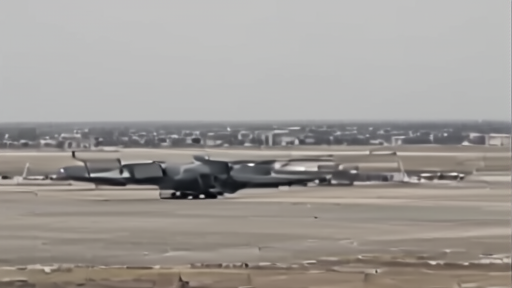
NDTV published a Vantor satellite image on Monday dated April 25, 2026. [1] The image shows what NDTV's reporting describes as the presence of an Iranian Air Force aircraft at a hangar at Pakistan Air Force Base Nur Khan, the strategically important installation near the garrison city of Rawalpindi. CBS News had broken the underlying story on May 11, citing US officials who spoke under condition of anonymity to say Iran had sent "multiple aircraft" to Nur Khan in the days after Trump's early-April ceasefire announcement, including, specifically, an RC-130 reconnaissance and intelligence-gathering variant of the Lockheed C-130 Hercules. [2] The image is the second public artifact in a story that began as anonymous US-official sourcing. The first artifact was the report itself. The second is the picture.
The paper's May 13 standard said Pakistan's mediation was under pressure from a detail about its own airspace. The detail today is imaged. The mediation, today, also has presidential backing. Donald Trump, asked by a reporter at the White House on May 12 whether he was reconsidering Pakistan's role as negotiator, answered directly: "No, they're great, the Pakistanis have been great. The Prime Minister and Field Marshal of Pakistan have been absolutely great." [3] The president was speaking before boarding Air Force One for Beijing.
Two reactions. South Carolina Senator Lindsey Graham, who is by every account a close Trump ally, used his hearing time on Tuesday's Senate Appropriations Defense Subcommittee meeting to press Secretary of War Pete Hegseth and Joint Chiefs Chairman General Dan Caine. [4] "I don't trust Pakistan as far as I can throw them," Graham said. He asked Caine whether the CBS reporting was accurate. Caine declined to comment, citing the classified nature of the intelligence. Graham asked whether the alleged sheltering was "consistent with Pakistan being a fair mediator." Hegseth answered that he "wouldn't want to get in the middle of these negotiations." Graham replied: "I want to get in the middle of these negotiations. I don't trust Pakistan as far as I can throw them. If they actually do have Iranian aircraft parked in Pakistan bases to protect Iranian military assets, that tells me we should be looking maybe for somebody else to mediate. No wonder this damn thing is going nowhere."
Earlier, Graham had posted on X — through his @LindseyGrahamSC account — that "if this reporting is accurate, it would require a complete reevaluation of the role Pakistan is playing as mediator between Iran, the United States and other parties. Given some of the prior statements by Pakistani defense officials towards Israel, I would not be shocked if this were true." [5] As of Thursday morning, no second Republican senator had publicly endorsed the reassessment call. The reassessment is, today, one senator's position.
Pakistan's foreign ministry on Tuesday confirmed Iranian aircraft were in Pakistan and rejected the framing. "The Iranian aircraft currently parked in Pakistan arrived during the ceasefire period and bear no linkage whatsoever to any military contingency or preservation arrangement," the official statement read. "Assertions suggesting otherwise are speculative, misleading, and entirely detached from the factual context." [6] The statement said the aircraft had supported the movement of diplomatic personnel and security teams during the initial Islamabad Talks round. The aircraft, it said, were administrative. The ministry called the CBS report "misleading and sensationalised."
This is the diplomatic structure: a satellite image with an April 25 date; CBS reporting that names the aircraft type; a Pakistani statement that acknowledges Iranian aircraft in the country but disputes their purpose; a US senator who wants Pakistan removed as mediator; a US president who backs Pakistan publicly. The structure is consistent with the May 13 standard the paper carried — the mediator with the airspace fact under image continues with presidential backing. The image-vs-defense pairing is the news.
The aircraft itself merits care. The paper's editorial guidance specifies that the "17 aircraft" figure has not been independently sourced beyond initial commentary. CBS reported "multiple aircraft" and named the RC-130 specifically. [2] World Israel News, citing the CBS officials, called the RC-130 a "reconnaissance and intelligence-gathering aircraft" — the Lockheed C-130 Hercules variant adapted for surveillance. [7] The Vantor image, per NDTV's caption work, shows the C-130-shape silhouette in a Nur Khan hangar area, dated April 25. The paper's framing: satellite-confirmed presence of an Iranian C-130 at Nur Khan, with multiple aircraft per US-official sourcing and the RC-130 specifically identified.
The mediator's broader posture is what Trump's defense is propping up. Pakistan brokered the early April ceasefire. Field Marshal Asim Munir and Prime Minister Shehbaz Sharif requested the ceasefire's extensions. Iran channels messages through Islamabad to Washington. The US has accepted Pakistan as the de facto intermediary because no other capital could simultaneously talk to Tehran's military and host US negotiators. The price of Pakistan's accessibility is the latitude it has taken with its airspace. CBS reported that Pakistan's reliance on China for military equipment had risen sharply over the past decade — Stockholm International Peace Research Institute data showed China supplied about 80% of Pakistan's major arms between 2020 and 2024. [2] Islamabad's accommodation of Tehran sits inside that supply relationship. Trump's calculation is that it costs less to keep the mediator than to relitigate him.
There is a second Pakistani concession the satellite image touches indirectly. CBS reported that Iran moved some civilian aircraft to neighboring Afghanistan as a precaution against possible US strikes. An Afghan civil aviation officer told CBS that a Mahan Air aircraft landed in Kabul shortly before the war started and was later moved to an airport in Herat. [2] The Mahan Air aircraft in Afghanistan is a tactical fact; the Iranian Air Force aircraft at Nur Khan is a different kind of fact. The first is Iran finding empty pavement. The second is Iran being permitted use of a Pakistani military installation by a state actively brokering the ceasefire that produced the lull during which the aircraft moved.
The diplomatic question is asymmetry. The reporter Jim LaPorta, who co-bylined the CBS story, has been criticized by Pakistani outlets — Kashmir English carried a piece noting his 2022 firing from the Associated Press for erroneous reporting on a separate story. [8] The criticism does not invalidate the satellite image, which Vantor produced independently and NDTV ran independently. But it suggests Islamabad will frame the underlying account as journalistically compromised even as it acknowledges the aircraft's presence. The acknowledgment is what survives the framing.
For Iran, the Nur Khan posture is leverage of its own. Tehran kept fleet assets through the war by parking them on territory of a state that ceased being a target. The arrangement is the kind of thing that becomes invisible if a peace deal is signed and visible if a peace deal collapses. The paper has tracked Pakistan's mediation channel since March 21; the May 13 standard noted that the channel was under pressure but had not yet been cut. Today the pressure has acquired an image. The channel remains.
What did not happen today: a US move against Pakistan; a public Iranian acknowledgment of the Nur Khan presence; a second senator joining Graham; a higher-resolution Vantor image showing more than one Iranian aircraft. The satellite image is one frame. The story remains, at the US-Pakistan diplomatic surface, a question of denial and defense rather than confirmation and consequence. Trump's "they're great" sits across the same news cycle as the picture. The mediator survives the image because the mediator's value is bigger than the image. The paper's May 13 reading — the channel will continue until something else replaces it — continues to hold.
-- PRIYA SHARMA, Delhi