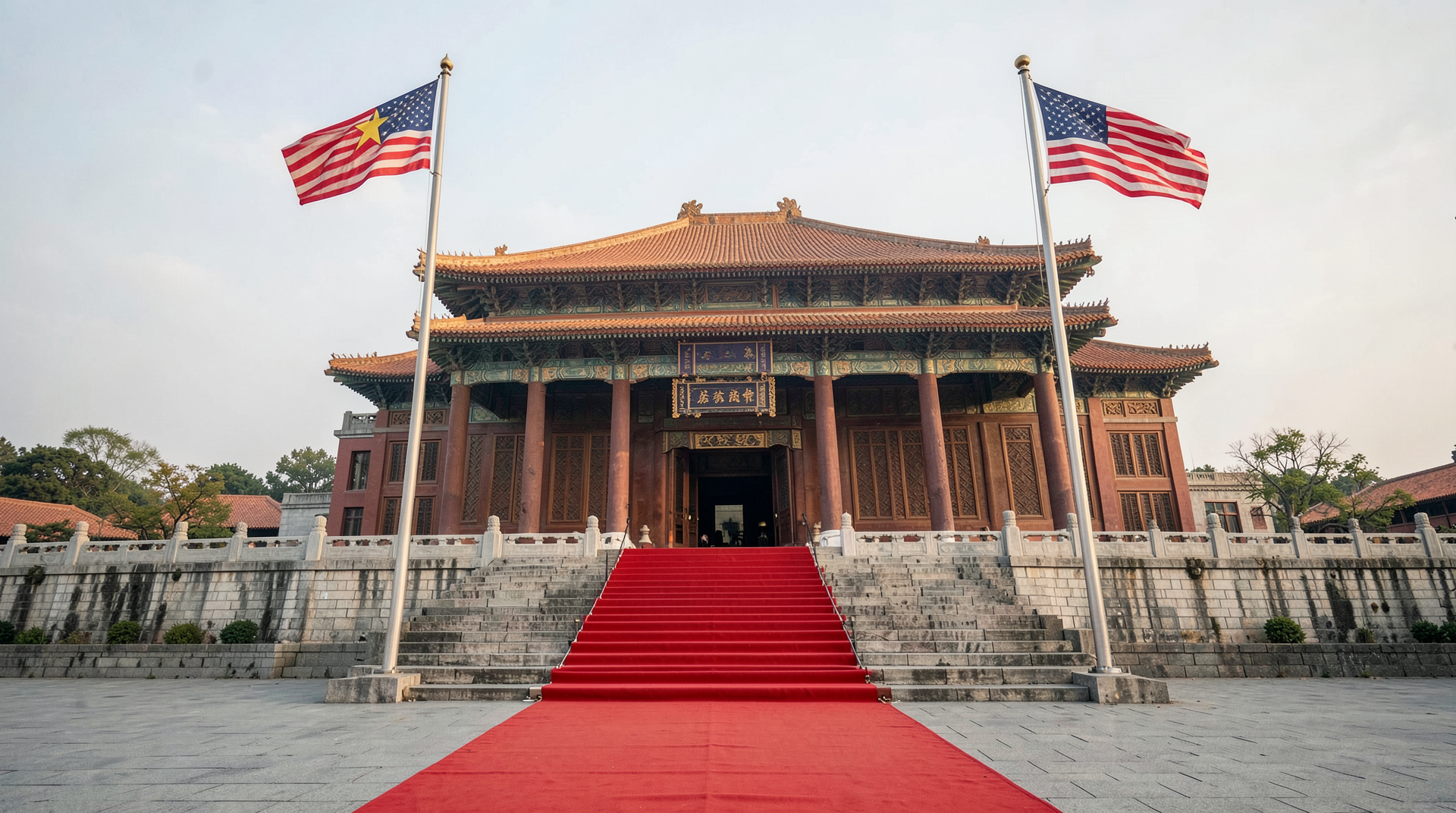
Mao Ning's readout went up first, on her Foreign Ministry's account, and Taiwan was the first line. The White House readout went up later, and Iran was the first substantive item. Neither readout named what the other readout named. That asymmetry is the artifact this paper will hold the summit to.
The American sheet on Thursday committed, in writing, that "the Strait of Hormuz must remain open." It said China opposed the militarization of the strait and any effort "to charge a toll for its use." It said Xi expressed interest in buying more American oil to reduce his country's dependence on the waterway. And it said both sides agreed that Iran "can never have a nuclear weapon." [1] That is the most substantive Iran-specific language in any joint document produced since the war began on February 28. The paper's May 13 lead had asked what would follow Iran's expired deadline. The answer turned out to be a paragraph.
A paragraph is a thinner thing than a treaty. It is also thinner than an implementation channel. What the readout did not name, Iran spent the same Thursday filling in.
In New Delhi, hours after the Great Hall reception ceremony, Iran's foreign minister Abbas Araghchi told the BRICS foreign ministers' meeting at Bharat Mandapam that there was "no military solution to any issue involving Iran" and that Iran was "invincible," that the country emerged "stronger and more united whenever it comes under pressure." [2] At the same venue, his deputy Kazem Gharibabadi told a select group of reporters at the Iranian embassy that Iran was working on a Hormuz "protocol" with a financial component, administered jointly with Oman, to cover the costs of safe passage. [3] Gharibabadi avoided naming the United Arab Emirates directly but said "a neighbouring country that is also a member of the BRICS" was thwarting a joint statement by trying to introduce language that condemned Iran's military strategy. The line traced a triangle in one news cycle: Beijing produced the prohibition, Tehran produced the protocol, and Abu Dhabi got named as the blocker.
NPR confirmed the rest. A shipping data company had reported that Iran has established a government agency to vet and tax vessels seeking passage through Hormuz, called the Persian Gulf Strait Authority, and that the authority had emailed Lloyd's List Intelligence an application form for ships seeking passage. [4] AGBI had named the agency on May 8 as the PGSA. [5] Lloyd's List documented at least two tankers paying approximately $2 million each in yuan to make the northern transit through Iranian territorial waters near the islands of Qeshm and Larak. Three vocabularies for the same checkpoint regime emerged in a single 24-hour cycle: the White House readout called it a toll, Gharibabadi called it a service-fee protocol, NPR and Lloyd's List called it a toll-collection agency. The institution has a name now. It also has an application form.
The State Department had laid the groundwork. On Tuesday, May 12, the day before Trump landed at Beijing Capital International Airport, spokesman Tommy Pigott had told Reuters that Secretary of State Marco Rubio and Foreign Minister Wang Yi had agreed in an April phone call "that no country or organization can be allowed to charge tolls to pass through international waterways like the Strait of Hormuz." [6] The State Department had not previously published a readout of that call. The bilateral language was placed on the record forty-eight hours before the summit, projecting consensus before the cameras arrived. By Thursday morning that consensus had become a presidential commitment in Beijing — and a contradiction in Delhi.
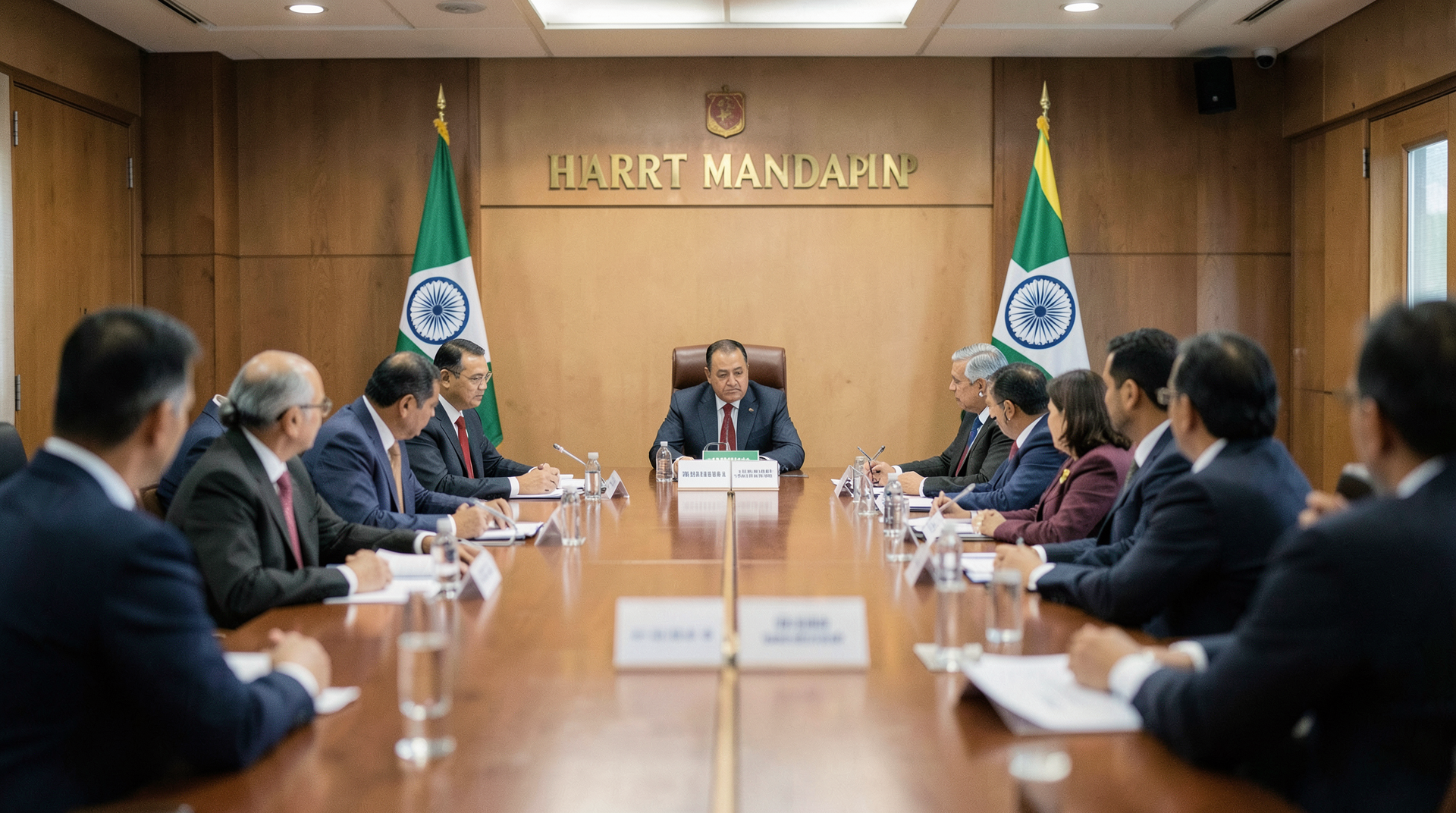
The geometry of Wang Yi's absence is the second artifact. China was the only BRICS member to skip the Delhi foreign ministers' meeting at ministerial rank. Beijing sent Ambassador to India Xu Feihong in his place. The Chinese Foreign Ministry described the substitution as "due to scheduling reasons." [7] In other words: Wang chose Trump over BRICS the week BRICS was supposed to ratify a joint Iran position that India has been trying to broker for three months. The Indian Express counted at least seven phone calls between Araghchi and India's External Affairs Minister Subrahmanyam Jaishankar since February 28. [8] By Thursday morning the Chinese co-chair of the position they were trying to draft was in Beijing instead, signing a parallel paragraph in a different building.
This is what bifurcation looks like. The paper has been describing a war in which the operating system hardens regardless of language; the language has now caught up to the operating system without bending it. The Trump-Xi readout opposes the toll. The Iranian state has institutionalized the toll. Both happened on Thursday. Both are now on the public record.
Tehran's two-track posture was not improvised. The day Araghchi flew to Delhi, Iranian Foreign Ministry spokesperson Esmail Baghaei posted that the country "looks forward to bilateral meetings with other ministers" at the BRICS event and described the gathering as "of importance to Iran." [9] The deputy foreign minister was selling. The foreign minister was defying. The semantic gap between the two officials — one talking in transactional vocabulary about a fee schedule, the other talking about civilizational invincibility — is the gap Iran needs to keep open for as long as possible, because both audiences exist and neither has yet enforced a choice.
Araghchi's BRICS speech also did something the deputy's did not. It named cause. The Iranian foreign minister said the United States and Israel had carried out "two brutal and unlawful acts of aggression against Iran in less than a year" and that the attacks had been justified by "false claims that contradicted assessments by the International Atomic Energy Agency and US intelligence services." [10] He coupled the defiance with a stated commitment to "pursuing and safeguarding diplomacy." The country, Araghchi said, was "ready for diplomacy" and "prepared to deliver a devastating strike if necessary." This is the rhetorical register that survived the deadline. It is the same register that, under different leadership configurations, has produced negotiating exits before. It is also the register that, under the same leadership configurations, has been compatible with continued sea-ledger control.
The American readout sits awkwardly against that register. The line about China buying more American oil to "reduce its dependence" on the strait reads, on first encounter, like an off-ramp for Beijing. On second reading it reads like a procedural acknowledgement that the strait may remain a problem for some time. The dependence reduction is not described as a short-horizon adjustment. It is the same logic the paper has been tracking inside the IEA's May 13 monthly report — the energy agency said the market will be "severely undersupplied" until October even if the war ends next month. [11] The horizon on which Beijing reduces its dependence is the horizon on which the conflict's structural premium prices itself into the global market. The readout did not name that horizon. It implied it.
There is a third register the readout did not name, and that is the bank ledger. Two days before the summit, Reuters and Bloomberg reported that China's National Financial Regulatory Administration had verbally instructed major state banks to suspend new yuan-denominated lending to five US-sanctioned Iranian-linked teapot refineries, including Hengli Petrochemical (Dalian) Refinery. [12] The directive arrived before Beijing's May 2 public order to firms to disregard US sanctions. Existing loans stayed intact; new credit froze. The Commerce Ministry's blocking statute produced the rhetoric. The NFRA produced the balance sheets. The blocking statute is a public artifact. The NFRA instruction is not. Both came before the summit; only one was meant to be visible.
The summit's Iran paragraph rests on that asymmetry. Beijing can publicly support Iran's right to peaceful nuclear energy — Wang Yi made exactly that point hosting Araghchi in Beijing the week before — and quietly tighten the credit lines that finance Iranian crude purchases. The bilateral commitment to oppose tolls can coexist with three months of NFRA caution toward five named refineries. The readout language is real. The operating system underneath is also real. The paper's discipline from May 13 — that a non-event becomes consequential when measured against an operating record that does not bend to it — applies here too, but with a sign change. Today an event happened. Today a paragraph exists. The question is whether the paragraph bends anything.
Iran has not signed the paragraph. The paragraph does not require Iranian signature to exist as a US-China document, and that is part of what makes it useful to both Beijing and Washington: it lets each capital project consensus without negotiating one. Tehran sees the paragraph as a US position adopted by Beijing under duress, not as a multilateral framework. Tehran's response — Araghchi at one podium, Gharibabadi at the next, the PGSA application form circulating beneath both — is a non-signature in three forms. Beijing knows this. The Chinese readout's procedural placement of Iran below Taiwan acknowledged it. The American readout's procedural elevation of Iran above Taiwan acknowledged it differently. Each capital used the readout to talk past the other's priority.
There is one more line in the American readout that has not yet been independently corroborated by Beijing's text. The line about Xi expressing interest in buying more American oil appeared only in the US version. The Chinese readout, in the Mao Ning version posted to X, opened with Xi's warning that the Taiwan question, if mishandled, "could send relations down a dangerous path" and "could lead to conflict and an extremely dangerous situation." [13] The Chinese readout led with Taiwan and concluded after a little over two hours of bilateral talks. Beijing exchanged views on the situations in the Middle East, Ukraine, and the Korean peninsula, according to state media — but the Chinese readout's hierarchy of issues did not place Iran first. The asymmetry between the two readouts on which item leads is itself a divergence the paper holds against any reading that the summit "agreed on Iran." The summit agreed on a US sentence. The Chinese readout did not amplify it.
Russia continued to say nothing. Sergey Lavrov was in Delhi. He delivered his prepared remarks on energy supplies to India, praising Prime Minister Modi as "one of the most energetic leaders the world has ever seen," and the Russian Foreign Ministry's statement said the discussion with Jaishankar would pay "special attention" to the Middle East. [14] No Iran-specific Russian position was issued. The paper's May 13 reading of Russian silence — silence as a documented strategic position, not absence — held through a second day. The Kremlin had two diplomatic venues this week to take a position. It used neither.
For shipping, the operating record speaks for itself. Lloyd's List reported that traffic through the strait fell from 44 to 39 weekly passages through May 5, with Iran-linked vessels accounting for 46% of all strait traffic that week. [15] Project Freedom, the US Navy's effort to escort merchant ships out of the strait, paused on its second day. Hapag-Lloyd said transits "remain unchanged" and impossible for its ships. Sparta Commodities counted 58 VLCCs trapped inside the strait. DHT's chief executive Svein Moxnes Harfjeld put the tally at 57 and said the industry needed "a high level of credibility on a Hormuz solution," with trapped ships exiting first to "demonstrate" safety. The paper's May 13 standard on Hormuz said the strait was open by permission and the permission had never been written down. Today the permission has been formalized by Iran into an application form. The PGSA's vocabulary — "the only valid authority to grant permission" — is the institutional answer to the paper's verb. Three vocabularies for the toll regime, one administrator. The summit paragraph repudiates the toll. The application form circulates.
So what did the summit produce? A US-China bilateral commitment that no country may charge tolls to pass through the strait. An American commitment from Xi that China will reduce its strait dependence by buying more US oil. A shared statement that Iran cannot have a nuclear weapon — a sentence Beijing has been willing to say since long before the war. A photograph of the two presidents standing for national anthems at the Great Hall. A planned state banquet on Thursday night and a working lunch at the Diaoyutai State Guesthouse on Friday. A roster of US CEOs flown into Beijing — Cook, Huang, Musk among them — to "pay respects." No joint readout. No Iranian signature. No enforcement mechanism. No timeline. No agency designated to monitor compliance with the toll-prohibition language. No mention of the EU's Aspides amendment, no mention of Pakistan's mediation, no mention of the satellite-imaged Iranian C-130 at Pakistan's Nur Khan airbase. [16] The summit is a paragraph. The summit is also, by official US statement, "a 12 on a scale of 10."
Inside that gap — between what was written and what was not, between Beijing's text and Delhi's counter-text, between the paragraph and the application form — sits the war's next phase. The mediation architecture the paper has tracked all spring lost its Chinese co-chair this week to a US presidential visit. The Pakistani channel acquired its first imageable airspace compromise and kept its Trump endorsement. The Russian seat is occupied; the Russian voice is not. The Iranian state operates two foreign ministers and a new statutory authority. The summit's contribution is to put language on the record that the operating record has consistently overrun.
The paragraph exists. The application form exists. Whichever document the strait ends up obeying will be the document that matters. On Thursday neither obeyed. Both were published.
-- DAVID CHEN, Beijing