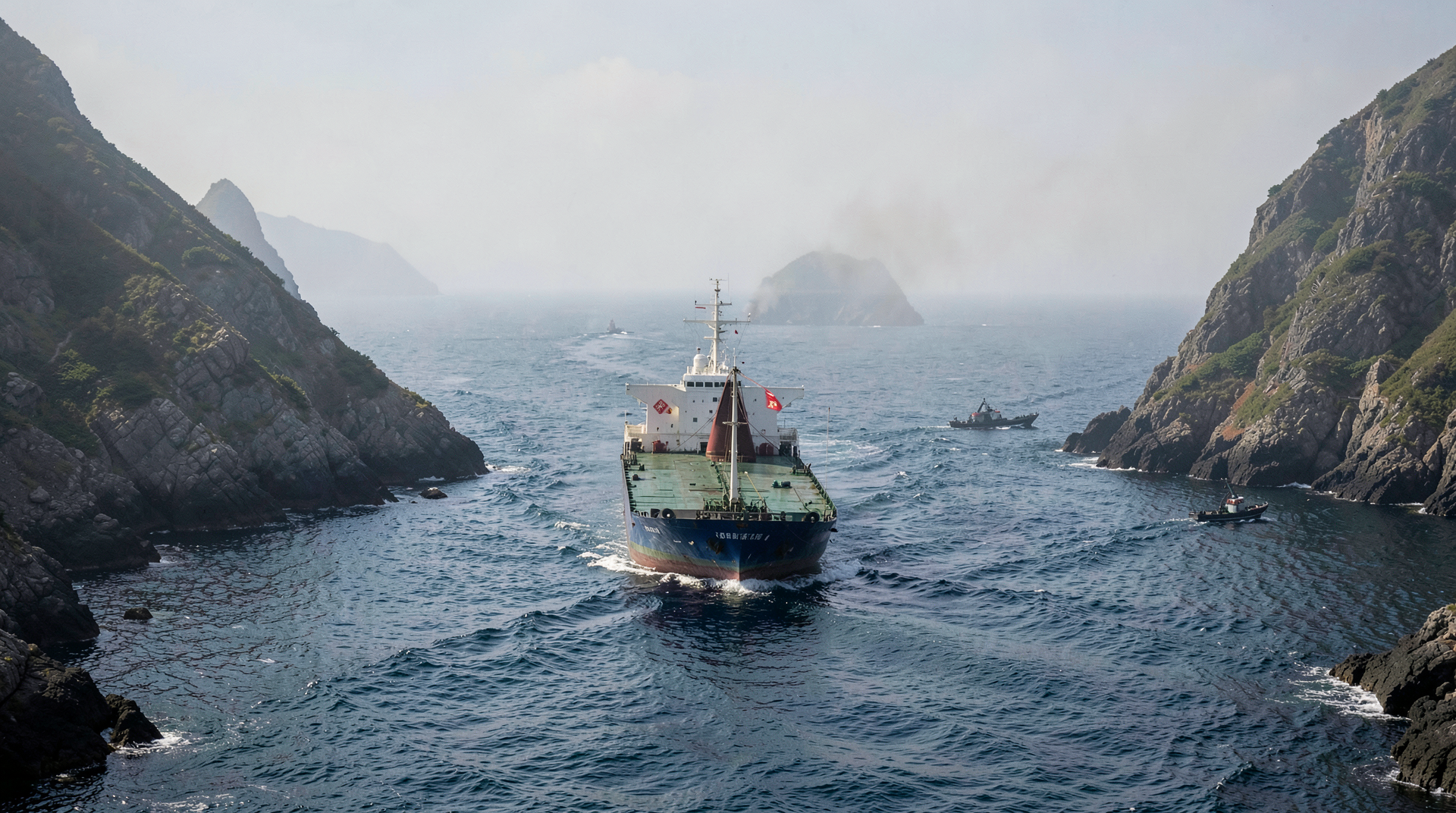
Iran did not reopen the Strait of Hormuz. It opened a lane for China.
That is the first rule for reading Thursday night's reports that some Chinese vessels had begun passing through the strait after Chinese requests and Iranian management protocols. The paper's Thursday account of Iran's new toll agency argued that the Persian Gulf Strait Authority was the documentary form of the permission verb. Friday adds the operational form: permission can be granted selectively.
Reuters, carried by Internazionale, reported that Iran was allowing transit of some Chinese vessels through Hormuz after an understanding over Iranian management protocols, citing Fars News. [1] The timing was not incidental. The report came as Trump and Xi had just agreed that the strait must remain open and that any tolling effort should be opposed. The White House version of the summit language, carried by the Algemeiner, said Xi opposed militarization of the strait and any toll for its use. [2] AGBI had already described Iran's formalized ship approvals and transit tolls, giving the permission system a name and a form. [3]
This is not a contradiction in the Iranian position. It is the position. Tehran can say, with a straight face, that Hormuz is open to commercial vessels that cooperate with Iranian naval forces. That sentence does not mean all vessels may pass. It means the authority deciding cooperation sits on the Iranian side of the water.
The China lane therefore matters less as a shipping relief story than as a sovereignty story. A free strait does not sort vessels by strategic relationship. A controlled strait does. A free strait does not require a foreign minister's request. A controlled strait can. A free strait is not proved by some ships from a favored power. A checkpoint is.
Fars' account, as summarized in the Reuters-linked report, said the passage followed requests by China's foreign minister and ambassador to Iran and was facilitated in line with the countries' strategic partnership. [1] Each noun is doing work. "Requests" means Beijing asked. "Protocols" means Tehran set terms. "Strategic partnership" means the permission was not universal. It was diplomatic, bilateral, and conditional.
The White House sentence cannot absorb that fact without changing shape. If China opposes tolls but uses Iranian protocols to move its own vessels, Beijing's opposition is not an enforcement commitment. It is a position statement. The difference is the same difference between a law and a waiver. China can oppose the rule and accept the exception that moves Chinese cargo.
Tehran's design has always depended on exceptions. If the strait were closed to everyone, Iran would invite a total naval confrontation. If the strait were open to everyone, Iran would lose leverage. The permission system sits between those extremes. It lets Iran punish enemies, court partners, extract fees or compliance, and insist that disruption is the product of American blockade rather than Iranian closure.
That is why the ship count is less important than the clearance logic. Fars said some Chinese vessels had passed after Chinese requests and Iranian protocols. [1] The number may move as AIS records settle and Kpler-style counts distinguish Chinese-owned, Chinese-bound, Chinese-flagged and Chinese-chartered vessels. But the count cannot answer the constitutional question of the waterway. Approved passages are still approved passages.
AGBI's earlier account of the PGSA described a system for formal approvals and transit tolls. [3] That system gives Iran the paperwork to turn ad hoc naval control into administration. Once a form exists, a lane can be opened without conceding that the strait is open. The authority can say: here is the process, here are the requirements, here is the clearance. The exception becomes proof of the institution.
The Chinese case is the cleanest possible demonstration because China is the one outside power with enough leverage to obtain passage and enough exposure to need it. Beijing buys Iranian crude. It needs Gulf supply. It does not want the US Navy setting the terms of Chinese energy security. It also does not want to be seen accepting an Iranian toll regime after Xi has been quoted opposing one. The compromise is protocol language. No one calls it submission. The ship moves.
This is the kind of semantic arrangement wars produce when no party can afford full clarity. Iran calls the regime management. Washington calls it a toll. China calls for openness while coordinating passage. Shipping companies call their insurers. The vessel's master waits for instructions.
The mainstream frame sees movement and asks whether the summit began to work. The X frame sees the same movement and says the checkpoint has been validated. The paper's view is narrower: the summit created a documentary contradiction, and the China lane shows which document governs at sea. Not the no-toll sentence. The protocol.
The lane also changes the diplomatic burden on Beijing. It is no longer enough for Chinese officials to say they support free flow of energy. If Chinese vessels are receiving access under Iranian procedures, the practical Chinese position is that some coordination with Iran is acceptable. Washington can tolerate that if the coordination becomes a bridge to general reopening. Washington cannot tolerate it if it becomes the model everyone else must use.
That is the next test. Does the Chinese exception become universalized into a route available to neutral shipping without discriminatory fees, or does it remain a privileged lane for the strategic customer Iran most wants to keep? If it is the first, the summit sentence has begun to bend the operating system. If it is the second, the summit sentence has been domesticated by the PGSA.
Iran has incentives to keep the second model. A selective China lane reduces pressure from Beijing without surrendering pressure on Washington. It lets Tehran show that American blockade, not Iranian policy, is the real obstacle for broader traffic. It preserves revenue claims. It puts Oman, the UAE and other Gulf neighbors in the awkward position of reacting to a regime that is functioning for at least one large buyer.
The legal problem remains. The Strait of Hormuz is an international waterway. Iran's claim to manage wartime safety does not erase the international-law objection to tolling or discriminatory passage. But legal categories are slow. Clearance practices are immediate. The ship either receives permission or it does not.
That immediacy is why the China lane belongs high in the paper. It is easy to make the Hormuz story abstract: maritime law, summit language, diplomatic readouts, oil futures. The lane makes it physical. A vessel with a cargo and a destination moved because a government asked and another government allowed. That is a sentence any port understands.
If Beijing later says no toll was paid, that will matter. If Tehran releases a list of vessel names, that will matter. If ship-tracking firms show non-Chinese neutral vessels passing under the same procedure, that will matter. If Oman publicly rejects joint administration, that will matter. None of those facts is in the current record.
The record that exists is enough. The PGSA form says permission is bureaucratic. The Fars-Reuters account says permission can be diplomatic. The Trump-Xi language says permission should not exist as tolling. The first two facts operate at the waterline. The third operates in a readout.
Iran has not beaten the summit. It has absorbed it into a narrower category. The strait, Tehran can say, is open to China. That is not an answer to freedom of navigation. It is an answer to a customer.
-- YOSEF STERN, Jerusalem