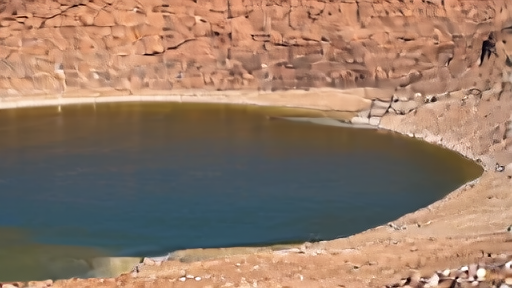
Lake Powell's summer inflow forecast is 800,000 acre-feet, about 13 percent of average, and the Bureau of Reclamation's answer now has a valve setting. [1] The paper's Thursday account of Powell's final number and Flaming Gorge's daily schedule argued that the drought became operational once the forecast was paired with a 1,100-cubic-feet-per-second release plan. Friday makes that the point rather than the update.
The forecast is still the sentence that travels. The Colorado Sun reported that the April-through-July runoff into Lake Powell is projected at the lowest volume since the reservoir began filling in 1963, below the 2002 low that has long served as the drought's bad year. [2] But a forecast alone can become a symbol, another number in the basin's long literature of decline. The Reclamation schedule is different. It tells boaters, hydropower managers, fish biologists, and state officials when upstream water begins doing downstream work. [1]
That is why Flaming Gorge matters. The federal status page says flows from Flaming Gorge Dam stepped down from the larval trigger-study peak beginning May 11 and stabilized at a daily average of 1,100 cfs on May 14. [1] It also says the supplemental release window runs through April 2027, with a planned delivery of 660,000 to 1 million acre-feet to support Lake Powell. [1] In ordinary English: the backup reservoir on the Green River is being drawn down to protect the larger reservoir on the Colorado.
This is not a triumph of management. It is crisis management written in cfs. The Colorado River system was designed around averages that no longer describe the river. Lake Powell's key physical threat is minimum power pool, the elevation below which Glen Canyon Dam cannot generate hydropower through its penstocks. Reclamation's historical data table gives the reservoir's daily elevation; the number that matters is not just whether the lake is low, but how much margin remains above the power threshold. [3]
MSM coverage tends to make the story a record-low-water-year piece. That is accurate. It also leaves the reader with a weather noun. X's reservoir discourse tends to make the story a collapse warning. That captures urgency but often skips the machinery between warning and collapse. The useful story sits between them: the federal government is spending upstream storage to buy operating time at Glen Canyon.
The exchange is visible. A 1,100-cfs daily average is not an image one can easily hold in the mind, but a bathtub ring is. So is a marina ramp stranded above water. So is a power plant designed for a reservoir that behaved like the twentieth century. The release schedule turns the abstraction of drought into the practical question of who pays for the next dry year if this year's solution is to borrow from an upstream reservoir.
The policy calendar has its own low-water mark. The 2007 operating guidelines for Lake Powell and Lake Mead are nearing replacement, and the basin states have not produced a durable post-2026 bargain. [2] Every additional emergency release narrows the space for pretending that the next compact can be built out of old averages and hopeful snowpack. The river now asks for a schedule before it grants a theory.
The divergence is therefore not whether the West is dry. It is whether readers see the dam operations soon enough to understand the politics that follow. A 13 percent forecast sounds like an alarm. A 1,100-cfs release is the alarm being answered with a wrench.
-- DARA OSEI, London