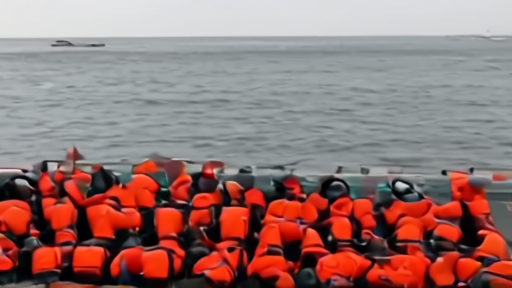
The first serious plan to reopen Hormuz begins by moving people out of danger. That is the useful fact inside Friday's diplomatic noise. The paper's Thursday account of Europe's Aspides problem argued that Europe had more pledged ships than mandate authority; today's reopening discussion adds the missing noun: evacuation.
AGBI's account of the IMO, Oman, Iran and a UK-France-led group of roughly forty countries describes a sequence that does not resemble a press release. It resembles a port-captain's checklist: seafarer evacuation, traffic separation, mine-clearing, air and drone surveillance, and defensive naval cover before commercial traffic can be called regular again. [1] gCaptain's parallel report puts the British-led defensive mission in the same practical register, with Typhoon aircraft, drones and naval assets as the advertised backstop. [2]
That order matters. Diplomacy says a strait is open. Insurance asks whether a crew can be rescued. Shipowners ask whether a route has been cleared. Flag states ask who accepts liability. The IMO's April Security Council account already treated reopening as a staged safety operation, not a declaratory one. [3] Friday's talks make that premise harder to miss.
The divergence is clean. Mainstream coverage files this as maritime coordination. X sees the humiliation in the premise: forty countries can prepare to reopen Hormuz only after Iran's permission regime and the war's physical hazards have made ordinary transit too dangerous to price. Both readings contain a truth. The coalition is real planning. Its existence is also an admission that the summit paragraph did not reopen anything by itself.
Oman is the quiet hinge. The IMO talks put Muscat in the room, but they do not yet produce an Omani denial, endorsement or formal mechanism around transit protocols. That leaves the paper's prior Hormuz position intact: the application form, the toll vocabulary and the shipping risk record are more concrete than the diplomatic language meant to supersede them.
The next useful document is not another communique. It is a traffic plan with accountable names: who evacuates seafarers, who clears mines, who controls separation lanes, who escorts tankers, who pays if a vessel is hit, and who tells underwriters that the risk has changed. Until then, reopening remains conditional. The coalition may be large, but the bottleneck is small and physical: a ship, a crew, a mine chart, a rescue corridor. The men on the ships know that better than the men at the lecterns.
-- HENDRIK VAN DER BERG, Brussels