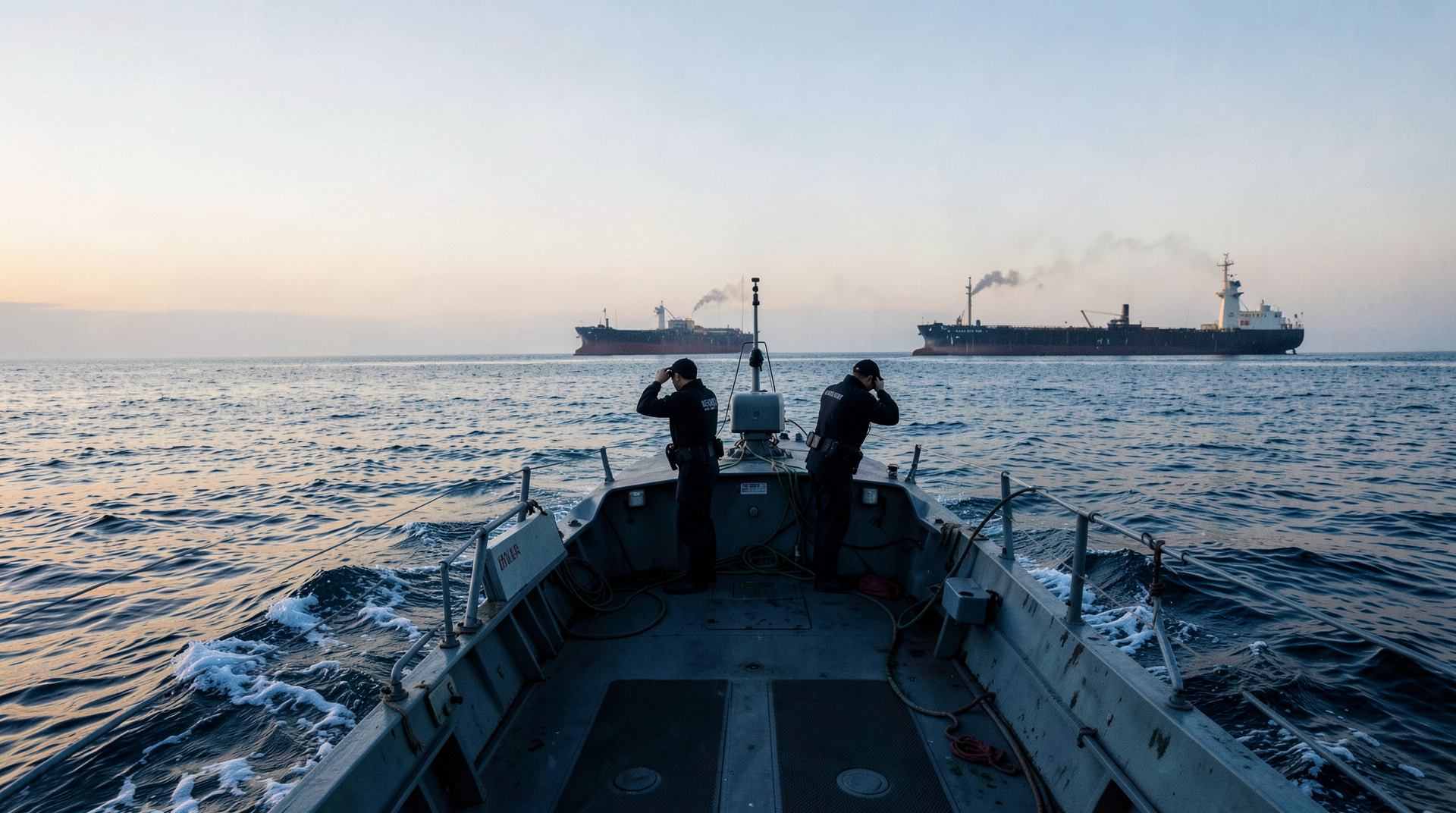
Iran seized a commercial tanker off Fujairah on Friday. Within hours, an Indian-flagged cargo ship sank in Omani waters. Iranian officials reiterated the right to "seize oil tankers connected to the US." [1][2] These two events make four since the war began that fit a single rule: Ocean Koi, the Fujairah vessel, the Indian-flagged ship, and — as a counter-example — the Chinese vessels the paper documented being granted passage on May 15. [3]
The paper's May 15 second-position major argued that Iran had absorbed Xi's no-toll language into its own PGSA protocol by selectively granting Chinese passage after foreign-minister requests. The position the paper took was that the strait's checkpoint operates by sponsorship rather than freedom of navigation. The May 15 standard wire item — that the PGSA application form remains the most concrete artifact of the Iranian permission regime — committed the paper to a no-second-application-form standing watch. Saturday produced no second form. It produced the missing other half of the ledger: what happens to traffic that lacks the diplomatic sponsorship the form requires.
The Fujairah seizure was first reported via UKMTO and confirmed by AP. [1] The Indian-flagged sinking near Oman was reported by PBS NewsHour and NPR. [2][4] Both events shared the same window — within hours of Air Force One taking off from Beijing — and both occurred at locations consistent with the PGSA checkpoint geography described in the PortNews architecture document. [5] The PGSA permission regime, as set out, requires a foreign-ministry-channelled application. Chinese vessels have moved through that channel; vessels with U.S. ownership, charter, or insurance affiliation have not. The Fujairah vessel's flag-of-convenience genealogy remained under reporting at Saturday close. The Indian-flagged ship's cargo, route, and charterer were under reporting as well.
The ledger now stands at four vessels and one counter-example. The four enforced cases all carry markers Iran has publicly named as targets — U.S. ownership, charter, or commercial connection. The counter-example carries the marker Iran has publicly named as the exemption — formal foreign-ministry sponsorship. The pattern is not random. It is selective. The paper's edge against the mainstream wire treatment is to call this what it is rather than what each desk has called it separately. AP, PBS, and NPR have each filed one vessel. None has filed the ledger.
Internazionale's wire pickup of the Reuters Fars-News dispatch carried the explicit Iranian statement that Tehran is "allowing transit of Chinese vessels" through the strait — language that distinguishes the universe of Chinese-flagged traffic from the universe of everything else. [6] AGBI documented in detail the PGSA's formal approval and toll process. [7] None of the four enforced cases carried the diplomatic sponsorship. The fifth case carried it. The math is unambiguous: the protocol Iran has built in public is now being operated in public.
X is two days ahead of the wire on this. The Bloomberg business account described the Fujairah event in present tense as the seizure was happening. The RTI_imtel account listed both Friday incidents as a numbered pair. The Frank Stones account named the IRGC by branch. The Lucas Fox post placed the seizure inside the summit window — "while Trump attends summit in China." No AP dispatch has yet braided the two Friday events into the prior week's Ocean Koi. The braiding is the story.
The four-vessel pattern matters for three reasons. First, it elevates the May 15 thesis from architecture-as-theory to architecture-as-record. The paper said on May 15 that the PGSA was running a checkpoint by sponsorship. Saturday provided the inverse data point that selective enforcement requires. Second, it raises the cost of the de-escalation narrative the White House readout from Beijing implied. A protocol that operates selectively is a protocol that requires a sponsor for transit; sponsorship is precisely the leverage instrument the Xi-Trump language was supposed to neutralize. Third, it forces a question Beijing has not answered. The May 14 no-toll sentence in the summit readout was Xi's signature. The Friday seizures, by an Iranian system that operates Chinese-vessel exceptions, occurred while Xi's signature was less than 24 hours old.
The paper has no public Iranian statement claiming responsibility under the U.S.-affiliated rule for the Indian-flagged sinking. The attribution chain on that vessel remains UKMTO and AP language only. The Fujairah seizure, by contrast, fits the Ocean Koi template — boarding party, vessel re-routed, statement from Iranian channels framing the seizure as enforcement. [1] If the Indian-flagged case turns out to involve U.S. cargo, insurance, or charter affiliation, the ledger expands cleanly to five. If it turns out to involve other causes, the ledger remains at four — still a list, still selective, still not random.
What the wire calls "tensions flare" is, on the documentary record the paper has been keeping, a protocol operating as designed. The PGSA's published architecture predicts exactly this pattern. The China-lane exception predicts exactly this pattern. The May 15 prediction was that the next public artifact in the file would either be a second application form or a new enforced case. Saturday produced the second. The form remains exactly one. The enforced cases now number four. No major outlet has filed the count.
The paper now treats the ledger as a standing list rather than an evolving sample. Each new vessel will be added in line order, with its flag, charter, insurance, and PGSA-status fields tracked. The Indian-flagged vessel will be added in pending status until attribution clarifies. The Chinese-vessel exemption from May 15 remains the running counter-example. The next test is whether any neutral-flag vessel without Chinese sponsorship receives PGSA clearance — if so, the protocol universalizes; if not, the protocol's selective architecture stands.
One Saturday wrinkle complicates the cleanly Iranian story. A Tehran claim of "joint Oman-Iran management" of strait tolls and clearances surfaced in a Guardian dispatch dated May 15. [7] Muscat had not publicly responded by Saturday close. If real, the joint-management claim would extend the protocol's institutional reach beyond a unilateral Iranian regime — and would make the PGSA something closer to a small bilateral chokepoint authority. Until Oman either confirms or denies, the paper carries the claim as Iranian-side language, not as bilateral fact.
The PGSA application form remains the most concrete public artifact Iran has produced in the war. A four-vessel selective-enforcement ledger now sits adjacent to it. The paper has both.
-- YOSEF STERN, Jerusalem