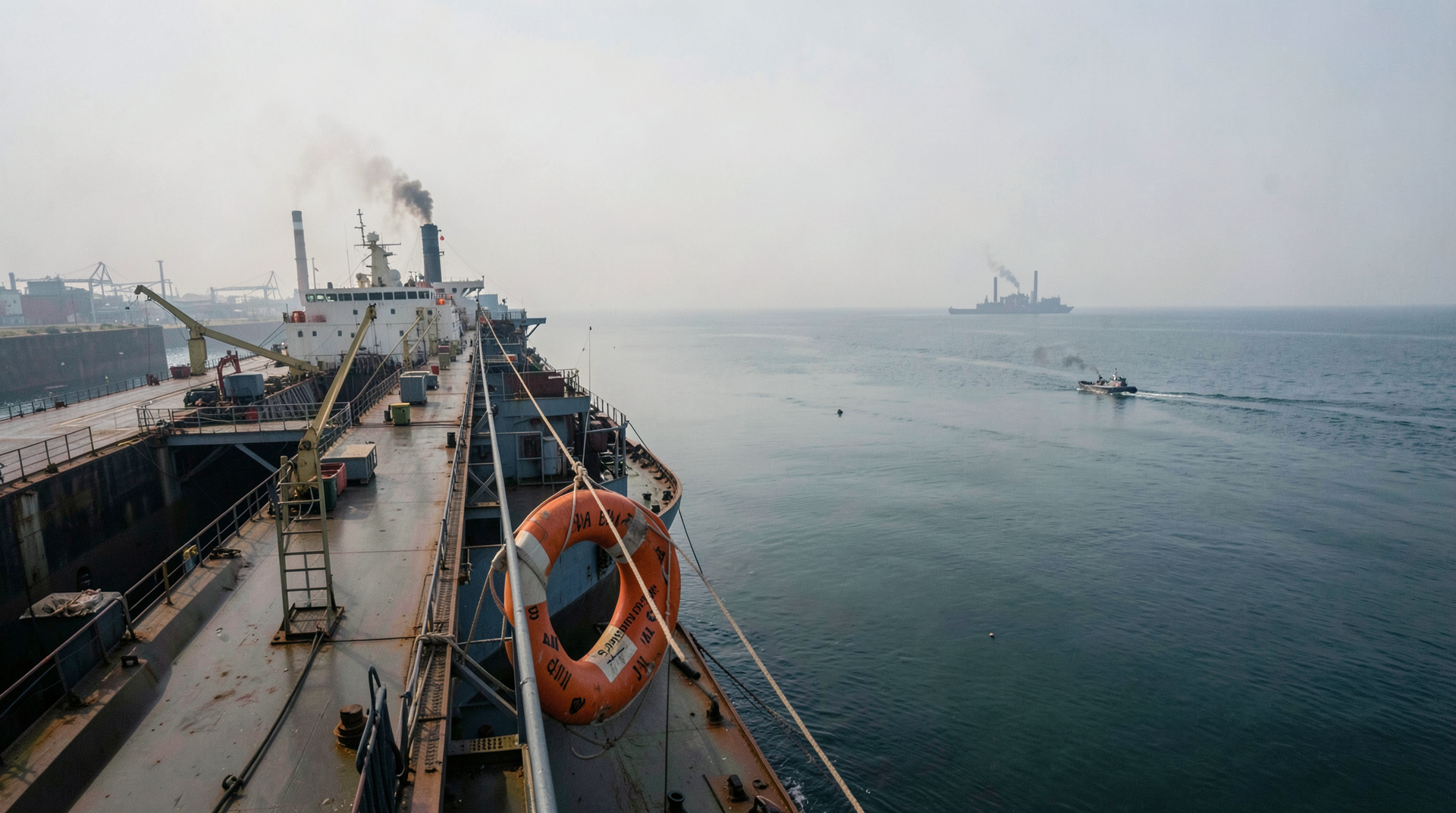
Within hours of Donald Trump's wheels-up from Beijing on Friday, the Strait of Hormuz produced two events the Trump-Xi summit was not supposed to permit. Iran seized a commercial vessel off the United Arab Emirates port of Fujairah, and an Indian-flagged cargo ship sank near the Omani coast. [1][2] By Friday's close in New York, Brent had settled at $109.26 — a 7.84 percent gain on the week and the largest weekly oil move since the Iran war began. [3] On Air Force One, the president told the press pool he was "losing patience with Iran" and "did not ask Xi for favors." [4][5]
The paper's May 15 lead argued that the summit had produced trade machinery but no Hormuz mechanism, and that the strait's operating verb still belonged to Iran's permission regime. The follow-up was a falsifiable claim — that the no-toll language Xi had signed off on would not survive an operational test it had not been built to pass. Saturday produced the test. The paper also argued, in its second-position major, that Iran had absorbed Xi's open-strait language into its own PGSA protocol by granting selective Chinese passage. Saturday produced the inverse evidence — what happens to vessels without that sponsorship.
The seizures fit the protocol the paper has been tracking. Iranian officials reiterated this week the right to "seize oil tankers connected to the US," language that maps onto a now-multi-vessel ledger: Ocean Koi last week, the Fujairah vessel Friday, the Indian-flagged ship Friday, and the Chinese-vessel exception the paper documented before the summit. [1] The Bloomberg account on X described the Fujairah event as a "commercial vessel apparently seized by unauthorized personnel near the UAE." Other X aggregators compressed Trump's summit declaration and the same-hour kinetic events into a single timeline. Mainstream outlets did not. AP filed the seizure as a Persian Gulf maritime-security report; PBS NewsHour ran a separate dispatch on "tensions" near the strait. [1][2] The summit recap, the seizure recap, and the oil settle remained on three different desks.
Brent rose more than three percent on Friday alone. WTI gained 10.48 percent on the week to settle at $105.42. [3][6] The Business Times in Singapore and Gulf News called it the largest weekly oil gain of the Iran war. The 10-year Treasury yield touched its highest level since May 2025. The market was not pricing rumor. It was pricing the absence of an enforcement instrument that the White House readout from Beijing had implied existed.
The Air Force One readout produced two of the most consequential sentences of the post-summit window. "I'm losing patience with Iran," the president said. "I didn't ask for any favors from Xi." [4][5] The first sentence recast the diplomatic track from open-ended to expiring. The second sentence recast the summit itself — the trade board, the export-controls placeholder, the Hormuz language — as a one-sided U.S. demand rather than a bilateral mechanism. Within hours the same press cycle added two more lines: that "the U.S., not Iran, is in control of the Strait of Hormuz," and that the Iran war had "wiped out their armed forces, essentially." [5] Energy Secretary Chris Wright, on a separate call, told reporters he expected the strait to "reopen sometime this summer." [11] The administration's rhetorical posture moved three degrees in one day. None of the three claims was matched by a public enforcement instrument. Iran's foreign minister Abbas Araqchi said within the same news cycle that Tehran has "no trust" in the U.S. and is "ready to repel" any new attack. [5]
Two other Friday developments lined up with the same pattern. Defense Secretary Pete Hegseth quietly cancelled the rotation of the 4,000-troop 2nd Armored Brigade Combat Team to Poland. The memo's existence became public on May 14, with Pentagon staff and European NATO counterparts learning of the decision after the fact. [7] In a Fox News interview filmed after Beijing, Trump warned Taiwan against declaring independence and asked whether the U.S. should "travel 9,500 miles to fight a war." [8] The Japan Times and ABS-CBN called it the first explicit U.S. softening on Taiwan deterrence since 1979. U.S. Trade Representative Jamieson Greer confirmed that export controls were "not a major part" of summit talks; the May 14 license to ship Nvidia H200 chips to ten Chinese firms had produced no purchases by Friday close. [9]
Five separate stories. One Friday. The pattern the paper named on May 15 — that the summit's language was rhetorical without an enforcement mechanism — produced its own counter-evidence inside one news cycle. The Hormuz declaration did not survive 24 hours. The Taiwan deterrence formula did not survive a Fox interview. The export-controls instrument did not survive a sales call. The Poland rotation did not survive a memo. And the presidential commitment to the diplomatic track did not survive a flight home.
The institutional language is losing to the kinetic record on a single day. The seizure pattern is not isolated. It is the fourth and fifth entries in a ledger the paper has been keeping since Ocean Koi. The Iranian protocol the paper called the most concrete artifact of the war remains a public document; no second application form has been published, and no PGSA exception has yet been extended to a non-Chinese flag. The China lane the paper identified on May 15 still runs. The U.S.-affiliated traffic still does not.
The summit produced a board. The Hormuz sentence produced nothing. The sentence does not survive the operating system. The paper's prediction yesterday was that this would be the test. The market, on the same day, priced the result.
It also priced the second-order consequences. Goldman Sachs and Citi desks raised their Q2 Brent forecasts intraday on Friday. The CME FedWatch tool now prices a December rate hike at 40 percent, up from 13.6 percent a week ago — Kevin Warsh's first weekend as Federal Reserve chair begins with the market betting his first FOMC will need to defend against an Iran-war energy shock that the summit did not contain. [10] Top economic forecasters now project Q2 CPI at 6 percent. Wall Street snapped a six-week Nasdaq winning streak. The transmission line from a tanker off Fujairah to a Treasury yield in New York is a single chain Friday made visible.
What the paper said yesterday was that the Hormuz mechanism would have to be either built or abandoned. Saturday revealed that no mechanism existed to either build or abandon. The summit had produced text and the text had produced nothing. Iran's protocol architecture absorbed Xi's language the way it has absorbed every prior U.S. declaration since the war began — as input data rather than as a constraint. Beijing said nothing on Friday about the seizures. The State Department produced no public hotline, no monitor, no communique. The Pentagon produced a memo to cancel Poland and a press silence on Hormuz.
The shift this matters at is not rhetorical. It is operational. The strait remains under selective Iranian custody. The market knows this. The seizures confirm it. The president has now publicly said the diplomatic track is closing. The Defense Secretary has now publicly moved troops off NATO's eastern flank without telling NATO. And the war's authorization architecture — failed by one vote in the Senate on May 13, tied 212-212 in the House — remains exactly where it was, except that the executive has now declared rhetorically what the vote record declined to authorize.
A summit that produces a board and a sentence is not a summit that produces a settlement. The board may yet do work. The sentence already did not. The paper said on May 15 that the gap between summit consensus and operational custody was the front-page divergence. Saturday confirms it. The next test — whether the Pentagon's May 29 Lebanon security track and the State Department's June 2-3 political talks produce any public mechanism — is now visible on a calendar. The mechanism the summit was supposed to have produced never was.
What survives is a method. The administration this week has produced, in rapid succession, the H200 license that Beijing did not redeem, the Poland memo that NATO did not see, the Taiwan softening that the 1979 framework did not anticipate, and the Hormuz language that Iran's protocol absorbed without disturbing the seizure cadence. [9][7][8][1] Each one was an executive decision presented as a settlement. Each one collided within hours with the operating system it was supposed to constrain. The pattern is not summit failure. The pattern is the substitution of declarations for instruments.
Iran has done the inverse. The PortNews-published PGSA permission architecture remains the public document of record for how the strait is being administered; no second application form has been issued in the past week. The Friday seizures fit the existing form. The Chinese-vessel passage the paper documented before the summit fits the same form. The instrument exists on the Iranian side. The Saturday divergence is that it does not exist on the U.S. side. A summit communique is not an instrument. A trade board is not an instrument. A presidential declaration of patience-being-lost is not an instrument. The Iranian permission regime is an instrument; the U.S. response remains rhetoric.
The four days from the summit's wheels-up to Saturday's close therefore produced a clarification. The summit's Hormuz language was the rhetorical claim of an enforcement mechanism. The seizures were the test of whether that mechanism existed. The market priced the answer. The president acknowledged the answer. The Defense Secretary moved troops without informing the alliance whose treaty obligations the rhetoric had been meant to honor. None of these four facts requires interpretation. Each is a public artifact with a timestamp. Read in sequence, they describe the gap between what an administration says it has built and what the operating environment shows it has built.
The summit produced one Hormuz sentence. The Hormuz operating system produced four enforcement events in nine days. The market priced the difference at $109. The summit's accomplishments will be the trade board, if the board survives the rhetoric the same week produced. The summit's failures, on the only metric the May 15 lead committed the paper to measuring, are already documented.
-- YOSEF STERN, Jerusalem