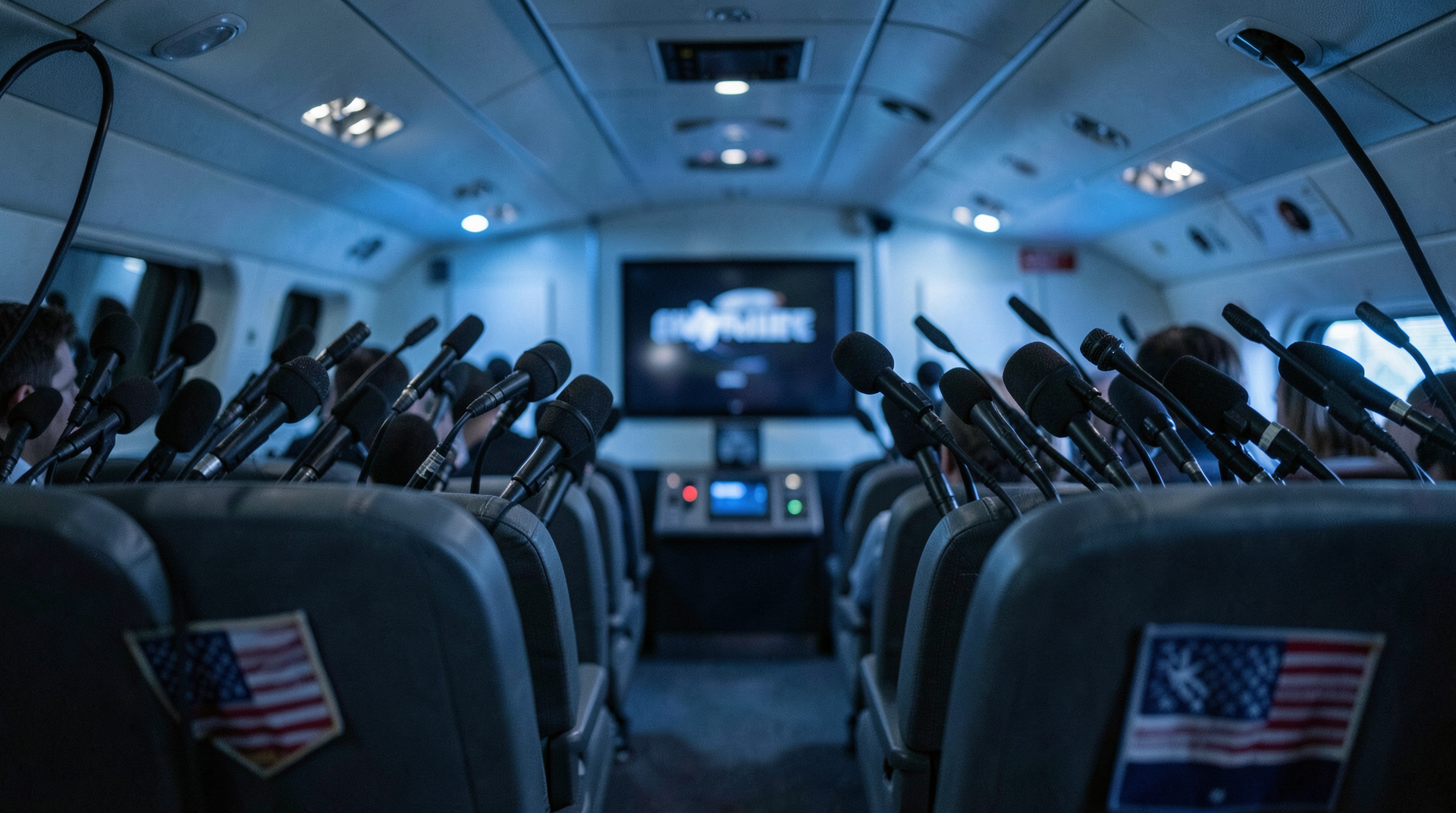
On the flight back from Beijing, President Trump told the Air Force One press pool he was "losing patience with Iran" and "did not ask for any favors from Xi." [1][2] The sentences came hours after Iran seized a tanker off Fujairah and an Indian-flagged cargo ship sank near Oman. [3] They came three days after the Senate failed by one vote to pass a war-powers resolution. [4] They came one day after Defense Secretary Pete Hegseth's memo cancelling a 4,000-troop Poland deployment became public knowledge — without prior notice to the Pentagon or NATO. [5]
This is not a travel-pool quote. It is a first-person presidential statement that the diplomatic track is closed and the kinetic track is the default. The paper's May 15 standard noted that Hegseth's twice-asserted Article II theory now sits inside a near-tied congressional record, converting near-majority doubt into operational permission by arithmetic. The May 15 third-position major said Congress came within one vote of checking the Iran war and failed again. The Friday lead said the summit had built a trade board while leaving Hormuz on permission slips. Saturday produced the missing rhetorical piece: a president who, in his own voice, said the de-escalation track is over.
The phrase "losing patience" is one a U.S. executive uses when it intends to act and wants Congress to know it can. The architecture for that signal was already in place. Hegseth told the Senate Appropriations Committee twice that the administration was operating under Article II authority and did not require an AUMF. The Senate then declined to disagree by one vote: 49-50. The House split 212-212. [6] Each chamber produced a near-majority of institutional doubt that translated into nothing. "Losing patience," delivered against that backdrop, is not rhetoric. It is the executive's announcement that the doubt has been priced and the runway is clear.
Iranian foreign minister Abbas Araqchi answered on the same news cycle. He said Tehran has "no trust" in the United States and is "ready to repel" any new attack. [2] The two statements pair. The diplomatic track now consists of two principals publicly declaring it does not exist. The summit readout from Beijing — which had described U.S.-China alignment on keeping Hormuz open — does not survive both statements landing in the same 24-hour window.
The second sentence Trump delivered may matter more for the medium term. "I didn't ask for any favors from Xi," he said. [1] That recast the summit itself. Where the White House readout described a bilateral consensus on the strait, the president now described a one-sided American demand. There is no mechanism in a demand. There is no enforcement instrument in a demand. There is no joint communique that survives "I didn't ask for favors" if "for favors" is what a Hormuz protocol would have to be. Beijing has, as of Saturday afternoon, not publicly responded to the framing.
What sits beside the Air Force One readout is a sequence of executive actions that read as preparation rather than rhetoric. The Hegseth Poland memo cancelled the 2nd Armored Brigade Combat Team rotation without prior notification to allies; Pentagon staff and European NATO counterparts learned by reading the press. [5] The May 14 license to ship Nvidia H200 chips to ten Chinese firms produced no purchases. [7] U.S. Trade Representative Jamieson Greer confirmed that export controls were "not a major part" of summit talks. The pattern is consistent: an executive operating under Article II posture, making force-disposition and trade-instrument decisions without coordinating with the institutional machinery that normally reads those signals.
The May 13 war-powers vote remains the last piece of formal congressional architecture in this story. No new vote has been scheduled. No Murkowski-Collins-Paul follow-up resolution has been filed. Senator Tom Barrett's AUMF retains a July 30 date and almost no Republican co-sponsors. CBS reported on Friday that the bipartisan Senate Appropriations grilling on the Iran spend produced no procedural commitment. [8] CNBC's account of the same week placed Hegseth's testimony beside the failed votes as one structural episode. [6][9]
Within the same Friday press cycle the rhetorical posture moved two further degrees. Trump told reporters "the U.S., not Iran, is in control of the Strait of Hormuz" and that the war had "wiped out their armed forces, essentially." [2] Three first-person sovereignty claims about a contested waterway, in one day, each less hedged than the last. None is matched by a public enforcement instrument. The arc is the story.
What "losing patience" therefore announces is not a policy. It is a posture. The posture has three components. First, the president has publicly converted the summit from a bilateral mechanism into a one-sided demand. Second, he has publicly attached an expiration date to the diplomatic track without specifying it. Third, he has done so inside a week in which the Defense Secretary has executed force-disposition decisions over NATO's eastern flank without telling NATO. Each component on its own would be a process story. Together they describe an executive that has stopped asking before it acts and now wants the public to know the asking is over.
The mainstream wire treatment has been narrow. The Daily Star, drawing on the AFP wire, surfaced the quote inside a routine summit-recap genre. [1] The CBS News live blog carried it as one of several Air Force One quotes. [2] Neither outlet braided it to the May 13 war-powers vote, the Hegseth-Poland memo, the Fujairah seizure, or the $109 Brent print. The braiding is the front-page argument. The paper is making it.
X has been quicker. The defense-reporter community on the platform — Patricia Kime, Paul McLeary, and the Politico Pentagon desk — read the Poland memo as evidence that civilian command is bypassing both allies and the building. The war-powers community on the platform read the one-vote miss as the institutional record that enables the bypass. The "losing patience" line is now circulating in both communities as confirmation that the de-escalation track has ended.
What remains open is whether any Republican other than Murkowski, Collins, or Paul publicly reacts to "losing patience" as a war-authorization signal — that would tighten the vote record. Whether the Pentagon produces a force-disposition update Friday or Saturday that distinguishes rhetoric from preparation. Whether Caine or the Joint Chiefs were informed of the Poland cancellation before the memo went out. And whether Beijing publicly responds to "I did not ask for any favors from Xi," which would change the summit-recap diplomatic temperature.
The paper's position on May 15 was that the war is unauthorized by act and ratified by arithmetic. The position on Saturday is that the arithmetic now has a presidential voice attached to it. The voice said the diplomatic track is closing. The voice said the summit was not a bilateral mechanism. The voice came down the airstairs the same day a tanker was seized. Three institutional doubts — congressional, allied, diplomatic — have now been answered by an executive that did not need to ask permission to answer them.
-- SAMUEL CRANE, Washington