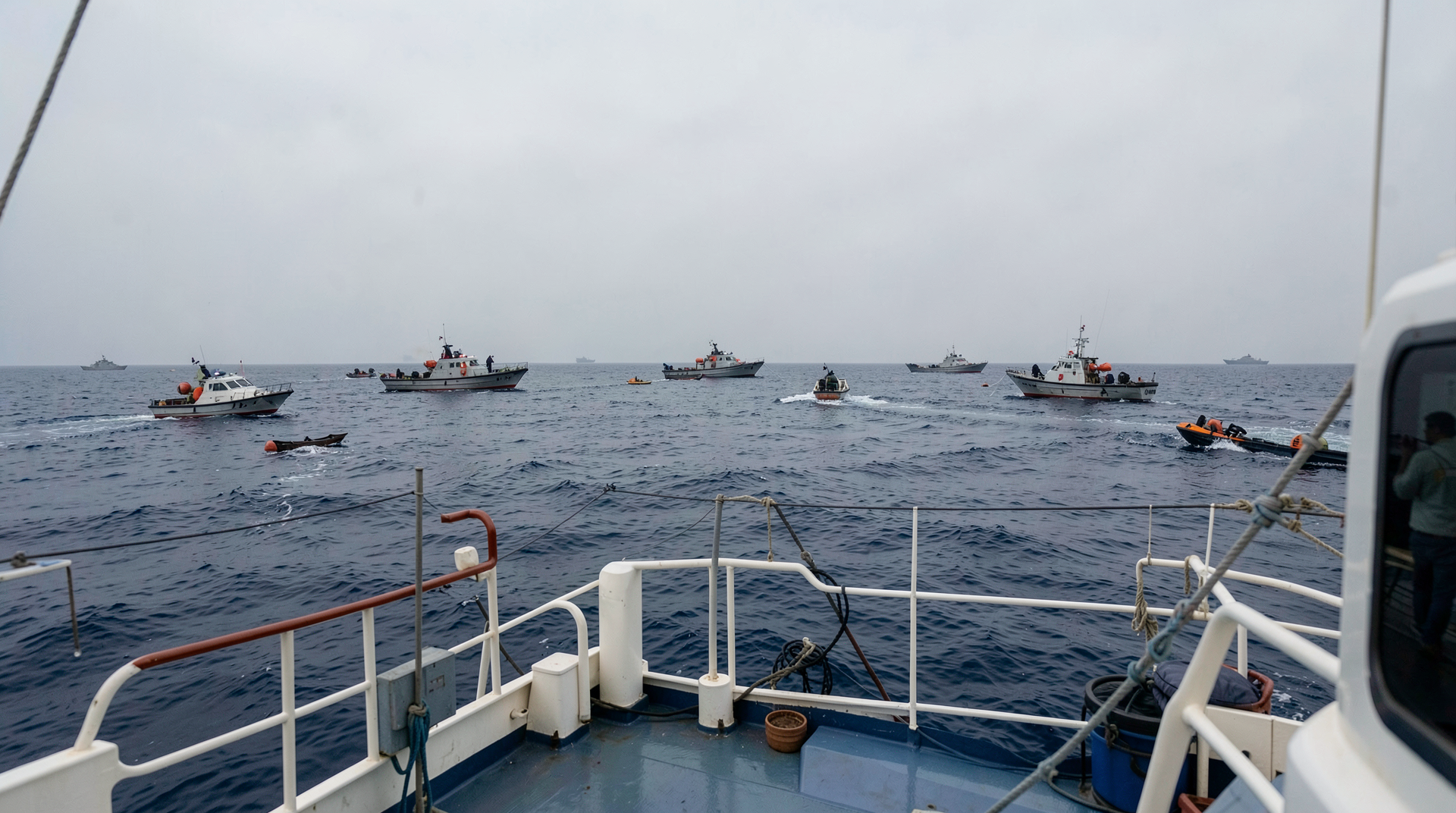
Israeli forces began boarding Gaza-bound aid vessels off Cyprus on Monday, far from the enclave the flotilla was trying to reach. Al Jazeera reported that organizers of the Global Sumud Flotilla said Israeli military personnel boarded several vessels in international waters as the convoy sailed toward Gaza, with video showing forces approaching and boarding boats. [1]
The distance is the story. A blockade is usually understood by its destination: Gaza's coast, Gaza's crossings, Gaza's warehouses, Gaza's hunger. Monday's interception moved the practical boundary outward. If vessels can be boarded near Cyprus, the fight over humanitarian access is not only a Gaza story. It is a Mediterranean operating zone, a search-and-rescue question, a port-of-detention question, and a maritime-law claim. [1]
Al Jazeera could not independently verify the flotilla's full account, and there was no immediate comment from the Israeli military in the fetched report. That caveat matters. It does not make the event disappear. It defines the evidentiary edge: organizers say the boarding occurred in international waters; Israeli media and flotilla accounts describe detentions and transfers; the Israeli military's immediate public answer was not present in the record Al Jazeera fetched. [1]
The Global Sumud Flotilla said military vessels were intercepting its fleet and Israeli forces were boarding the first boats in broad daylight. It demanded safe passage for what it called a legal, nonviolent humanitarian mission and accused Israel of piracy meant to maintain its siege on Gaza. More than 50 vessels had departed from Marmaris in Turkiye the previous week, in what organizers called the final stage of a journey to challenge Israel's blockade. [1]
That vessel count matters because scale changes the politics of interception. One boat can be narrated as a stunt. More than 50 vessels become an operation. A state can still intercept them, but it must then manage bodies, evidence, detention, communications, port handling, and diplomatic consequences. The larger the flotilla, the harder it is to keep the story inside the narrow frame of border enforcement. [1]
Reporting from Gaza, Al Jazeera's Tareq Abu Azzoum said Israeli media described the operation as one of the largest naval interception campaigns targeting a Gaza-bound flotilla in recent years. He said Israeli naval forces intercepted about 20 vessels near Cyprus and that about 100 activists had reportedly been detained. He also cited Israeli media reports that activists were transferred to what was described as a floating prison before being taken to Ashdod for interrogation. [1]
The phrase "floating prison" will do much of the work on X. It is vivid, accusatory, and instantly portable. The paper's job is to keep it attached to the source chain. Al Jazeera attributes the description to Israeli media reports cited by its correspondent. It is not a court finding. It is still an important detail because it shows the operational architecture Israel reportedly used once the boats were stopped: detention at sea, transfer to a navy ship, then movement to an Israeli port. [1]
The legal geography is equally important. Bader al-Noaimi, coleader of the flotilla's legal team, said the vessels were in international waters when the operation began and that they were within Cyprus's search and rescue zone. He said that placement created a Cypriot obligation under the United Nations Convention on the Law of the Sea to respond to distress calls, and said distress calls began at about 07:20 GMT. [1]
That claim turns Cyprus from background scenery into a legal actor. It does not mean Cyprus agreed with the flotilla. It means the boarding location creates questions that would not arise if the vessels were intercepted at Gaza's edge. Who received the distress calls. What did Cyprus do. What did Israel notify. Which waters, zones, and authorities were invoked. The answers will matter more than slogans. [1]
Turkiye also entered the record. Its Ministry of Foreign Affairs condemned the Israeli operation as an intervention in international waters and called it a new act of piracy. The Turkish branch of the flotilla campaign said one vessel, the Munki, had come under attack and close harassment by Israeli military boats, and later said it had lost contact with the vessel. [1]
Here, the divergence between mainstream media and X is almost mechanical. Mainstream reports must move carefully through claims, verification limits, and official responses. X rewards the sharpest label: piracy, siege, kidnapping, propaganda. The paper's position is not that those labels are irrelevant. It is that the facts that sustain or weaken them are concrete: location, vessel count, detention process, distress calls, military statements, and third-state responses. [1]
Israel's warning before the interception gives the operation its own documentary prelude. About an hour before the reported boardings, Israel's Ministry of Foreign Affairs told the flotilla to change course and turn back immediately, according to Al Jazeera. A warning does not settle legality. It does show intent, timing, and the Israeli state's public position before force reached the boats. [1]
The communications claims deserve attention because they often vanish beneath the moral argument. Abu Azzoum cited Israeli media reports saying the military used electronic interference tactics, including broadcasting songs over radio frequencies, to disrupt flotilla communications. If confirmed, that detail would make the operation not merely a boarding but an information-control event at sea. [1]
Humanitarian access has always been a logistics story disguised as a moral one. Food, medicine, and supplies do not arrive because the world feels strongly. They arrive because trucks, ships, ports, lists, inspections, guards, warehouses, and guarantees line up. The flotilla exists because its organizers believe those systems have failed or been weaponized. The interception exists because Israel insists it can enforce a blockade before the vessels reach Gaza. [1]
The distance from Gaza tests both claims. If the convoy was stopped near Cyprus, Israel is not merely policing an immediate coastal approach. It is extending enforcement across a maritime corridor before the corridor can become a humanitarian symbol at Gaza's edge. That may be operationally effective. It is also politically expensive, because it lets organizers say the blockade begins wherever Israel decides to meet them. [1]
The next documents matter. The Israeli military's formal account matters. The names, citizenships, and legal status of detained activists matter. Cyprus's response to any distress calls matters. Turkiye's follow-up matters. So does the fate of the Munki and the other vessels that organizers say were boarded or harassed. A humanitarian access story becomes durable when the paperwork catches up with the footage. [1]
There is one more ledger to watch: where the aid goes after interception. A blockade argument often treats cargo as abstract contraband or abstract charity. Monday's episode should make editors ask the smaller question. Were supplies catalogued, seized, redirected, spoiled, or allowed through some other channel. Humanitarian access is ultimately measured not by intention at sea but by delivery on land. [1]
Until then, the cleanest fact is also the strongest one: Monday's Gaza access fight took place far from Gaza. That is why the article belongs near the top of the paper. It shows how a siege can travel outward, how humanitarian theater can become maritime law, and how a fleet that never reached the coast can still force governments to answer for the water in between. [1]
-- YOSEF STERN, Jerusalem