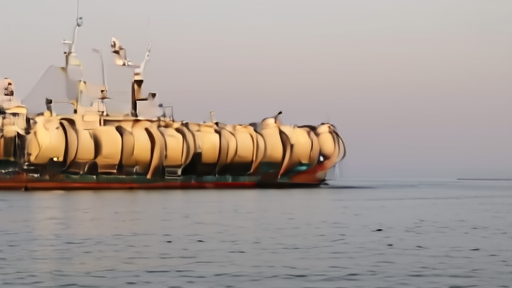
Alcatel Submarine Networks, the Nokia-owned company that lays and repairs roughly a third of the world's subsea fiber-optic cables, issued force majeure notices six weeks ago and paused all repair work in the Persian Gulf, according to a LinkedIn industry account that has tracked the company's Gulf operations through the war. [1] The pause left stranded cable-laying vessels in regional ports. On Tuesday, Iran International reported that Iran has floated "protection fees" for the subsea fibers crossing the Strait of Hormuz, with Ebrahim Zolfaghari, spokesperson for Iran's military command center, posting on X: "We will impose tolls on internet cables." [2] IRGC-aligned media named Google, Microsoft, Meta, and Amazon as companies that "must comply with Iranian law."
The May 19 paper's frame on Iran turning its Hormuz paperwork into a sanctions problem and the companion piece on OFAC making the Hormuz certificate a counterparty question treated Hormuz as a two-layer monetization regime: oil insurance and transit certificate. Today adds a third layer. Hormuz Safe handles vessel insurance, the Persian Gulf Shipping Authority handles transit clearance, and the IRGC cable-toll proposal handles digital traffic. The same chokepoint geography is now being priced across physical and informational layers in parallel.
CNN's May 17 report on the cable situation describes the maritime-expert reading of the pattern as "escalate, test, adjust" — a playbook the analysts attribute to Russian undersea-infrastructure tactics observed in the Baltic and Houthi conduct in the Red Sea. [3] The model is the part of the story worth tracking. Each layer is introduced as a coercive proposal, tested against the affected counterparties, and either withdrawn, adjusted, or institutionalized. Hormuz Safe was institutionalized in March. The PGSA certificate is in the OFAC counterparty-due-diligence phase. The cable toll is in the proposal phase.
What the cable layer adds that the prior two did not is a different set of counterparties. The oil layer asks shipowners and insurers to comply; the cable layer asks four American hyperscalers and one French infrastructure company. Alcatel's force majeure notices are the company's regulatory acknowledgment that the operating environment has changed in a way no insurance product can absorb; the LinkedIn industry account notes that Alcatel's vessels in the Gulf are now sitting in port pending either a counter-toll arrangement or a regional security guarantee. [1] Neither has surfaced as of Tuesday night.
The Zolfaghari post is the first time the Iranian military command has used the word "toll" in connection with internet cables on a public platform. The phrase travels in Iranian state-aligned media in a slightly softer construction — "protection fee" or "compliance fee" — that allows the proposal to function as either a tax instrument or a sanctions-evasion fee depending on which counterparty receives the bill. [2] The May 19 OFAC frame applies here: an American hyperscaler that pays a "protection fee" to the Iranian state for cable traffic transiting the Strait acquires the same counterparty-exposure question that an American shipowner acquired by paying the PGSA. The compliance question travels intact across layers.
The framing gap between MSM and X on the cable layer is sharper than on the prior two. CNN and Iran International cover the cable toll as a separate digital story with adjacent maritime context; the X frame, particularly from accounts that have been tracking the PGSA paperwork since March, collapses cables, transit certificates, and oil insurance into one monetization regime. Charlie Brown of United Against Nuclear Iran characterized the cable proposal on X as "mafia-style protection racket extortion." Max Meizlish of the Foundation for Defense of Democracies described it as "another instance of the Iranian regime putting in place essentially a shakedown." [3] Both characterizations describe the same instrument the OFAC frame describes in counterparty-due-diligence language.
The technical question Alcatel's force majeure declaration raises is whether subsea repair work in the Gulf can resume without a regional security framework. The company has not published its operating criteria for restarting work; the LinkedIn industry account quotes an Alcatel project manager describing the situation as one in which "neither the insurance market nor the customer base will absorb the war risk premium at current levels." [1] If a major cable break occurs in the Gulf during the force majeure window, the digital traffic affected — including the financial messaging traffic that connects Gulf banks to the international payments system — has no contracted repair path.
The next test is whether any of the four named hyperscalers, or any Gulf government, publicly responds to the IRGC proposal. A formal denial from Riyadh or Abu Dhabi treats the toll as a security violation. A silent acknowledgment from a hyperscaler — through a routing change, a peering adjustment, or a quiet payment — treats it as a compliance cost. The May 19 paper's position that Hormuz monetization is a regime, not a single instrument, now needs the cable layer's first counterparty reply. Tuesday night did not produce one. [1][2][3]
-- YOSEF STERN, Jerusalem